

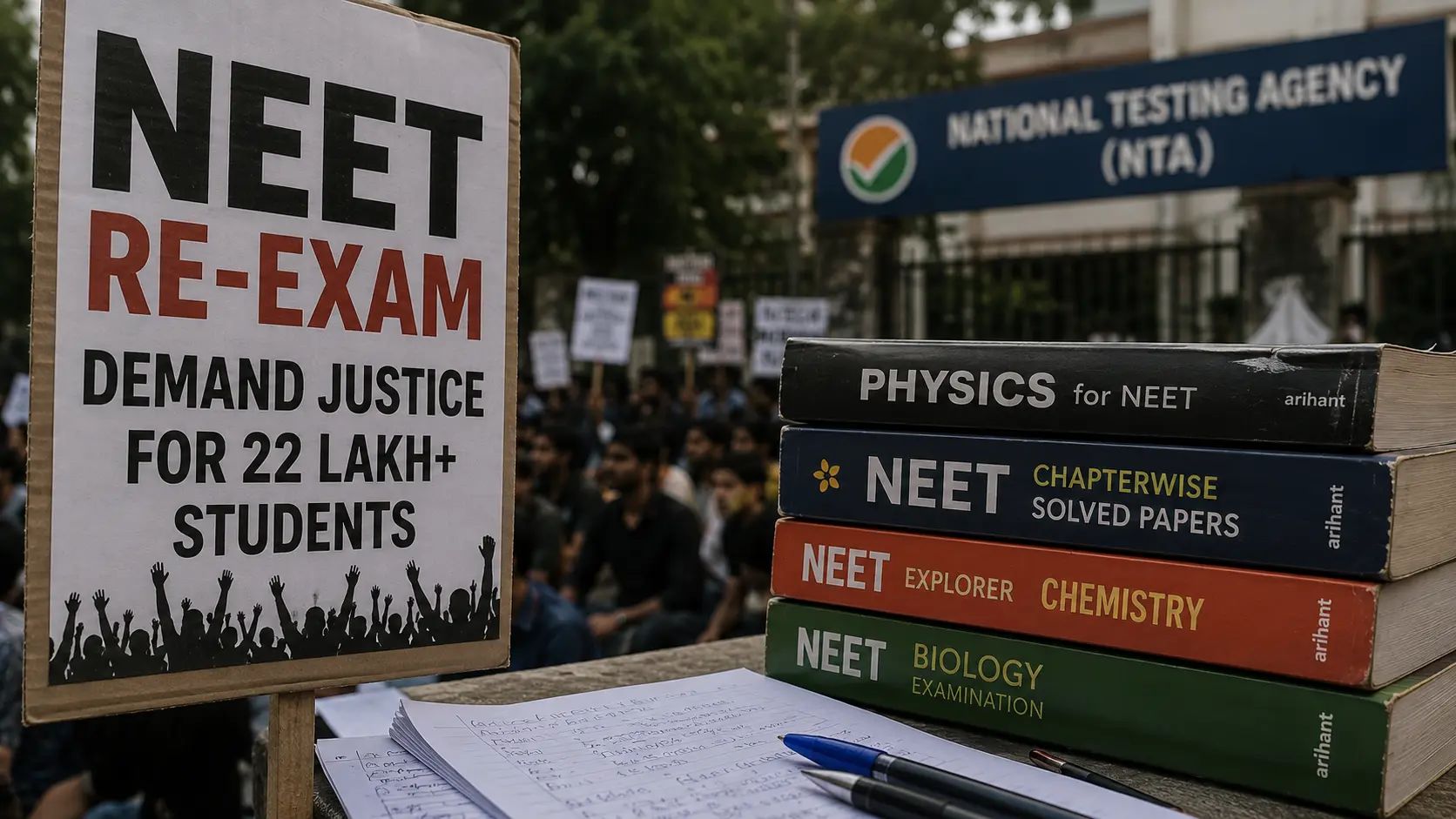
In today's era where competitive examinations dictate the fates and career paths of millions of young minds across India, the systems governing these assessments are coming under unprecedented scrutiny. We are living in a high-stakes environment where a single mark or fractional percentile can elevate an aspirant into a prestigious government institution or completely derail years of relentless, agonizing preparation. Somehow, these centralized testing frameworks were created to build a uniform, standardized meritocracy, but when we just end up relying blindly on massive, single-day national evaluation systems without evolving their underlying security and infrastructure, we inevitably witness catastrophic vulnerabilities. We don't know where we actually lost the balance between extreme logistical efficiency and absolute examination integrity, leaving millions of students caught in an endless loop of uncertainty, anxiety, and judicial interventions.
This comprehensive analysis is going to get you all thoroughly aware about the ground realities of the recent NEET-UG 2026 re-exam controversy, what went wrong within the National Testing Agency (NTA), and what concrete structural shifts are required to build an uncompromised, future-proof examination architecture for our country.
1. The 2026 NEET-UG Crisis and the Anatomy of a Leak
The National Eligibility-cum-Entrance Test for Undergraduate courses (NEET-UG) has historically stood as one of the largest academic evaluation exercises globally. On May 3, 2026, more than 2.27 million medical aspirants took the test at thousands of centers across India — their families' dreams and the result of years of grueling coaching riding on the outcome. But in a matter of days after the exam was finished, the entire system was shaken to its core. Rumours of a widespread paper leak surfaced, slowly being confirmed as a massive nationwide crisis, and the Central Bureau of Investigation (CBI) had no choice but to intervene and assume complete control of the investigation.
The operational breakdown was complete when investigative agencies discovered a precirculated "guess paper" that had an almost perfect match with the question paper that was actually given out on May 3. Raiding teams in Rajasthan and Maharashtra recovered material matching the official test almost exactly. The extent of this deep-seated malpractice was exposed with the arrest of a few subject matter experts and coaching institute owners—including a Latur-based coaching institute owner and a Pune-based school headmistress, who had been trusted by the NTA as internal paper-setters or evaluators. The inquiry discovered that these individuals had leaked the confidential contents weeks in advance, selling the localized papers to select candidates for huge sums.
"We cannot let the credibility of a national exam be the victim of organisational sloth. When a question paper leaks, it is not merely a digital or physical vault that is being broken into; it is a violation of distributive justice that systematically disadvantages the poor."
The Education Ministry was left with no option but to cancel the examination scheduled for May 3 after the sheer scale of the duplication became evident, affecting more than 22 lakh students nationwide. This caused nationwide upset and rendered the results of over 22 lakh students not only invalid but also subjected them to enormous hardship because of the ugly acts of a few privileged individuals. As the CBI widened its investigations into earlier assessment cycles, revealing that even the 2025 examination had been subject to quiet, systemic compromises by the same illicit networks, the National Testing Agency's institutional integrity hit an all-time low. Instead, the people of the nation demanded immediate, explicit relief, and the path was set for a closely guarded, fiercely secure re-examination. The NEET-UG re-examination was conducted on June 21, 2026, under exceptional security arrangements.
NEET-UG 2026 Disruption at a Glance:
- Total Students Affected: More than 2.27 million students across India.
- Sequence of events: May 3 initial exam, May 12 cancellation, and June 21, 2026 official re-examination.
- CBI Arrest Profiles: Several high-profile coaching institute owners from Latur and an NTA-appointed school headmistress serving as a subject expert in Pune.
- Digital Booby-traps: A ban on message edits on communication platforms to impede real-time correction of leaked answers.
In addition, the scandal unveils the deepest layers of educational disparity fuelled by India's coaching cult. Privileged pupils in elite, well-resourced schools are well placed to cope with the stress of an unexpected re-examination, fortified as they will be by an unending supply of fresh testing materials, psychological counseling, and strategic advice. But students from rural and marginalized communities who converge on examination centers after a single, frantic trip to gather resources are left stranded. Retaking the test means more travel expenses, lodging, and more time off from farming or daily wage work. This disparity highlights how the malfunctioning of the competitive exam system is ultimately destructive to democratic meritocracy, tipping the scale against the very students the system claims to serve.
The Logistical Nightmare and Its Mental Toll on Aspirants
A resit for millions of students in under two months is a logistical nightmare of the highest order. The logistics include reprinting millions of secure booklets, reassigning thousands of tightly secured centers, re-verifying test administrators, and establishing national coordinating networks involving multiple intelligence and law enforcement agencies. For the June 21 re-exam, NTA adopted a "Zero Error, Zero Tolerance" approach: GPS-enabled transportation of secret question papers, multi-tiered digital locks, police escorts for all transit vehicles, live CCTV streaming from every room around the clock, and bans on digital platforms — including an unprecedented government order to Telegram to temporarily disable its message-editing feature to stop the digital spread of manipulated leaks.
While the bureaucratic reporting system rushed to patch its structural leaks, the human toll of this controversy was borne entirely by the young aspirants. Medical entrance preparation is known for its torture-chamber ambience. Students live in isolated coaching hubs like Kota, Latur, and Pune, where they study for 14 to 16 hours under crushing expectations. When an exam is suddenly cancelled and moved to a later date, the strain on one's mental health is not just doubled; it becomes utterly untenable. The unexpected upheaval compels students into a grueling stage of re-revision, pushing them to the brink of mental collapse and devastating families financially and emotionally.
The Radhakrishnan Committee and the Blueprint for Reform
Acknowledging that local corrections were not enough for an ailing eco-system, the Central Government constituted a High-Level Committee of Experts headed by ex-ISRO Chairman Dr. K. Radhakrishnan. Originally intended to fortify the overall framework of the NTA, the 2026 paper leak broadened the panel's mandate into a keystone, emergency rescue operation. The Radhakrishnan Committee has produced a vast, tiered strategy for completely revamping the way national-level entrance exams are designed, protected, and conducted.
Advertisement
The heart of the committee's proposals is the wholesale institutional restructuring of the NTA itself. Currently, the NTA operates as a registered society under the Societies Registration Act of 1860, but this structure does not give it the independent legal powers needed to manage a testing environment that has become far more complex. The committee, in line with the recommendations of the Parliamentary Standing Committee on Education dated 1 July 2026, has also emphatically recommended that full statutory status be accorded to the NTA. This change in legislation would turn the agency into a much more independent, professionally-managed organization — answerable to its own governing board and directly to Parliament, rather than functioning as a subordinate arm of the Department of Higher Education under the Ministry of Education — with separate, compartmentalized verticals for technology application, operational security, governance, and public participation reporting.
Yet another significant change recommended by the panel is the elimination of human intervention altogether in the handling of question papers. Leaks traditionally occur at the point of "physical handoff"—setting, printing, transporting, or storing at localized banks or schools. The Radhakrishnan Committee's model requires a complete shift towards fully automated, digitized procedures. The expert panel has proposed a High-Powered Steering Committee to provide ongoing assurance of compliance, moving away from the outmoded, vulnerable pen-and-paper infrastructure toward modern, digital-first workflows that minimize human touch points to the utmost degree.
Tech-Driven Evolution: Computer-Based Testing and Multi-Phase Models
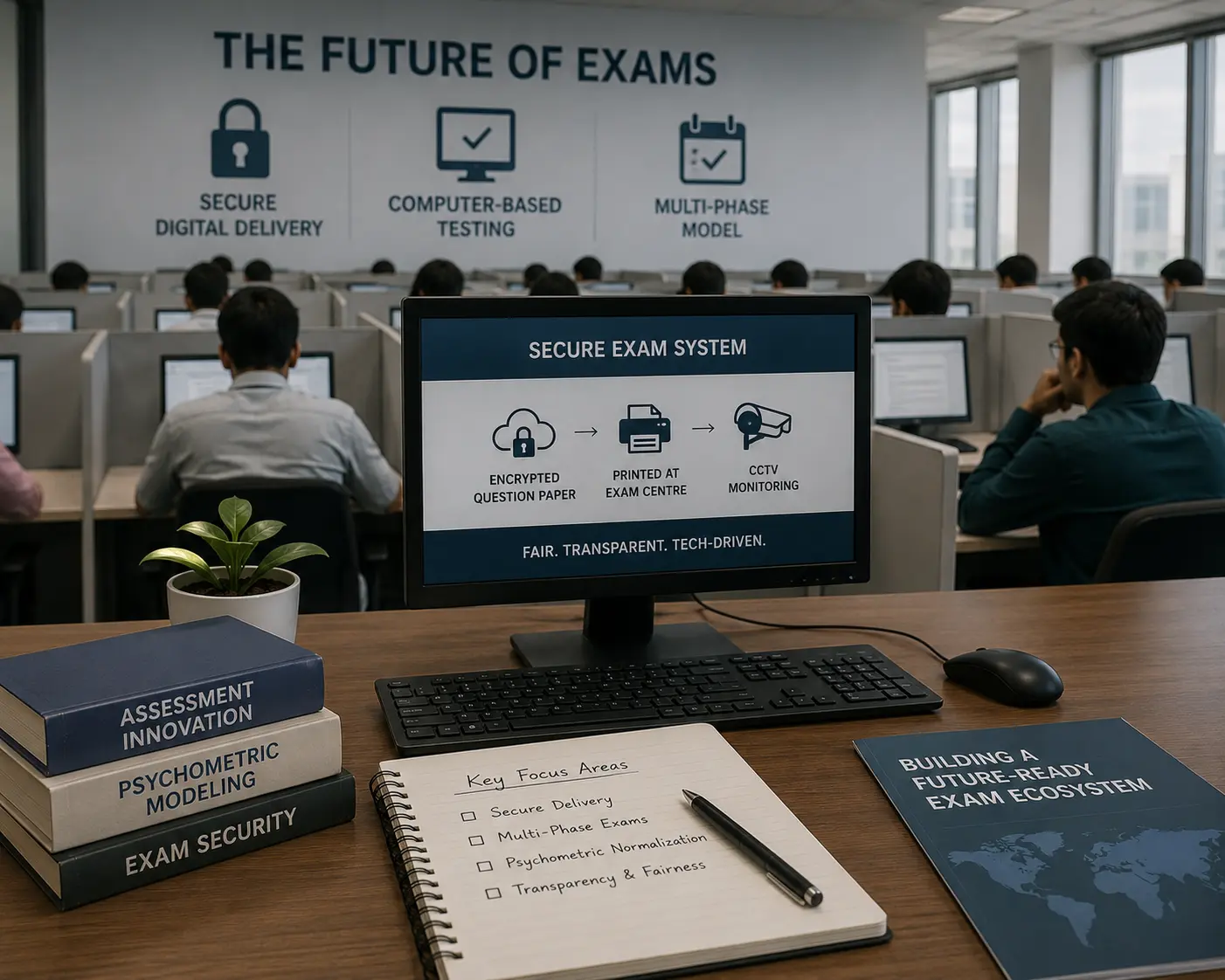
With its eyes on the future, the NTA is increasingly finding it operationally burdensome to continue with the traditional, single-day, pen-and-paper mode at the national level. Handling two million physical question booklets at the same time, across thousands of diverse geographic locations, gives bad actors a ludicrously extensive attack surface to hit. To address this weakness, the conduct of competitive examinations in India is fast moving towards Computer-assisted Secure Pen and Paper Testing (CPPT) and full Computer-Based Testing (CBT) formats, combined with a multi-stage delivery modality.
In a Computer-assisted Secure Pen-and-Paper Test environment, question papers are not printed weeks in advance or moved physically across the country. Instead, they are tightly encrypted inside a centralized, cloud-based digital vault. On the day of the exam, these encrypted files are electronically sent directly to the authenticated testing centers. The questions are decrypted and printed in the examination hall itself just a few minutes prior to the start of the exam, under the watchful eyes of CCTV cameras. This process effectively negates the transit and storage vulnerabilities that have compromised past exams.
"Moving to digital-age governance is not just a matter of replacing paper with screens. It requires a radical redesign of security systems, psychometric normalizations, and multi-phase timelines that distribute the operational risk."
Along with digital transmission, the Parliamentary Standing Committee on Education has also urged the Education Ministry to hold massive exams such as NEET-UG in multiple stages and in different states on different dates. Instead of a single-day national logistical nightmare, spreading it out over phases relieves the strain and enables far stronger security — and if a localized breach ever occurs, it becomes easier to isolate and contain, without throwing the entire nation's academic calendar into chaos. To maintain complete fairness across different question papers administered in a multi-phase examination, sophisticated psychometric normalization models are being introduced to ensure that a student's score is independent of the relative difficulty of the question paper in which they appeared.
The Future of Competitive Exams: Restoring Merit and Distributive Justice
The regular collapse of India's testing regime is a grim reminder that technology cannot rebuild public trust without a cultural and systemic transformation at its core. Reforming the examination system means regaining the tenets of true meritocracy and distributive justice. For decades, the booming business of commercial coaching centers has warped the educational system into a test of endurance and memorization that benefits people who can pay for pricey coaching packages.
With the adoption of unpredictable, analytical-type questions, continuous comprehensive internal assessment, and integrated multi-stage examinations, the state may gradually dismantle the coaching-factory stranglehold. The deployment of sophisticated Artificial Intelligence can facilitate this evolution, not by mechanizing the human mind, but by analyzing patterns of testing to unearth anomalies, identifying unexpected center-wide performance surges indicative of mass cheating, and developing customized, adaptive evaluation instruments that measure a student's genuine problem-solving capabilities.
Every student who takes a test inside an examination hall should have a process that is unquestionably secure, fully transparent, and intrinsically fair. The NEET-UG 2026 controversy should act as a line of demarcation in our education history—a propelling force that compels the country to turn away from brittle and antiquated methods towards a strong, technologically sound, and deeply moral testing system that protects the dreams of India's upcoming generations.
References & Further Reading
- 2026 NEET Controversy — Wikipedia
- Parl Panel Calls for Statutory Status for NTA — The Tribune
- Parliamentary Panel Backs NEET Re-Exam, Urges Statutory Status For NTA And Inclusive CBT Implementation — Free Press Journal
Disclaimer: All data, institutional references, and case study details presented in this article were compiled from contemporary internet resources, judicial reports, and public policy studies regarding national budgeting, public administration, and examination systems. This content is structured strictly for highly comprehensive, detailed knowledge dissemination and does not constitute formal legal or academic counsel.
Advertisement