

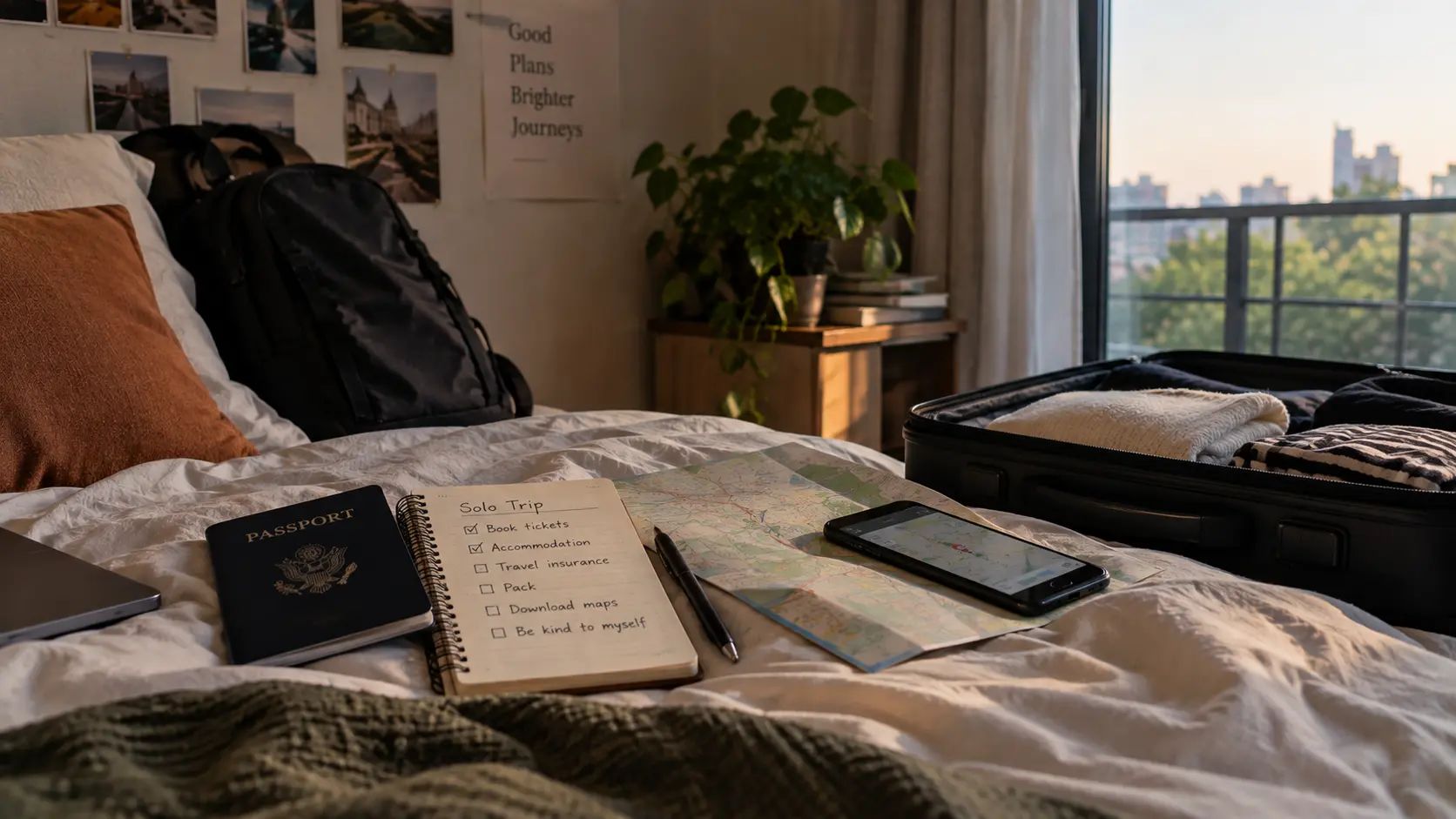
There is a kind of quiet panic that settles into your chest about forty-eight hours before your first international solo flight. Your passport is tucked securely into your carry-on zipper pocket. Your packing cube zippers are pulled taut. You have downloaded Google Maps for a city you have never laid eyes on — and yet, sitting on the edge of your bed, your brain whispers a persistent, uninvited question: What on earth am I doing?
Mainstream travel culture tells you that you are supposed to feel giddy, fearless and invincible. Instagram feeds are saturated with drone footage of sun-drenched solo wanderers staring wistfully into horizons, sipping coffee in cobblestone plazas, seemingly untouched by existential dread or logistical confusion. When your actual lived experience involves sweaty palms at the security checkpoint, a sudden spike in heart rate when looking at subway maps in a foreign script, or an overwhelming urge to close your browser tabs and cancel your Airbnb, you feel like you are failing before you have even begun.
Let us clear the air immediately: you are not failing. You are experiencing nervous system arousal in response to a genuinely novel, high-stakes environment. Travel anxiety before a solo trip is not a character flaw or proof that you aren't "cut out" for seeing the world. It is a biological alarm system trying to protect you from the unknown. This guide does not promise to erase your fear, nor does it ask you to adopt toxic positivity. Instead it offers structured and compassionate preparation frameworks designed to make uncertainty manageable, giving your nervous system the scaffolding it needs to explore the world on your own terms.
Core Philosophy: Fearlessness is a myth perpetuated by travel media. Competence, preparation and self-compassion are real, sustainable and entirely sufficient for a solo journey.
1. Separate Normal Anticipation from Anxiety That Significantly Disrupts Functioning
Before packing a pair of socks it is essential to build a psychological baseline. When we talk about "travel anxiety" we often lump together different emotional states under one broad umbrella term. In reality, anticipatory excitement and clinical or subclinical anxiety manifest differently in the body and mind, and understanding the distinction can save you from self-judgment.
Anticipation is characterized by energy, restlessness and hyper-awareness. Your heart beats faster because your body is preparing for action, novelty and stimulation. You might feel jittery, talk faster, or find yourself double-checking your itinerary out of eagerness. It feels uncomfortable because arousal states mimic fear. Underneath the flutter in your stomach is a thread of curiosity and positive expectancy.
Disruptive travel anxiety, on the other hand, operates from a place of perceived threat and catastrophic forecasting. It tells you that every missed train is a catastrophe, that getting lost equals danger and that you are fundamentally incompetent. It leads to avoidance behaviors — spending hours scrolling through worst-case scenario travel forums, feeling paralyzed when booking accommodation, or experiencing symptoms like nausea, insomnia and intrusive thoughts that interfere with your daily life weeks before departure.
The Physiological Mechanics of Pre-Trip Stress
When you commit to traveling solo for the first time, your amygdala — the brain's emotional processing center — treats the upcoming trip as a departure from the safety of the tribe and known territory. Evolutionary psychology reminds us that for thousands of years leaving the group carried mortal peril. Your brain is essentially running survival software in a modern context. Recognizing this helps reframe the anxiety: your brain is not broken; it is trying to keep you safe using ancient tools.
To manage this, practice labelling — a neurological technique where simply naming your emotional state ("This is anticipatory adrenaline, not actual danger") reduces activation in the amygdala and engages the prefrontal cortex. Keep a designated anxiety journal for the two weeks leading up to your trip. Write down every catastrophic "What if?" without filtering. Once externalized on paper you can evaluate them with logic rather than letting them bounce around in your working memory.
2. Build a 'Knowns and Unknowns' Travel Map
Anxiety thrives on ambiguity. The human brain abhors a vacuum and will instinctively fill gaps in information with catastrophic assumptions. When you don't know how you will get from the airport to your hotel, your imagination supplies worst-case scenarios involving scams, lost luggage and total abandonment. The antidote to ambiguity is structured information gathering — not through over-planning, but through a systematic "Knowns and Unknowns" inventory.
Take a blank sheet of paper and divide it into two columns: "Knowns" and "Unknowns." In the "Knowns" column list everything you have control over or have already confirmed: your flight booking reference numbers, your first night's accommodation address, the fact that your passport is valid, and the amount of local currency you have ordered. You will often find that this list is surprisingly substantial.
Mapping the Unknowns Without Obsession
In the "Unknowns" column list the variables that are currently causing you distress: "What will the neighborhood look like at night?" "Will my phone data work immediately upon landing?" "How do I buy a metro ticket in a language I do not speak?"
Now look at the "Unknowns" list and apply a triage filter. Categorize each item into three buckets: (1) Things I can research and resolve now, (2) Things that can only be solved when I physically arrive, and (3) Things that are entirely outside my control.
For bucket one, do the legwork: look up the transit route from the airport using Google Street View, read reviews of the arrival terminal and verify cellular eSIM activation instructions. For bucket two, accept in advance that you do not need to solve them today — give yourself permission to figure out transit ticketing when you are standing in front of the kiosk with a coffee in hand. For bucket three (weather, flight delays, strangers' moods), consciously practice radical acceptance. Acknowledging that some elements will remain uncertain is the pillar of resilient solo travel.
3. Prepare Arrival, Transport, Communication, Money and Accommodation Backups
The vulnerable window of any solo trip is the first four hours after landing. You are sleep-deprived from the flight, disoriented by a new time zone, navigating foreign signage and carrying all your worldly belongings. This is when travel anxiety peaks. The best way to neutralize arrival anxiety is not by hoping everything goes smoothly — it is by building robust, frictionless backups for the five critical pillars of travel: Arrival, Transport, Communication, Money and Accommodation.
Pillar Breakdown: Engineering Frictionless Transitions
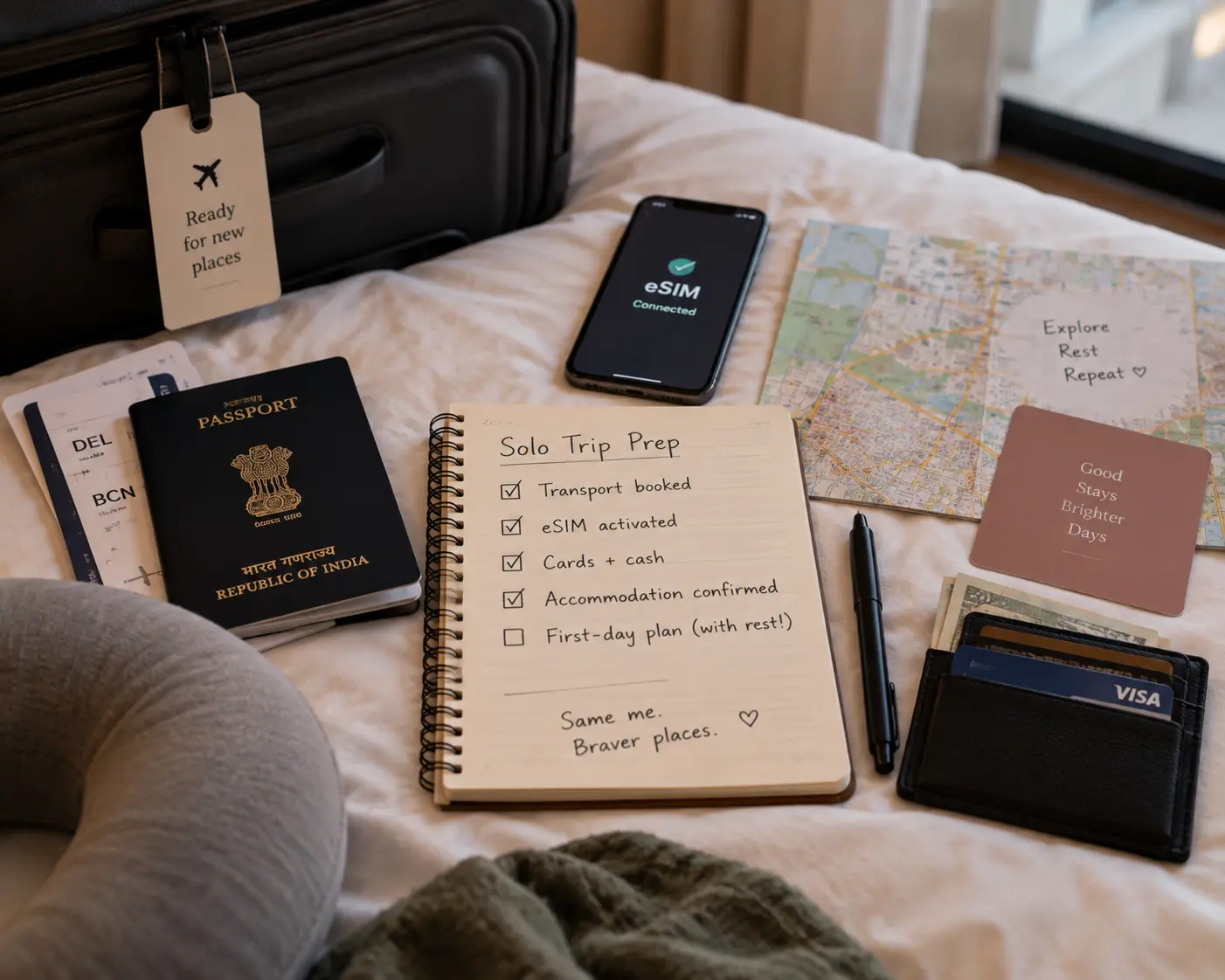
1. Arrival & Transport: Never leave airport transport to chance on your first solo trip. Do not plan to wander out of the terminal looking for a taxi or trying to decode a complex commuter rail network while jet-lagged. Pre-book an official airport transfer or use an official taxi queue service. Write down the exact bus or train line with step-by-step instructions (complete with screenshots) saved in an offline folder. Have the address of your accommodation written in the local language on a physical piece of paper in your pocket, independent of your phone battery.
2. Communication: Connectivity is armor for a first-time solo traveller. Install an eSIM (such as Airalo or Holafly) before you leave your home country, or verify that your current carrier offers seamless international roaming. Ensure your phone is unlocked. Test the data connection while at your departure airport if possible, or verify that you can connect to airport Wi-Fi immediately upon landing to download ride-sharing apps or message your accommodation host.
3. Money: Never rely on a single financial instrument. Carry at least two different credit or debit cards stored in separate compartments of your luggage and on your person, along with a modest amount of local cash (equivalent to about $50–$100 USD) obtained before departure. Inform your bank of your travel dates to avoid automated fraud freezes. Research whether the destination relies heavily on tap-to-pay mobile wallets (Apple Pay/Google Pay) or cash so you are never caught unprepared at a transit turnstile or small café.
4. Accommodation: For your first solo trip, do not compromise on your first night's lodging to save a few dollars. Book a well-rated hotel, apart-hotel or reputable boutique hostel with a 24-hour front desk. Avoid self-check-in Airbnbs that require downloading third-party apps or hunting for lockboxes in dark alleys late at night. Knowing there is a receptionist waiting to hand you a key provides immeasurable peace of mind after a long travel day.
4. Create a Calm First-Day Itinerary with Recovery Space
A trap for first-time solo travellers is the "FOMO itinerary" — packing the first day with museum visits, walking tours, reservation times and neighborhood explorations from 9:00 AM until midnight, driven by the subconscious belief that every single minute must be optimized. This is a recipe for sensory overload and acute anxiety.
When you arrive in a new country, your brain is processing an unprecedented volume of novel stimuli: new linguistic sounds, unfamiliar smells, different traffic patterns, architectural styles and social norms. This cognitive load is exhausting even if you are sitting still. Consequently, your first-day itinerary should contain one anchor activity: checking into your room.
Advertisement
Designing the 'Zero-Pressure' Arrival Day
On your first full day, focus only on getting settled. Leave your backpack in the hotel room. Take a shower. Change into something comfortable. Eat a meal you recognize. Let your body register that you have made it safely. If you want to go for a walk, limit it to a loop around the neighborhood — no longer than an hour. No photos. No maps. Just observe. Let your pace slow. Let your breath deepen. There is no need to perform or prove anything. Your job on day one is not to see everything. Your job is to survive the transition. To begin. To exist without being overwhelmed.
Allow yourself to feel tired. Allow yourself to feel afraid. Allow yourself to sit quietly in your room and just be. The journey begins with this kind of patience — not with declarations or heroic acts. With presence. With gentleness. With showing up when your hands shake. Because you are already enough. You are not alone.
Structure your arrival day around a gradient of activity. Try to arrive at your accommodation by mid-afternoon if you can. Once you check in, give yourself a two-hour decompression window. Do not force yourself to go sightseeing straight away. Unpack your essentials, take a shower, charge your devices and lie down for twenty minutes without scrolling through media.
For your evening meal, remove all culinary ambition. You do not need to find the city's authentic hidden-gem local bistro on your first night. Find a good-looking café or restaurant within a five-minute walking radius of your hotel, or even grab supplies from a local neighborhood market. The goal of the evening is simply to establish a sense of place and safety — to prove to your nervous system that you can exist independently in this new environment without anything going wrong. Save the cultural deep-dives for Day Two, once your circadian rhythm and internal compass have had time to recalibrate.
The discomfort of existing in an unfamiliar space while your nervous system catches up is something science has a name for. You Are Sad in Your Rented Flat Because Impermanence Has a Scientific Name explores exactly why new, temporary spaces feel psychologically unsettling — and why that feeling is normal, not a warning sign.
5. Grounding and Orientation Techniques That Are Risk-Free and Optional
With meticulous planning, somatic anxiety can still ambush you. Your heart might start racing while standing in a bustling train station, or a wave of homesickness might hit you while eating dinner alone at a table for one. When acute anxiety strikes, trying to "think" your way out of it often fails because physiological arousal bypasses reasoning. You need somatic grounding tools that require zero equipment, draw no attention and can be executed discreetly in public spaces.
Somatic Reset Protocols for the Traveller
1. The 5-4-3-2-1 Sensory Method: When you feel dissociation or escalating panic creeping in, anchor yourself in the present by silently identifying: 5 things you can see around you (a blue sign, a tile floor, a passing pigeon, a metal railing, a yellow backpack); 4 things you can physically feel (the weight of your shoes on the pavement, the cool breeze on your cheek, the texture of your jacket fabric, the strap of your bag); 3 things you can hear (distant traffic, a murmur of conversation, rolling suitcase wheels); 2 things you can smell (bakery exhaust, fresh rain); and 1 thing you can taste (lingering mint gum, coffee). This exercise forces your brain to process sensory data rather than internal catastrophic loops.
2. Physiological Sighs: Developed by neuroscientists studying stress modulation, the physiological sigh consists of two inhales through the nose (one deep breath followed immediately by a sharp top-off inhale) followed by a long, slow, extended exhale through the mouth. Repeating this cycle two or three times rapidly offloads carbon dioxide and signals the vagus nerve to lower your heart rate.
3. The 'Invisible Anchor' Orientation: When exploring a neighborhood, pick a distinct landmark as your psychological anchor — a tall clock tower, a specific metro station entrance or a recognizable coffee chain. Remind yourself: "No matter what happens, I can walk back to this spot and hail a cab to my hotel." Knowing you have a physical tether to safety dramatically reduces claustrophobia and spatial anxiety.
For a structured, low-pressure toolkit of grounding strategies you can carry into any overwhelming moment — on the road or at home — A 10-Minute Reset Routine for an Overwhelming Day covers practical techniques that require nothing but your attention.
6. A Contact Plan: Who Knows Your Itinerary and When You Check In
Independence is the hallmark of solo travel, but absolute isolation is neither smart nor necessary. One of the drivers of travel anxiety is the subconscious fear: "If something happens to me, how long will it take for anyone to notice?" Creating a lightweight communication plan with a trusted person back home provides a vital psychological safety net without compromising your autonomy.
Designing a Low-Friction Check-In Protocol
Before departure, share a Google Doc or digital itinerary with a trusted family member or close friend. This document should contain your flight numbers, hotel names, phone numbers and reservation confirmation codes. Crucially, establish a low-effort check-in routine — such as a quick WhatsApp message or photo sent once a day when you return to your accommodation for the evening.
Set expectations: agree that no news is good news during the active sightseeing day, and that a single daily check-in ("Safe and sound in Lisbon!") is all that is required. This eliminates the anxiety of feeling obligated to text while exploring, while guaranteeing that someone across the globe holds the master puzzle pieces of your whereabouts. It creates a safety tether that allows you to feel brave while knowing you are never truly untethered.
7. When Postponing, Changing Plans or Seeking Professional Support Is Sensible Rather Than a Failure
We live in a culture obsessed with overcoming adversity at all costs, where "pushing through your comfort zone" is treated as a moral good. There is a profound, mature distinction between everyday nervousness — which deserves to be gently coached and planned through — and acute, paralyzing distress that indicates your psychological reserves are completely depleted.
Sometimes life throws curveballs right before a planned trip: acute personal grief, sudden health crises, burnout exhaustion or overwhelming trauma anniversaries. In these moments, honoring your health by postponing a trip, shortening your itinerary or modifying your travel style from ambitious backpacking to a quiet, structured retreat is not cowardice. It is wisdom.
Reframing Plan B as Self-Preservation
If you find yourself experiencing insomnia, panic attacks or depressive symptoms that persist despite preparation, give yourself unconditional permission to pivot. Travel will always be there; your mental well-being is irreplaceable. Seeking support from a therapist or counselor prior to departure or during travel preparation can help untangle whether your anxiety is standard situational jitters or an indicator that you need additional therapeutic tools.
Remember that your first solo trip does not need to be a multi-continent odyssey to be valid. You can start with a solo weekend trip to a town two hours away by train. You can build your solo travel muscle in manageable steps. There are no gold medals awarded for suffering through a panic attack in a foreign hostel. True travel mastery lies in self-awareness — knowing when to lean into discomfort with courage and knowing when to hold yourself with gentleness, pause and choose care over performance.
On the days when your reserves feel low and the idea of a big solo journey feels impossible, returning to the basics of self-care matters. Low-Energy Self-Care: A Minimum Routine for Difficult Days is a kind, non-demanding guide for exactly those moments — whether you are at home or on the road.
Read Further
-
Lieberman, M.D. et al. Putting Feelings Into Words: Affect Labeling Disrupts Amygdala Activity in Response to Affective Stimuli. Psychological Science, UCLA, 2007. — collaborate.princeton.edu
-
Balban, M.Y. et al. Brief Structured Respiration Practices Enhance Mood and Reduce Physiological Arousal. Cell Reports Medicine, Stanford University, 2023. — cell.com/cell-reports-medicine
Disclaimer: This article is for informational and educational purposes only and does not constitute professional mental health, medical or clinical advice. If you are experiencing severe or persistent anxiety, panic attacks or depressive symptoms, please consult a licensed mental health professional before or during travel planning.
Advertisement