

We live in an era obsessed with optimization. Every waking moment can now be quantified, indexed, graphed and scored. Your wrist vibrates if you have not walked enough steps; your ring grades your sleep quality to the exact decimal; your phone tallies your screen time down to the minute. On paper, this is the age of self-awareness — we have never had this much access to data about our own biological functioning.
Yet an ironic phenomenon accompanies this data deluge: people feel more anxious, fragmented and exhausted than before. When every biological output is treated as a performance, rest starts feeling like failure, recovery feels like stagnation, and intuition is systematically replaced by algorithmic feedback loops. We check our scores before checking in with ourselves. We ask our devices how we feel instead of asking our bodies.
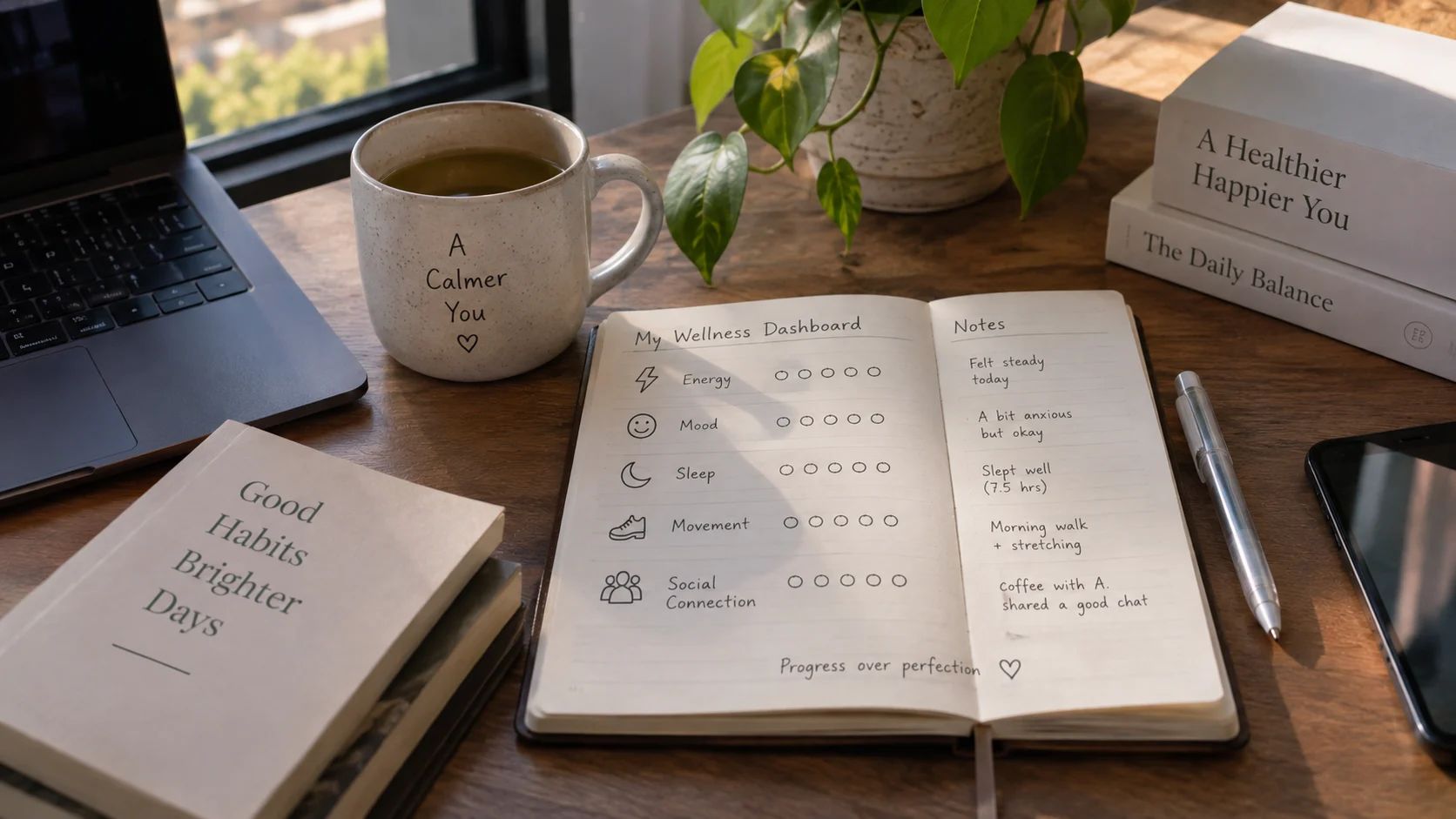
This article explores an alternative paradigm: the Personal Wellness Dashboard. Rather than building an exhaustive, high-frequency surveillance system over your own existence, we will examine how to track five foundational signals in a way that preserves nuance, respects biological variability, and fosters genuine self-inquiry — without turning your daily life into a relentless video-game score.
The Difference Between Noticing Patterns and Monitoring Obsessively
To understand why traditional self-tracking often backfires, we must first examine the chasm between "noticing patterns" and "monitoring obsessively." These two approaches look superficially similar — both involve recording experiences — but their internal mechanics and psychological consequences are worlds apart.
Noticing patterns is an act of curiosity. It is the posture of a naturalist walking through a forest, observing how the canopy changes with the season, noting which trees blossom early and which soils retain moisture. There is no judgment attached to the observations. If a tree sheds its leaves, the naturalist does not scold the tree for underperforming; they simply note that autumn has arrived.
Monitoring obsessively, by contrast, is an act of surveillance and judgment. It transforms the organism into an employee and the self into a micromanager. Every dip in energy or irregular sleep cycle is logged as a demerit, triggering an internal crisis or a desperate scramble for corrective protocols. Psychological research on self-regulation shows that when monitoring becomes hyper-frequent and evaluative, it can trigger anxiety spikes and performance pressure, ultimately degrading the very physiological markers being tracked — sleep researchers have documented exactly this pattern in people who fixate on their sleep-tracker scores until the fixation itself starts disrupting their sleep.
"Curiosity asks: What conditions preceded this fatigue? Obsession asks: Why is my score failing again?"
When you monitor obsessively, you outsource your locus of control to algorithms. If your sleep tracker gives you a score of 62, you suddenly feel sluggish even if you woke up feeling refreshed. You have allowed an external gadget to override your own sensory experience. A healthy wellness dashboard reverses this dynamic, placing your somatic awareness in the driver's seat and using simple notation merely as an anchor for reflection — not a verdict on your worth.
Select Five Signals That Are Meaningful and Easy to Record
The trap of wellness tracking is scope creep. People start by tracking sleep, quickly add step counts, then heart rate variability, macronutrients, water intake, meditation minutes and cognitive focus scores. Within three weeks, maintaining the dashboard requires more cognitive overhead than the actual wellness practices it is supposed to support.
An effective wellness dashboard must adhere to the principle of economy. You do not need twenty metrics to understand your vitality; you need a small, high-leverage set of signals that capture the arc of your daily experience. Across psychology and physiological science, five core signals emerge as foundational pillars that require zero specialized gadgets to observe:
Signal 1: Energy (Dynamic Vitality). Energy is distinct from fatigue or sleep duration. It represents your capacity to engage with physical and emotional demands throughout the day. Rather than measuring watts or calories, energy tracks your subjective sense of fuel — whether you feel generative, stable or depleted.
Signal 2: Mood (Emotional Baseline). Mood captures your resilience and baseline disposition. It accounts for how you navigate friction, your baseline patience, and your capacity to experience contentment or neutral calm amidst daily stressors.
Signal 3: Sleep (Restorative Depth). We track sleep not through hypnograms or REM-latency algorithms but through the gauge of morning restoration: did your sleep feel cohesive and restorative, or fragmented and hollow?
Signal 4: Movement (Physical Embodiment). Movement tracks how your physical body interacted with space. Did you stretch, walk, lift or circulate blood, or did you remain sedentary for hours on end? It honors expression over arbitrary step quotas.
Signal 5: Social Connection (Relational Nourishment). Humans are deeply wired for affiliation. This signal measures whether you experienced grounded social touchpoints or drifted into isolating silos.
Use Words or Ranges, Not False Precision
One of the most insidious myths of the modern data age is that precision equals truth. We believe that if we assign a number from 1 to 10 to our mood, or record sleep down to the minute, we have achieved scientific rigor. In reality, human biology and emotional life are non-linear systems. Forcing qualitative states into rigid numerical scales introduces false precision.
When asked to rate your mood on a scale of 1 to 10, what is the exact operational difference between a 6 and a 7? On Tuesday, a 6 might feel acceptable after a workday, whereas on Friday a 6 might feel deeply disappointing. The number remains static while your internal context shifts wildly, rendering the data noisy and misleading.
Advertisement
A more resilient approach is categorical, range-based tracking. Instead of assigning a sterile integer, use descriptive qualitative ranges:
- Energy: Depleted / Moderate / Vibrant
- Mood: Strained / Neutral / Grounded
- Sleep: Fragmented / Adequate / Deeply Restorative
- Movement: Sedentary / Light / Active
- Connection: Isolated / Neutral / Nourishing
Words honor nuance. They allow you to capture the texture of your days without pretending that human vitality can be boiled down to a single spreadsheet cell. Ranges and qualitative categories reduce measurement anxiety because they eliminate the trap of trying to optimize a score from an 8 to a 9.
Review Weekly, Not Continuously

Frequency dictates psychology. If you check your wellness dashboard several times a day, you are engaging in real-time anxiety management disguised as productivity. Real insight does not happen at the daily level; it emerges at scale, when you step back and look at the macro view.
A weekly review cadence transforms data from a whip into a compass. By recording your five signals in a 60-second evening log and setting them aside until Sunday morning, you decouple data collection from emotional reactivity. When Sunday arrives, you open your journal with the detached curiosity of a researcher reviewing field notes.
During a review, look for macro-patterns rather than daily anomalies:
- Did a cluster of low-energy days coincide with poor sleep hygiene or high professional friction?
- Did movement levels drop during weeks with administrative workloads?
- How did social connection buffer against emotional states?
By aggregating data weekly, you bypass the noise of single bad days and focus on systemic rhythms.
Avoid Claiming That a Single Pattern Proves a Cause
Human brains are meaning-making machines, wired to detect patterns — sometimes where none exist. This evolutionary survival mechanism leads directly to the fallacy of post hoc ergo propter hoc: after this, therefore because of this. If you ate walnuts on Tuesday and had a rough morning on Wednesday, your brain eagerly stitches them together into a rigid causal rule.
When maintaining a wellness dashboard, you must cultivate humility. Tracking reveals correlations, never causal proof. If your wellness dashboard shows that low sleep preceded low energy, sleep is certainly a prime suspect, but confounding variables are everywhere: ambient room temperature, hydration status, underlying immune activation, or anticipatory work stress.
Treat your entries as hypotheses, never as biological laws. When you notice a recurring correlation — say, mood dipping on sedentary days — treat it as an experiment rather than a diagnosis. Test the hypothesis gently: take a short afternoon walk for a week. Observe whether the mood pattern shifts. If it does, great; if it does not, remain open to other variables.
Decide What Action Each Signal Can Reasonably Trigger
Data without an action framework is hoarding. If your wellness dashboard logs show depletion but you have no pre-determined, compassionate protocol to respond, the journal becomes a monument to your own distress. Every signal on your wellness dashboard should have a pre-negotiated threshold for action.
Crucially, these actions should be systemic and supportive, never punitive. For instance:
- If energy registers as "Depleted" for three days, the triggered action is not "work harder" or "drink more caffeine," but a scheduled audit of upcoming commitments and a mandatory early bedtime.
- If connection registers as "Isolated," the triggered action is a low-friction outreach to a trusted friend — not a social calendar overhaul.
By establishing these guardrails ahead of time, you prevent your wellness dashboard from becoming a passive mirror of your struggles and turn it into a responsive self-care toolkit.
When Tracking Increases Anxiety and Should Be Paused
The ultimate test of any wellness tool is its net effect. If at any point maintaining your wellness dashboard starts feeling like an obligation, a source of guilt, or an audit that you are constantly failing, you have crossed the boundary from self-care into self-surveillance.
Tracking should serve your life, not consume it. It can quietly turn into a habit that feels like a chore. If tracking makes you obsess over whether to log an entry, if it makes you anxious when you miss a day, or if it makes you use your dashboard to judge your worth — stop immediately. Put the pen down, close the app, and take a one-week hiatus from tracking.
Your body and mind do not need a spreadsheet to heal, rest or thrive; the body is capable of healing on its own when given genuine rest. The ultimate goal of a wellness dashboard is to make the wellness dashboard obsolete — to train your awareness so finely that you no longer need external markers to know when to rest, when to move, and when to reach out to others. When you listen to your body, you will find the balance without a chart.
Read Further
- What Is Orthosomnia? — Sleep Foundation
- The Truth (and Lies) of Correlation vs. Causation — Scientific American
Disclaimer: This article is intended for general informational and educational purposes only. It is not a substitute for professional medical, psychological, or nutritional advice. If you are experiencing persistent fatigue, mood changes, or sleep disruption, please consult a qualified healthcare professional.
Advertisement