


The Architecture of Everyday Transition
Travel has a way of re-calibrating our relationship with time. When we leave our home environments, our daily routines dissolve, replaced by the textures of foreign streets, strange railway stations and the quiet dawn in unfamiliar hotel rooms. In these spaces, many travelers experience a distinct psychological shift: a sudden, heightened awareness of the present moment. We notice the quality of light hitting a limestone wall, the steam rising from a morning bowl of broth in a bustling Tokyo alleyway, or the deliberate pace of an afternoon stroll along a Mediterranean promenade.
For decades, the wellness industry has commodified these travel experiences, packaging cultural practices into glossy, expensive retreats, esoteric spa treatments and aestheticized lifestyle trends. This commercialization frequently strips away the social and cultural context of these practices, reducing living traditions into marketable commodities. Terms like "ancient wisdom" are bandied about with abandon, flattening centuries of nuanced human adaptation into quick-fix self-care solutions.
This field guide approaches wellness through a different lens. Drawing on cross-cultural research and historical context, we examine small everyday rituals from diverse travel cultures — not as exotic cures or mystical secrets, but as grounded, practical human adaptations to climate, community and survival. Our objective is not appropriation or mimicry, but respectful observation, critical understanding and thoughtful adaptation of universal principles of rest, nourishment, movement and connection.
1. The Boundary Line: Learning Versus Copying Out of Context
To engage respectfully with practices encountered during travel, one must first confront a fundamental ethical boundary: the distinction between learning from a tradition and appropriating it. Appropriation occurs when elements of a culture are adopted by members of an outside culture in a way that trivializes, decontextualizes or commercializes them, often ignoring the historical and social struggles of the originating community. Learning, by contrast, involves curiosity, respect for context, acknowledgement of origins, and an understanding that practices are deeply embedded in specific social fabrics.
When travelers witness a soothing ritual abroad — such as the deliberate preparation of matcha in Japan, the evening leisurely promenade (passeggiata) in Italy, or the communal sharing of mate in Argentina — it is easy to view these actions through a purely individualistic lens. We ask, "How can this make me feel less stressed?" rather than "What social, historical and environmental conditions gave birth to this practice?"
Scholars who study cultural appropriation and appreciation generally draw the line at context: appreciation involves learning about a practice's history, crediting its origins, and engaging with it on its own terms, while appropriation strips a practice of that context and repackages it as a personal accessory. In this guide, we examine practices not as wellness hacks but as windows into how different societies cultivate balance, connection and presence. By understanding that framework, we protect ourselves against exoticisation and try to keep our engagement respectful, grounded and intellectually honest.
2. Seven Everyday Practices: Local Context, Lived Reality and Named Sources
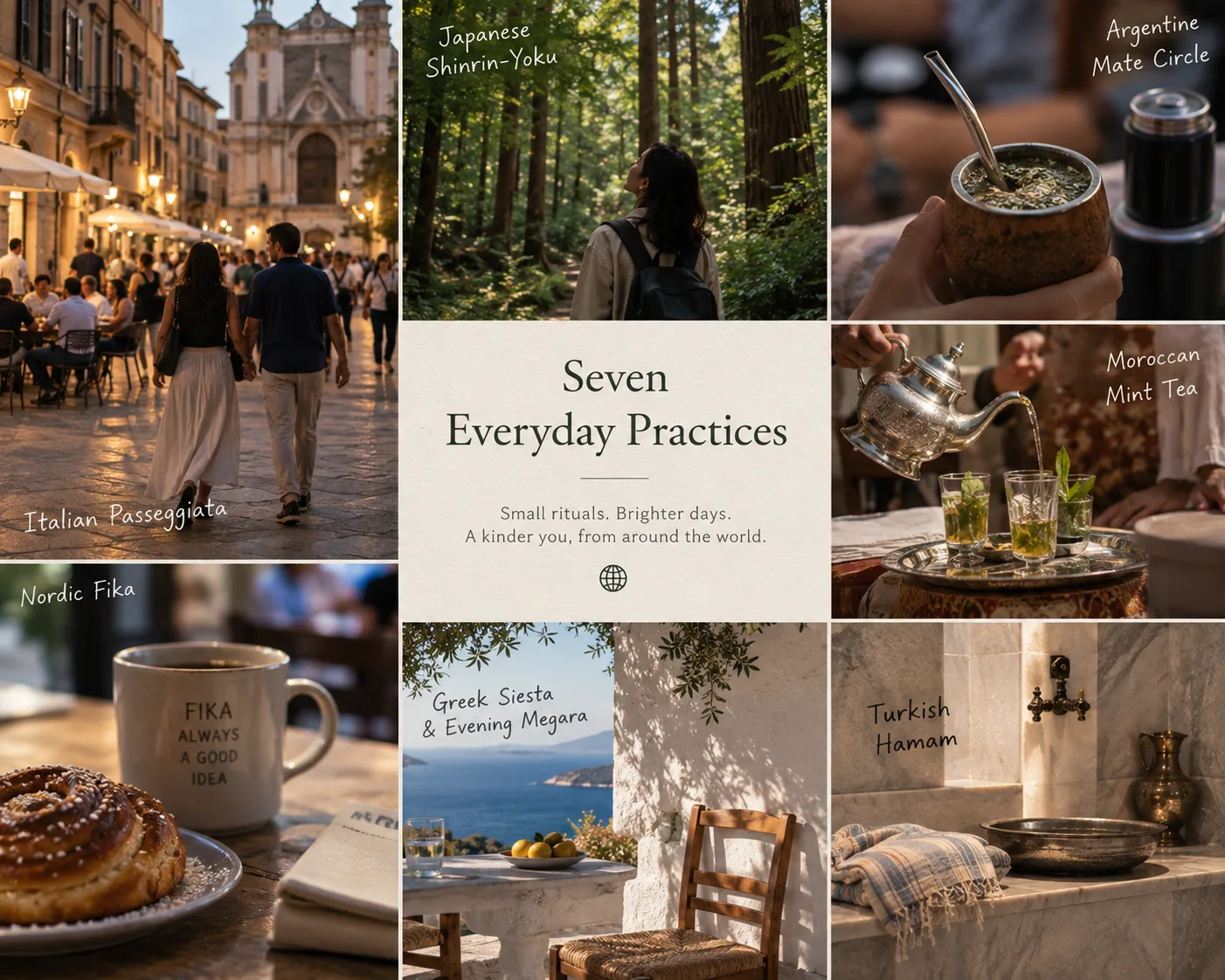
Here we explore seven everyday practices from around the world, detailing their cultural roots, environmental contexts and contemporary realities.
Practice 1: The Italian Passeggiata (Evening Stroll)
Context & Origin: Across towns and urban centers in Italy, particularly in the southern regions and smaller historic cities, the late afternoon brings a shift in civic life. Between roughly 5:00 PM and 8:00 PM, residents step out for the passeggiata — an unhurried walk through the piazza and main thoroughfares. In her ethnographic study The Passeggiata and Popular Culture in an Italian Town (McGill-Queen's University Press, 2004), folklorist Giovanna P. Del Negro documents how the ritual functions as a form of collective performance that reinforces a sense of belonging in the town.
Function: Historically, it served as a public venue for courtship, community gossip and civic pride. Today it acts as a boundary marker between the working day and domestic evening life, encouraging movement without the performative intensity of modern fitness culture, paired with spontaneous social encounters that combat urban isolation.
Practice 2: The Japanese Shinrin-Yoku (Forest Bathing)
Context & Origin: Developed in Japan during the 1980s by the Ministry of Agriculture, Forestry and Fisheries, shinrin-yoku translates literally to "forest bathing." Rather than hiking or cardiovascular exertion, shinrin-yoku is the practice of slow, sensory immersion in forested environments. Dr. Qing Li, an immunologist at Nippon Medical School in Tokyo and author of Forest Bathing: How Trees Can Help You Find Health and Happiness, has documented its physiological effects.
Function: Grounded in Shinto and Buddhist traditions that view nature as sacred, shinrin-yoku uses all five senses to anchor consciousness in the natural world. Research cited by Dr. Li indicates that exposure to phytoncides (compounds emitted by trees) is associated with reduced cortisol levels, lower blood pressure and improved immune markers.
Practice 3: The Argentine Mate Circle
Context & Origin: In Argentina, Uruguay, Paraguay and parts of Brazil, sharing yerba mate from a shared gourd (mate) and metal straw (bombilla) is a pervasive daily ritual. Cultural anthropologist Christine Folch, author of The Book of Yerba Mate: A Stimulating History, traces the drink's journey from Indigenous Guaraní tradition through the Jesuit missions and into its role as a marker of shared regional identity today.
Function: Originating with the Guaraní people, the mate ritual is built around communal sharing. One person (the cebador) pours the hot water, passing the gourd in a continuous circle. It punctuates the workday, fosters conversation, and anchors social connection in a rhythmic, unhurried cadence.
Practice 4: The Moroccan Mint Tea Ceremony
Context & Origin: Moroccan mint tea (atay), a blend of gunpowder green tea and fresh spearmint sweetened generously with sugar, is poured from a height into small glasses. A 2005 University of Nevada, Las Vegas master's thesis on the social significance of mint tea in Morocco found that the ritual is deeply tied to Muslim faith, gender roles, socio-economics and hospitality — that, in the thesis's framing, "what and how you drink is what you are."
Function: The high pour aerates the tea, creating a froth that signals care taken for the guest. The preparation is deliberate and unhurried, serving as a container for negotiations, family gatherings and quiet contemplation amidst bustling medinas.
Practice 5: The Nordic Fika (Swedish Coffee Break)
Context & Origin: Fika is much more than a coffee break in Sweden; it is a protected, culturally embedded social institution. Annika Härenstam, professor emerita in sociology and work science at the University of Gothenburg, traces its roots to traditional Swedish farming culture, while Linköping-based researcher Viveka Adelswärd has studied how deeply the practice is now woven into Swedish workplace norms.
Function: Practiced daily in most workplaces and homes, fika creates a space where hierarchy is temporarily suspended. Employees and executives sit together, disconnecting from task-oriented labor, and studies on Swedish workplaces have found that teams with regular shared fika breaks report better workplace mood and, despite the pause, no loss of overall productivity.
Advertisement
Practice 6: The Greek Siesta and Evening Gathering
Context & Origin: In Mediterranean and Aegean communities on islands like Ikaria — one of the world's five recognized "Blue Zones" — daily rhythms are dictated by climate and natural light. Longevity researcher Dan Buettner and demographer Dr. Michel Poulain, whose population studies helped identify Ikaria as a Blue Zone, found that residents who took regular midday rest and stayed socially engaged into old age lived years longer, on average, than their American and Western European counterparts.
Function: Pausing activity during peak heat protects cardiovascular health and energy levels, while evening gatherings strengthen community bonds across generations — a pattern researchers link to Ikaria's unusually high rate of residents living past 90.
Practice 7: The Turkish Hamam Cleansing Ritual
Context & Origin: The traditional Turkish bath (hamam) is a ritual of public hygiene, physical exfoliation (using a kese mitt) and communal relaxation, inherited from Roman thermal baths and adapted through Islamic traditions of ritual purification. Scholar Nina Cichocki, in her research on the continuity of Turkish bathing culture in Istanbul, describes the hamam as a social phenomenon whose study offers insight into the connections between everyday life and larger historical forces.
Function: Beyond skin health, the ritual promotes muscle relaxation, circulation and a psychological sense of renewal through water, heat and touch. As architect and Turkish bath historian Ahmet İğdirligil has noted, unlike a private bath at home, "a hamam is a public space" — historically one of the few places where women could socialize outside the house without needing permission.
3. Epistemic Humility: What Is Known, What Is Interpretation and What Must Not Be Generalised
When traveling, observers must exercise humility — an awareness of the limits of one's own understanding. It is dangerously easy to romanticize rituals, projecting our own therapeutic desires onto complex social practices. For instance, Western wellness culture frequently frames meditation and mindfulness as stress-reduction tools, detaching them from their rigorous ethical, philosophical and religious roots in Buddhist and Hindu traditions.
What is scientifically known about many traditional practices is often limited by Western-centric research paradigms that study isolated variables (e.g., cortisol levels during forest bathing) while ignoring the holistic, communal and spiritual context in which those practices operate. Furthermore, what is often interpreted as "relaxation" by a tourist may be understood by locals as a mandatory social duty, a religious obligation, or a basic survival strategy.
We must avoid generalisations. Not all Italians enjoy the passeggiata in the same way; urban congestion, economic pressures and changing work hours have altered the tradition across generations. Similarly, treating "Nordic culture" or "Latin American culture" as monolithic entities erases regional, class and Indigenous diversity.
4. Debunking Myth: Cultural Practices Are Not Medical Cures
A persistent pitfall in travel wellness literature is the elevation of practices into pseudo-medical cures. Magazines and travel blogs frequently claim that drinking green tea detoxifies the organs, that forest bathing cures depression, or that Mediterranean sleeping habits eliminate heart disease.
Such claims twist both science and culture. Traditional practices come from specific times, places and ways of life. They are ways of being, not medicines or treatments. Taking a walk in a forest or sharing mate in Argentina can support mental calm and a feeling of connection to others — but they should not take the place of real medical care, therapy, or broader changes in how society supports health.
Seeing this line clearly helps us avoid unrealistic thinking. It lets us value traditions for what they give — community, calm, mindfulness and a sense of grounding — without expecting them to cure illness or replace serious care.
5. "Try Respectfully": Adaptations Without Claims of Authenticity
How can travelers and readers use these ideas without taking them out of context or pretending to belong to a culture they don't? The answer is not to copy, but to adapt.
- Instead of trying to stage a Japanese tea ceremony or buying expensive imported gear, take a 15-minute pause each morning. Focus on the warmth, smell and taste of a drink. No ceremony, no props — just being present.
- Instead of calling it Swedish fika, set aside a coffee break at work. Use it to talk with coworkers about something outside of tasks and emails. Just connection.
- Instead of calling your walk after dinner an Italian passeggiata, just go for a walk in your own neighborhood. Greet people. Look at trees. Notice your surroundings.
These changes need no gear and make no claims of authenticity. They do honor what the traditions stand for — being present, staying connected, and resting without rushing.
6. Voices From the Tradition
To keep these ideas grounded, it helps to hear directly from people close to the practices themselves, rather than filtering everything through an outside lens.
On the Turkish hamam, architect and bath historian Ahmet İğdirligil has explained to CNN Travel why the ritual mattered so much to women historically: "a hamam is a public space," unlike a private bath at home, and for centuries it was one of the only places women could socialize freely outside their households.
On Swedish fika, Ambassador Ann Måwe has described it in an interview with Voice of Vietnam as something that runs deeper than a scheduled break — sitting down, having a coffee, and talking to colleagues about "whatever is on your mind," in a way that, she noted, tends to leave people more effective afterward, not less.
Neither quote is offered as a universal statement about "Turkish culture" or "Swedish culture" as a whole — individual experiences of both rituals vary widely by region, generation and class. They're included here as single, named, on-the-record perspectives, not composites.
7. What Can Readers Adapt Without Buying Anything?
Real wellness doesn't need a plane ticket, a retreat or expensive products. This guide shows that the best lessons from travel are about attention, connection and rhythm.
Without spending money or taking someone else's tradition, readers can bring three simple habits into their daily lives:
- Set boundaries with time: Use walks or quiet pauses to separate work from rest.
- Build connection: Share food or drinks with people without checking your phone.
- Use your senses where you are: Notice nature, seasons and your surroundings with quiet interest.
By staying humble and respectful in how we learn, travel stops being something we consume and becomes a way to learn how to live well.
Read Further
- What Really Happens Inside a Turkish Bath — CNN Travel
- Fika on the Job in Sweden: Where Does It Come From and Will It Survive? — The Local Sweden
Disclaimer: This guide draws on cultural, historical and academic sources to describe everyday rituals from different regions. It is intended for general informational purposes, is not exhaustive of any culture's full diversity, and does not offer medical advice. Practices described here should not replace professional medical or mental health care.
Advertisement