

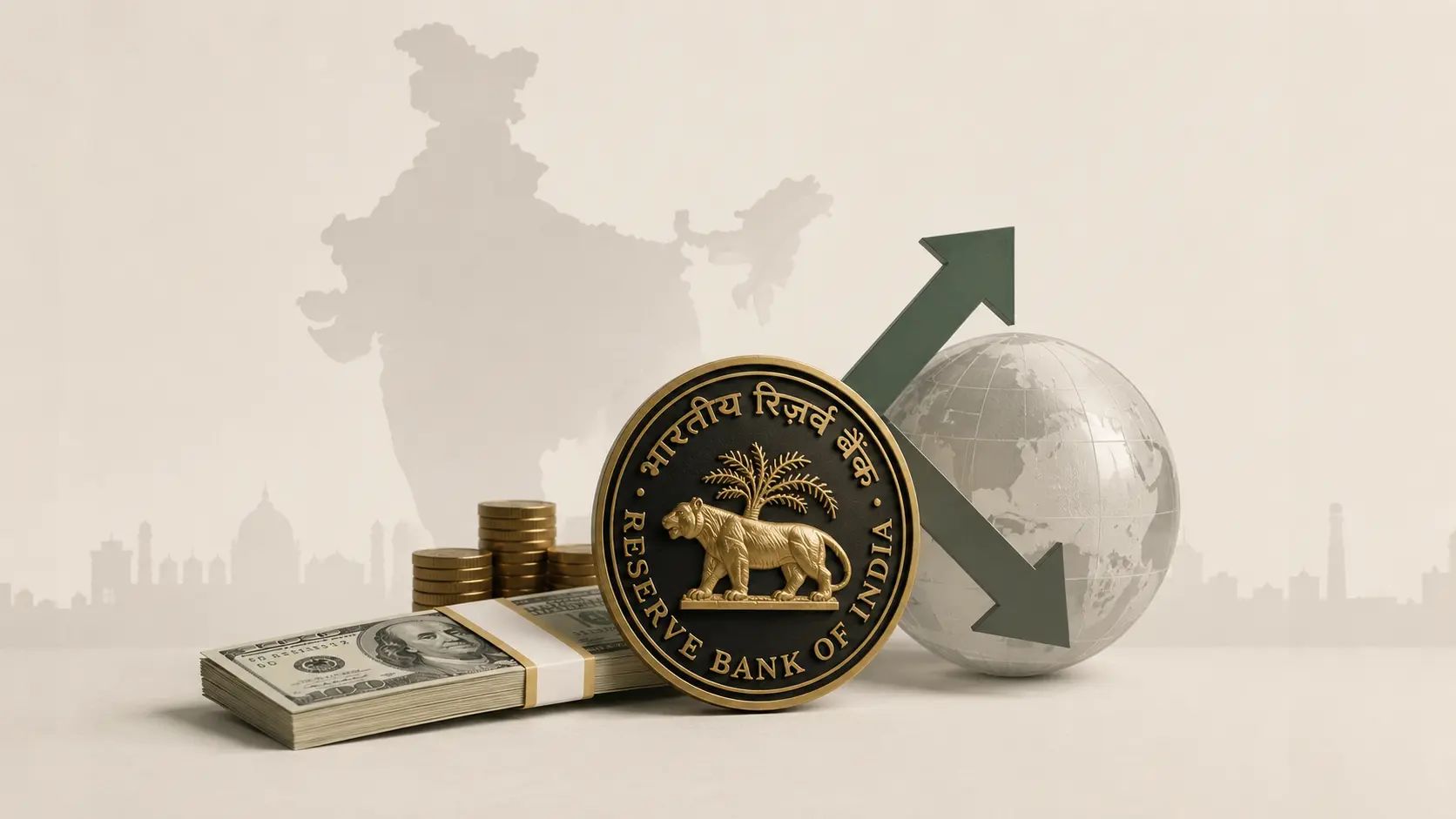
In today's global macro environment, where domestic central banks are increasingly forced to choose between aggressive monetary tightening and creative balance-sheet operations, the Reserve Bank of India (RBI) has turned its gaze backward. On June 8, 2026, the central bank announced an unexpected deployment: a Special Swap Window designed to incentivize Foreign Currency Non-Resident (FCNR-B) dollar deposits over a three-to-five-year horizon. For seasoned market watchers, this policy trigger immediately evoked strong memories of September 2013, when the legendary then-Governor Dr. Raghuram Rajan opened a near-identical emergency window to counter the devastating effects of the Federal Reserve's Taper Tantrum. That historical maneuver single-handedly pulled the Indian Rupee out of a vertical freefall, drawing in an astonishing $34 billion in weeks.
Yet, as the RBI attempts to recreate that exact magic in 2026 to capture an estimated target of $20 billion, an urgent structural question surfaces: Are we blindly misapplying an old playbook to a completely transformed global economic paradigm? The reliance on historical policy precedents often introduces a false sense of security. Just as modern consumers frequently default to autonomous digital budgeting apps without understanding the underlying behavioral constraints of their financial decisions, central planning authorities risk falling into institutional path dependency. In 2013, India was designated as part of the fragile and highly vulnerable "Fragile Five" economies; today in 2026, India boasts record-high foreign exchange reserves exceeding $680 billion, deeply integrated international bond inclusion via the JPMorgan Emerging Markets index, and far more robust corporate balance sheets. Applying a crisis-era structural intervention in a non-crisis environment creates systemic friction that could yield unintended distortions rather than seamless capital generation.
This extensive policy analysis deconstructs the mechanics of the newly opened 2026 window, explores the hidden balance sheet transformations, contrasts the current macroeconomic realities against the 2013 framework, and evaluates the critical structural inefficiencies that limit this intervention's ultimate efficacy.
The 2026 FCNR-B Architecture: How the Swap Window Works
To fully conceptualize why the Reserve Bank of India has reintroduced this policy, one must understand the precision-engineered mechanics of the 2026 special swap facility. Under standard market practices, when an Indian commercial bank accepts a dollar-denominated FCNR-B deposit from a Non-Resident Indian (NRI), it faces an acute asset-liability match dilemma. If the bank converts those dollars into domestic Indian Rupees to fund high-yielding domestic credit growth, it takes on massive currency exchange risk. To protect its balance sheet, the bank must buy a corresponding forward cover in the open market, which involves paying a steep premium reflecting the interest rate differentials between the United States and India. This open-market swap premium historically ranges between 2.0% and 3.0% per annum for a three-to-five-year tenor. This high hedging cost drastically compresses the bank's net interest margins, rendering aggressive deposit mobilization economically unviable.
The RBI's newly introduced 2026 structural intervention completely bypasses this open-market constraint by stepping in as the unilateral counterparty. Under the June 2026 framework, commercial banks can hand over their accumulated FCNR-B dollar deposits directly to the central bank in exchange for immediate domestic liquidity. Crucially, the RBI has committed to absorbing the entire underlying hedging and swap cost. Unlike the 2013 framework where banks were charged a fixed concessional swap fee of 3.5%, the 2026 window offers an absolute structural subsidy — banks get fully hedged, risk-free domestic funds at zero net swap cost. This enables Indian commercial banks to offer highly aggressive interest rates to global non-resident depositors, often scaling between 5.5% and 7.0% on pure US dollar term accounts, while completely eliminating the threat of domestic currency depreciation on those specific liabilities.
"When a central bank eliminates the cost of risk transformation entirely, it isn't merely correcting a liquidity deficit; it is actively tilting the market mechanism to create an artificial structural yield optimization layer."
The ultimate strategic objective of this mechanism is to build a massive outer defensive perimeter around India's balance of payments. By enticing a concentrated pool of long-term foreign exchange capital directly into the central bank's vaults, the RBI aims to offset the short-term capital flight caused by persistent foreign institutional equity outflows and elevated international energy costs. Banking sector analysts estimate that this policy could smoothly catalyze an aggregate inflow of up to $20 billion to $50 billion by the time the deposit mobilization window officially concludes on September 30, 2026. This sudden influx represents a potent buffer that insulates the domestic interbank market from external shocks and ensures an uninterrupted flow of credit to core industrial sectors.
Structural Inefficiencies and Hidden Systemic Risks
Despite the immediate mechanical efficiency that this subsidized swap window provides, the reliance on such heavy-handed central bank interventions introduces severe long-term distortions across the broader domestic financial architecture. The most glaring drawback lies in the asymmetric mispricing of currency risk. By bearing the entire financial burden of the forward swap, the RBI is essentially shifting a commercial balance-sheet liability directly onto the public book. If the Indian Rupee depreciates significantly against the US dollar over the next three to five years, the central bank's ultimate dollar liability on these billions of unhedged swaps will expand exponentially. This creates an unhedged fiscal overhang that could severely constrain future monetary policy flexibility and jeopardize the central bank's independent capital adequacy framework.
Furthermore, recent econometric analyses of macro-policy execution reveal that heavy reliance on centralized financial engineering often backfires due to structural operational errors. Recent institutional studies indicate that complex policy frameworks requiring multi-tier bank processing achieve their explicit targets with only a 65% accuracy rate across erratic market cycles. This means that nearly 2 out of every 5 institutional policy cycles encounter severe execution drag, misdirected capital allocation, or systemic timing mismatches. In a corporate or large-scale commercial banking context, such a significant margin of error does not merely slow down operations; it actively precipitates sharp localized capital losses, leaves banks exposed to unexpected unhedged cross-currency vectors, and forces constant back-and-forth operational corrections that exhaust treasury desks.
Advertisement
The operational reality of managing these specialized deposit channels quickly transforms into an exhausting, endless loop of administrative overhead. Commercial treasury departments must continuously monitor individual non-resident compliance, verify precise repatriation vectors, adjust internal transfer pricing metrics, and constantly reconcile swap books with the RBI's rigid criteria. This complex administrative friction completely offsets the theoretical speed of automated financial systems, imposing an immense cognitive and operational burden on bank managers. Instead of dedicating resources to optimizing core domestic lending and credit risk underwriting, major financial institutions find themselves bogged down by a tedious daily chore that increases systemic compliance risks and triggers corporate inefficiencies.
The 2013 Playbook vs. The 2026 Reality

To understand why this strategy faces such steep resistance today, we must actively examine its historical origin point. The original FCNR swap concept was pioneered in September 2013 by Dr. Raghuram Rajan during a moment of supreme national financial peril. India's current account deficit had spiraled out of control, the national currency was in freefall, and global investors were actively divesting from emerging markets. Rajan's structural masterstroke succeeded entirely because the interest rate differentials of 2013 offered an incredible, wide spread that perfectly aligned with international investor incentives. At that time, the US Federal Reserve maintained benchmark interest rates at a near-zero floor of 0.25%, meaning global dollar liquidity was searching desperately for any semblance of positive yield. When Indian banks offered 5.5% on fully backed dollar deposits, the resulting spread was an absolute blockbuster that instantly pulled capital across international borders.
| Macroeconomic Factor | The 2013 Playbook (Crisis Era) | The 2026 Reality (Modern Era) |
|---|---|---|
| US Federal Funds Rate | Near-Zero (~0.25%) | Elevated (~4.50% – 5.00%) |
| Offered FCNR(B) USD Yield | ~5.50% Average | ~5.50% – 7.00% Projected |
| Yield Spread Over US Risk-Free | ~525 Basis Points (Massive) | ~150 – 250 Basis Points (Compressed) |
| India's Forex Reserve Shield | Fragile (~$275 Billion) | Robust (~$680+ Billion) |
| Leverage Viability (SBLC) | Highly Profitable for Non-Residents | Economically Unviable at Current Spreads |
| Core Systemic Intention | Desperate Currency Stabilization | Preemptive Liquidity Optimization Layer |
In stark contrast, the macroeconomic landscape of 2026 completely rejects the assumptions of the 2013 playbook. Today, the US Federal Reserve maintains an elevated interest rate regime with benchmark yields holding strong near 4.50%. Consequently, when an Indian bank offers a 6.5% yield on an FCNR-B account in 2026, the real yield spread over alternative risk-free US assets shrinks to a meager 150 to 250 basis points. In 2013, non-resident investors could easily leverage their personal funds by 10x to 20x through overseas Standby Letters of Credit (SBLC) to maximize their returns because borrowing dollars cost next to nothing. In 2026, the high cost of global dollar borrowing completely destroys the underlying economics of this leverage model, making it exceptionally difficult for banks to trigger a massive, blockbuster influx of retail capital on the scale witnessed over a decade ago.
Ultimately, the core philosophy of financial wisdom dictates a timeless truth: real, sustainable security cannot be achieved through artificial central banking shortcuts, but through deep structural discipline and conscious capital management. Much like the core principles of successful personal wealth preservation, a nation must focus on organic export expansion, deep industrial productivity gains, and a stable, highly predictable fiscal policy environment to build lasting resilience. Reopening a decade-old emergency window in 2026 provides a short-term liquidity illusion, but it fails to address the structural issues of high energy import dependency and low domestic export elasticity. If India wants to maintain its stellar external balance sheet strength, its policymakers must stop leaning on outdated crisis playbooks and instead cultivate a forward-looking paradigm of absolute structural self-reliance.
For a broader understanding of the same rupee depreciation environment and the domestic institutional bid that is quietly countering FPI outflows in India's bond market, see India's Rupee Depreciation Is Creating Structural Bid from Life Insurers and PSU Banks That the FPI Outflow Narrative Is Missing 2026.
Read Further
- RBI Opens FCNR(B) Swap Window to Attract Foreign-Currency Deposits — Business Standard, June 9, 2026
- India: Shoring Up the Indian Rupee — RBI June 2026 Measures — MUFG Research, June 8, 2026
- FCNR(B) Swap Window 2026: RBI Operational Guidelines — ICICI Direct Research
Disclaimer: All data, factual references, and comparative metrics provided in this policy analysis were synthesized from official central banking reports, MUFG Research, Business Standard, and historical macroeconomic datasets available up to June 2026. This analytical content is intended solely for educational and research purposes and must not be construed as formal financial, legal, or investment advice.
Advertisement