

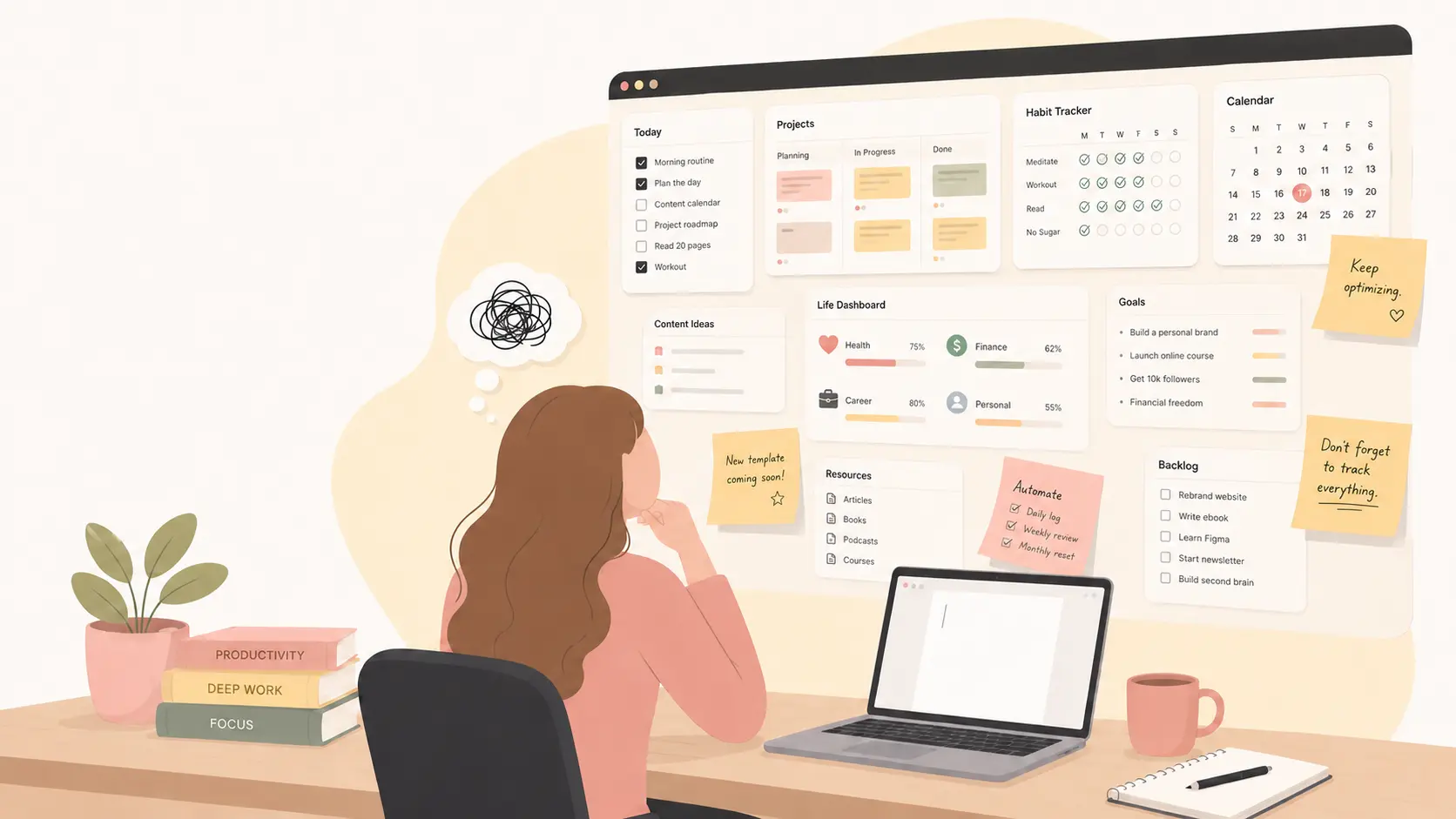
In today's era where everything is being optimized, structured, and cross-referenced by digital productivity software, we are too much dependent on it and somehow it is useful for us and somehow it is not. We live in an economy obsessed with personal output, tracking every hour, tagging every task, and building complex relational databases to map out our daily existences. Somewhere along this journey of self-optimization, tools like Notion, Obsidian, ClickUp, and Asana ceased to be simple utilities to get work done faster. Instead, they transformed into something psychological. Software was originally created to make our work faster and with better efficiency but when we just ended up depending on workspaces, tracking boards, and aesthetics for our everything, we don't know where we actually forgot lost and old methods of deep work and mental silence, we don't know. We find ourselves trapped in an endless loop of reorganizing dashboards, color-coding system nodes, and automating templates while our actual core outputs remain stalled. This article basically is going to get you all aware about what we should do with modern productivity systems and what we should do with authentic and original action-oriented work.
Productivity Theater and the Efficiency It Simulates
With digital tools, designing a workspace has become easier and more efficient to calculate the timelines of our daily day to day life and also in our careers, in business and creative fields as well. Modern productivity apps are evolving beyond simple text documents into complete digital ecosystems. They allow you to create personal dashboards that analyze habit consistency, forecast project deadlines, link reading notes, and even structure multi-year life visions with minimal friction. You can construct a perfect database where your gym schedule relates to your grocery list, which relates back to your monthly financial tracking budget.
These workspaces help you feel organized while managing your daily operations, making decisions on your base for your career or business. These digital systems work upon what is trending in the design market, utilizing beautiful minimal layouts, customized icons, and clean Kanban tables to help you choose from smart and successful templates. It feels like progress. When you see a perfectly customized dashboard with automated filters and relations, your brain receives a heavy hit of dopamine. You feel like a structured, high-performing executive before you have even typed a single line of actual content or made a single difficult phone call.
Data Metric Callout: The Rise Of Organisational Overhead
Recent workplace studies show that knowledge workers now spend up to 58% of their day on "work about work"—activities like searching for documents, moving tasks between statuses, and adjusting project management boards rather than performing the core specialized tasks they were hired to do. The issue is that this simulation of efficiency creates a sense of safety. When internal stress or career ambiguity rises, building a dashboard offers an immediate escape. It allows us to feel completely in control of an unpredictable environment. We mistake the optimization of the system for the execution of the work itself, burying our professional anxieties under layers of tags, relations, templates, and sub-pages.
"We build flawless systems to look at the work, because we are too terrified to actually start doing the work."
Cons of Using Hyper-Complex Tools for Everyday Work
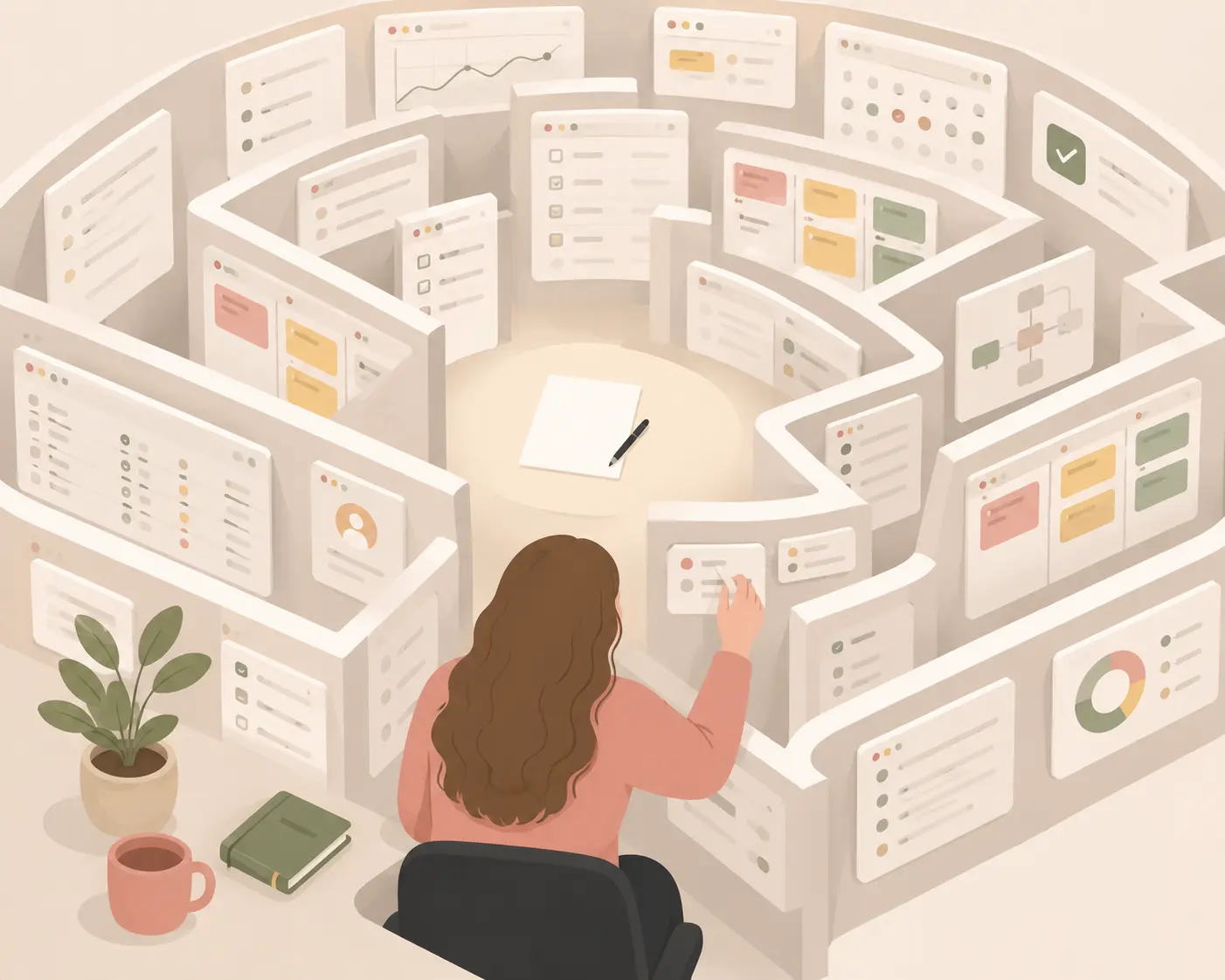
Digital setups as we know are still cold software frameworks, not action-driven mindsets which can execute human decisions after calculating endless real-world variables. In recent studies analyzing digital workspace habits, it was seen that major tracking platforms do provide great organization but with heavier and lengthier setups where each and every minor daily adjustment requires meticulous maintenance. A vast variance of error and friction is seen over time, calculating to a point where a significant portion of users abandon their complex tracking layouts within the first few months. This leaves a gap in actual execution which, if not in simple personal journals, can lead to severe operational losses in a business environment.
Giving formulas, linking inline tables, and constantly checking each and every database record can become an endless loop of getting a few layouts wrong and keeping it changed. This transforms what should be a tool into a tiresome chore of the day, which takes more time and head work, and gives major headaches and migraines in the long run. When your tool requires a 45-minute daily maintenance session just to log your standard activities, it is no longer serving you; you are serving the tool.
This phenomenon, known as "action bias," causes us to look for any task that makes us feel busy, preventing us from facing the silent anxiety of a blank text document or a hard creative challenge. Furthermore, these platforms isolate us from natural workflows. By forcing every single idea, thought, and emotion into a structured row within a multi-tiered database, we strip away the raw, unstructured creativity that characterizes true breakthroughs. The system demands data entry, and in return, it rewards us with a clean aesthetic—but clean aesthetics do not equal deep, focused execution.
Advertisement
For a closer look at how unmanaged workplace stress quietly compounds into long-term financial fragility, see The Hidden Financial Cost of Burnout.
The Traditional Approach: Mindful and Minimal Action
Before the advent of cloud-based relational software, individuals used raw, un-optimized methods of tracking that relied heavily on direct cognitive engagement. Traditional analog systems—such as simple physical notebooks, index cards, and classical journaling frameworks—focused basically on immediate actions, daily reflections, and high-priority outputs. Unlike modern applications, classic systems focused heavily on reflection and awareness, not just continuous layout building and automation.
People traditionally used handwritten paper to encourage mindful execution, improve daily focus, reduce unnecessary cognitive overhead, and help themselves gain true mental discipline. When you are limited to a physical pen and a piece of paper, you cannot create complex automated databases or spend hours selecting the perfect custom banner icon. You are forced to look directly at your tasks. The simplicity of analog methods started to fascinate the lives of those trapped in a hectic digital landscape around the 2010s, giving rise to movements centered around minimalism and raw focus blocks.
Comparative Analysis: Digital Overhead vs. Analog Reality
- Digital Dashboards: High setup time, heavy reactive tracking, continuous reorganization, low conversion to real output.
- Minimalist Systems: Zero setup time, high intentional focus, structure-independent execution, immediate conversion to action.
A minimalist approach dictates a simple structure with basic, clear sections: absolute requirements, optional tasks, personal learning, and unpredicted problems. This mirrors classic organizing principles where actions are categorized by immediate necessity rather than complex metadata. At the end of the day, you look simply at what was completed and what was avoided.
Now it may sound like a primitive, un-automated version of advanced digital apps, but no—this is the hidden magic of minimalist work. When you write and calculate your immediate focus yourself without software abstractions, your mind becomes fully aware of what you are doing, and whether it is right or wrong to delay a project. This process eventually becomes an active habit to think twice before shifting your focus or overcomplicating your work, which is the core principle of success in career management and productivity. By removing the digital screen that acts as an emotional support buffer, you force your mind to confront your tasks directly, converting your anxious energy into raw momentum.
"Organize minimally and execute intentionally."
Finding Balance in an Automated Era
To break free from this cycle of anxiety-driven optimization, we must re-evaluate our relationship with our digital tools. The goal should not be to completely abandon modern technology, but to strip away the theater. Use your digital tools as a flat repository for information—a simple bucket to hold data—rather than an interactive playground to dodge your fears. If a tracking dashboard takes more than ten minutes a day to maintain, it is no longer an asset; it is an elaborate distraction technique.
True productivity is never about the beauty of the dashboard; it is measured by the quality of the things you create when you close the application. By moving away from complex digital architecture and returning to direct, unbuffered action, you stop treating your tools as emotional support systems. You step out of the loop of endless planning and step into the real world of deep, focused work.
Read Further
[1] Asana. Anatomy of Work Global Index — "Work About Work" Consumes 58% of Knowledge Workers' Day — Click here
[2] Wikipedia. Action Bias — The Psychological Tendency to Favor Action Over Inaction — Click here
Disclaimer: All the data and observations provided above were gathered from internet resources, workplace psychological studies, and common trends in digital productivity frameworks. This should not be taken as an official medical quote or definitive psychological advice.
Advertisement