


In today's corporate era where productivity systems, automation platforms, and sophisticated HR matrices are implemented to optimize efficiency, we remain deeply dependent on middle management. Somehow, despite switching companies, moving across diverse industries, or seeking completely fresh starts, millions of professionals stumble upon an uncanny, frustrating phenomenon: your new boss feels exactly like your old boss. It is a tired loop of navigating the identical micromanagement, the same communication bottlenecks, and the structural toxicity you thought you left behind.
Modern management systems were originally designed to coordinate labor efficiently, streamline strategic communication, and provide systemic guidance. Yet, when companies build top-down corporate hierarchies that prioritize metrics over systemic human dynamics, they inadvertently cultivate conditions where poor leadership doesn't just survive — it explicitly thrives. We often complain about the individual quirks of our managers, without realizing that we are looking at an organizational blueprint that systematically manufactures the same bad boss everywhere.
The Structural Architecture of Incompetence
The ubiquity of the terrible manager is not an accident of nature; it is a mathematical inevitability explained by foundational organizational studies. The primary mechanism driving this is the Peter Principle, a concept formulated by Dr. Laurence J. Peter in 1969. The principle states that in a corporate hierarchy, every employee tends to rise to their level of incompetence. A brilliant engineer, an exceptional salesperson, or a highly skilled accountant is consistently promoted because of their technical prowess. However, the skill set required to execute technical work is entirely unrelated to the emotional intelligence, diplomacy, and strategic design required to manage human beings.
As a direct result, organizations systematically strip their front lines of high-performing individual contributors and transform them into incompetent, anxious, and defensive managers. Because they no longer understand or control the day-to-day tactical work with their former ease, they retreat into the only coping mechanism their anxiety permits: absolute control over trivialities. This is where the universal archetype of the micromanager is born.
"Employees don't quit bad companies; they quit bad infrastructure that promotes technical skill over human leadership."
The Corporate Incentive System and Behavior Reinforcement
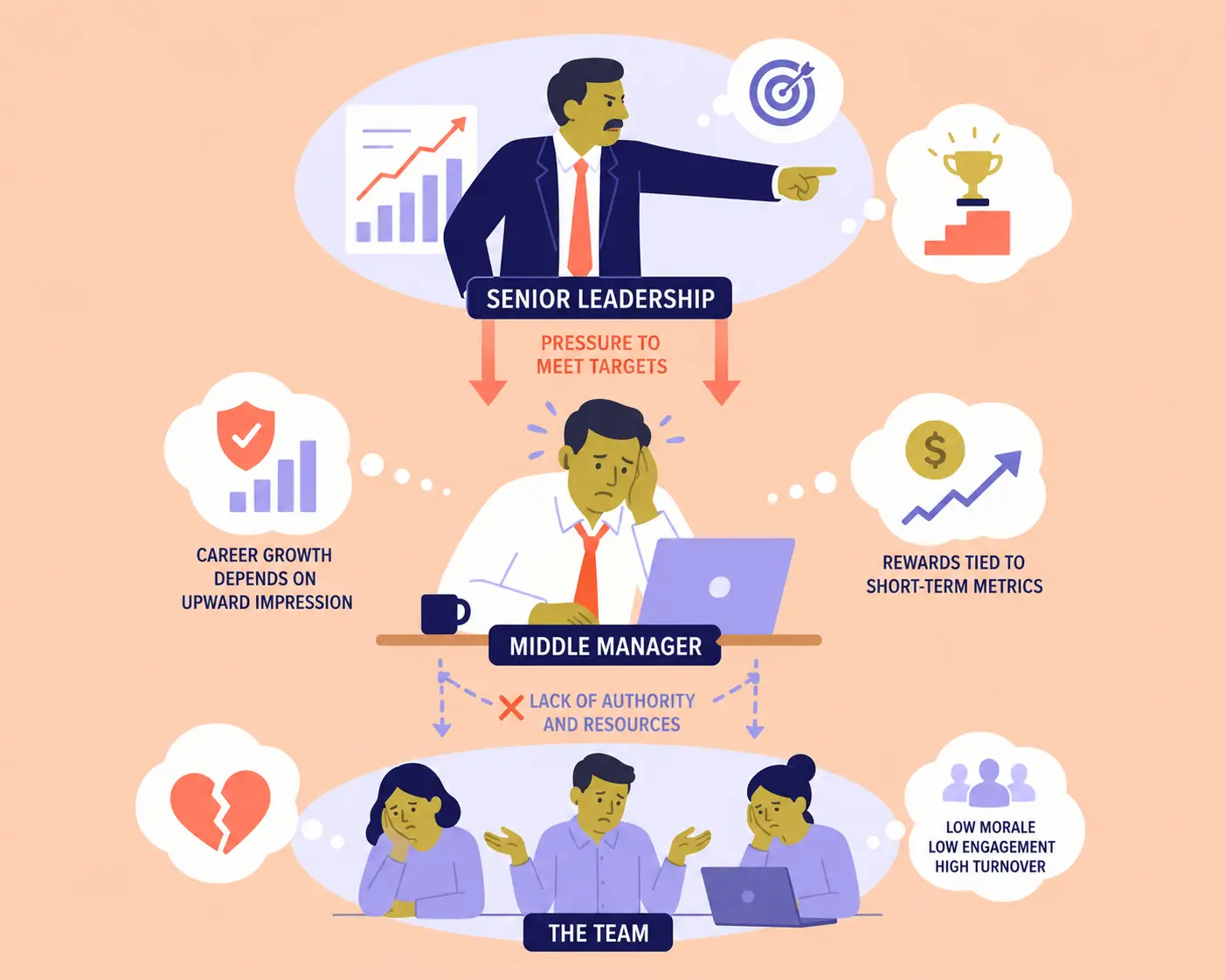
Beyond promotion mechanics, corporate incentive structures are fundamentally misaligned. Most middle managers are caught in a brutal organizational vice. They face immense, relentless pressure from senior executives to meet aggressive, short-term metrics, while lacking the real structural authority or resources to inspire organic productivity from their teams. When corporate survival is tied strictly to upward reporting rather than downward support, managers naturally adjust their behavior to satisfy their superiors at the expense of their direct reports.
According to extensive workplace culture studies, this creates an endless cycle of toxic behavior tracking. A study inspecting managerial tendencies showed that over 60% of corporate managers felt they lacked adequate training when stepping into leadership roles. This massive gap of preparation translates directly into operational friction, leading to a high statistical accuracy of negative leadership patterns across separate companies. The manager learns that protecting their territory and managing upward impressions yields career progression, while supporting psychological safety for their staff is viewed as an intangible, unrewarded metric.
Traditional Management Friction vs Adaptive Leadership System
The Archetype System (Broken)
- Reactive Control: Operates out of fear of executive reprimand.
- Metric-Obsessed: Values artificial presence and hyper-surveillance.
- Upward-Oriented: Filters truth to please upper levels.
- High Attrition: Over 65% of teams face burnout within 120 days.
Advertisement
Sustainable Infrastructure (Works)
- Intentional Trust: Devolves autonomy to build domain mastery.
- Outcome-Dependent: Focuses on objective goals, not digital tracking.
- Bi-Directional Support: Insulates the team from corporate chaos.
- Long-Term Growth: Retains institutional knowledge and loyalty.
The Loop of Administrative Burden and Headaches
Managing an under-resourced team using outdated tracking structures turns a leader's schedule into an endless loop of meetings, status updates, and administrative firefighting. Instead of designing long-term workflows, they spend their days demanding status reports to feed into executive dashboards. This exhausting choreography leads directly to cognitive overload, severe daily stress, and eventual executive burnout. When a manager operates in chronic fight-or-flight mode, their capacity for empathy drops to zero. They treat their employees not as stakeholders, but as resources to be extracted, accelerating the universal feeling of corporate alienation.
Furthermore, human psychology dictates a phenomenon known as mimetic desire and behavioral copying in corporate environments. Managers mimic the behavior of the leaders who promoted them. If your boss's boss is an aggressive, short-tempered executive who demands weekend emails, your boss will adopt that identical behavior to prove they belong in that circle. Thus, toxicity propagates downwards, ensuring that your next boss in a completely different firm duplicates the precise operational flaws of your previous one.
Breaking the Pattern: Awareness over Metrics
The true realization is that the "Terrible Boss" is rarely an isolated villain; they are a symptom of an industry-wide design flaw. Until organizations restructure their career pathways — separating high-salary technical tracks from people-management tracks — this cycle will continuously loop. True money management, project planning, and organizational design must understand that human beings cannot be tracked like static lines of code or predictable spreadsheet rows. It requires a fundamental shift toward psychological safety, structured boundaries, and objective outcome measurement rather than active surveillance.
When entering a new workplace, it is crucial to audit the structural infrastructure of the company rather than relying purely on the charismatic promises of an interviewer. Look at how long people stay on the team, how promotion decisions are made, and whether the company rewards collaborative excellence or hyper-aggressive individualism. Real success in protecting your career progression relies entirely on recognizing these structural red flags before signing your next contract.
For a practical framework on how to protect your own career trajectory once you recognize you are inside a loyalty trap, see The Loyalty Trap: Why Being Dependable Is Actually Keeping You Stuck.
Read Further
- Promotions and the Peter Principle — NBER Working Paper, Benson, Li & Shue (Yale / MIT / University of Minnesota)
- Do People Really Get Promoted to Their Level of Incompetence? — Harvard Business Review, Kelly Shue et al.
- The Peter Principle: A Theory of Decline — Stanford Graduate School of Business
Disclaimer: All structural theories, statistical trends, and behavioral analyses provided in this article were synthesized from contemporary organizational psychology resources, labor market studies, and management infrastructure frameworks. This article functions strictly as an analytical commentary on corporate design and should not be taken as direct legal, financial, or formal career-placement advice.
Advertisement