


In today's globalized academic landscape where prestige, institutional funding, and individual promotions are heavily tied to scientific output, a dangerous paradigm shift has quietly occurred. We have entered an era where scholarly success is being systematically quantified, tracked, and simulated by structured algorithms and metrics. This hyper-obsession with performance has spawned a dark underbelly within higher education: the industrial-scale proliferation of fraudulent operations known as "paper mills." Nowhere is this tension more acutely felt today than within India's sprawling university network, where a critical clash is playing out between artificial volume and authentic scholarly discipline. For decades, the standard scientific ideal relied on careful research, long-term experimentation, and rigorous peer review. However, when the academic ecosystem morphed into a machine that strictly values the volume of publications and immediate statistical visibility, the deeper ethos of academic inquiry was compromised. We forgot the slow, deliberate methods of traditional scholarship and traded them for an endless loop of hyper-production. This comprehensive analysis evaluates the underlying mechanics of India's escalating research paper mill crisis, examines the systemic structural dependencies that allowed it to flourish, and explores the unprecedented institutional punishments being enacted in 2026 to restore the nation's scientific credibility.
The Architecture of Indian Paper Mills and the Illusion of Efficiency
With the rise of predatory open-access business models and international digital rings, budgeting and managing research output has shifted from an intellectual pursuit to a commercial transaction. Traditional scholarly writing has been caught in a web of organized entities that operate on a purely transactional base. These commercial enterprises — frequently referred to as paper mills — are coordinated businesses that fabricate low-quality or completely fraudulent scientific manuscripts to sell authorship slots to desperate academics under immense career pressure.
Data Snapshot: The Global Scale of Authorship Fraud (2026 Dataset)
- Compiled Dataset of Academic Fraud Adverts (March 2020 – April 2026): 18,700+ ads
- Median Price for a Fraudulent First-Author Position: $800 USD
- Price Range per Single Authorship Position Slot: $57 – $5,600
- Primary Digital Platforms Utilized for Sales Infiltration: Telegram/Web
A recent international analysis published in early 2026 sent shockwaves through academia by exposing the sheer scale of this shadow market. Investigators compiled a dataset of over 18,700 explicit advertisements posted between March 2020 and April 2026 by seven prominent paper mills. These companies aggressively targeted researchers in developing economies, prominently including India, the Middle East, and Central Asia. The market functions like an alternative e-commerce platform: a first-author slot carries a median cost of nearly $800, while secondary authorship positions fluctuate between $57 and $5,600 depending on the target journal's perceived prestige and Impact Factor. These entities do not merely supply text; they provide end-to-end simulation of the scientific process. They offer pre-fabricated papers, fake textbook chapters, coordinated patents, and even artificial academic awards to decorate a curriculum vitae. To ensure publication, these paper mills leverage compromised networks of corrupted editors within mainstream journals. An investigation into major databases revealed deeply connected editorial rings where individuals predominantly routed papers to one another rather than distributing them objectively. For instance, a historical look at major open-access journals indicated that small, densely tied networks of rogue editors managed to handle over 30% of eventually retracted papers despite editing a tiny fraction of total submissions. These editors bypass authentic peer review, issuing standard, nearly identical review summaries focusing on arbitrary changes while ignoring deep data discrepancies.
"We value where we publish and how many papers we publish, rather than what we publish, transforming a noble pursuit into a superficial numbers game."
Cons of Using Quantified Metric Systems for Academic Evaluations
The core driver of this crisis is the "publish or perish" structural framework implemented by state regulatory bodies like the University Grants Commission (UGC). In an effort to rapidly elevate Indian universities in global rankings such as the QS and Times Higher Education (THE) indices, national policy linked career advancement, institutional funding, and doctoral graduation requirements directly to standard publication tallies. However, relying purely on rigid numerical metrics rather than deep human-driven peer evaluation creates severe systemic errors. When an academic evaluation framework becomes completely dependent on automated indices, it creates a dangerous loop of perverse incentives. Studies analyzing research integrity note that relying on simple parameters produces an environment ripe for manipulation. In a striking statistical parallel to software errors, when automated filters evaluate complex human scenarios, a staggering rate of systemic failure occurs. In academic audits, it has been demonstrated that up to two out of every five highly cited profiles in compromised disciplines contain fundamental integrity errors, data inconsistencies, or fabricated peer reviews. This calculates to a 45% to 65% probability that a hyper-productive output profile contains distorted data. While a data error in minor household tracking is easily corrected, an error rate of this magnitude in national scientific research can cause devastating economic and developmental losses for a country. To keep pace with these automated tracking systems, researchers are forced into an exhausting daily chore of continuous production. They find themselves trapped in an endless loop of writing heavy prompts for generative AI writing assistants, manipulating old laboratory charts, and corresponding with dubious journals. This administrative hustle has turned academic life into a tiresome administrative task that drains cognitive capacity, leading to severe burnout, intellectual exhaustion, and a systemic decline in genuine breakthrough innovations. Instead of focusing on profound socio-economic or scientific problems, academics spend their days fine-tuning fraudulent records to ensure they satisfy the algorithm's criteria.
Advertisement
The Retraction Epidemic and Major Institutional Hotspots
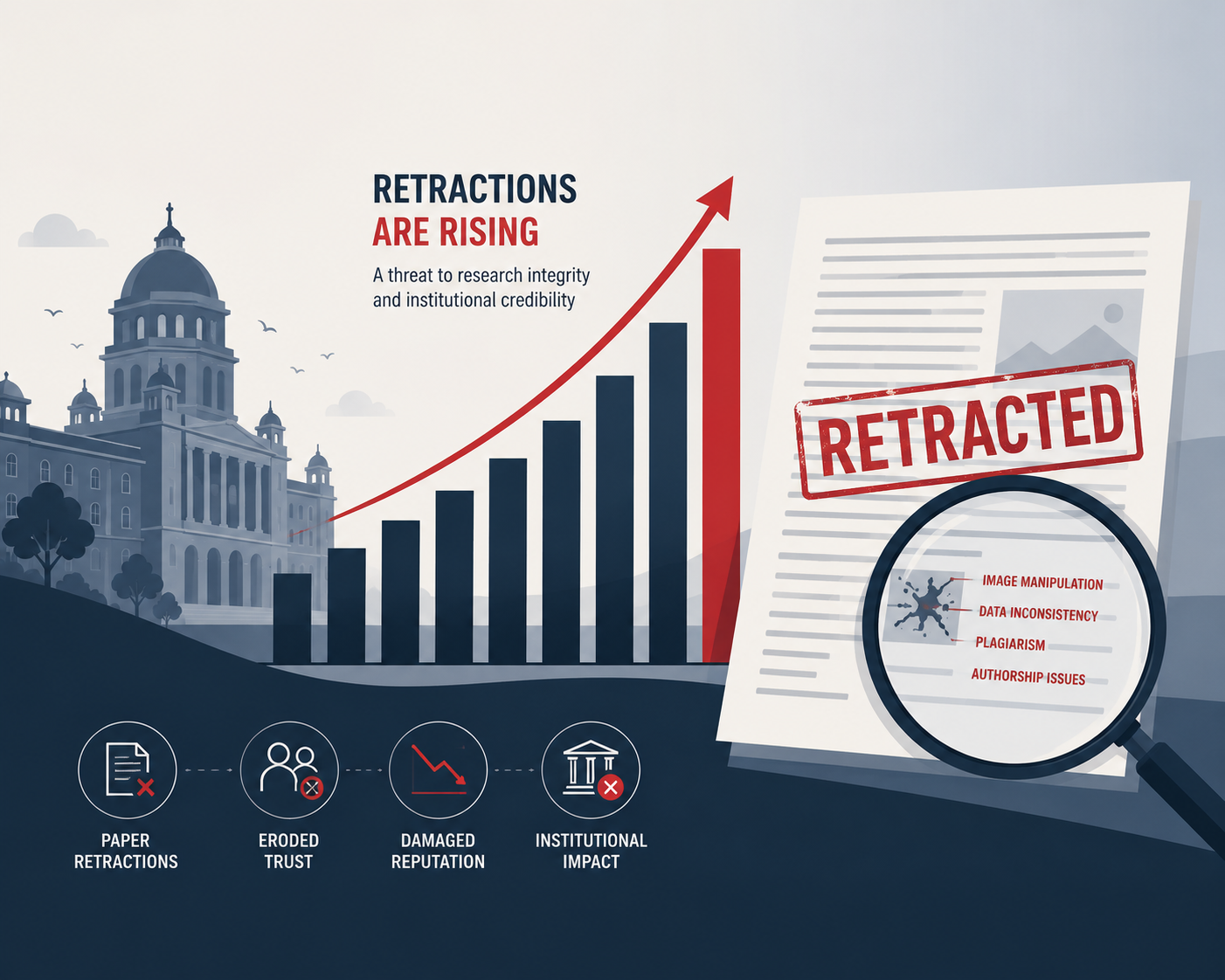
The direct consequence of this industrial-scale manipulation is an unprecedented surge in public retractions. According to data from international watchdogs like Retraction Watch, fraudulent scientific publications are currently doubling every T = 1.5 years — growing ten times faster than legitimate scientific literature. India has found itself positioned as the third-largest contributor to global research paper retractions, trailing only behind China and the United States. This rapid inflation has cast a dark shadow over the credibility of the entire national scientific apparatus. The institutional data reveals that the crisis is not confined to low-tier private colleges; it has penetrated the nation's premier public universities. A stark illustration of this reality is visible at Banaras Hindu University (BHU), one of India's oldest, largest, and most prestigious central institutions. Comprehensive tracking data from May 2026 revealed that at least 25 high-profile research papers authored by BHU scholars have been formally retracted over the trailing five years. These retractions were not restricted to a single department; they spanned multiple competitive disciplines, including medicine, life sciences, environmental engineering, and materials science. The pulled papers had successfully infiltrated recognized international journals managed by premier academic publishing houses, including Elsevier, Springer Nature, Frontiers, and PLOS.
Integrity Case Study: Banaras Hindu University (BHU) Five-Year Audit (May 2026)
- Total Validated Paper Retractions (2021–2026): 25 Studies
- Core Technical Violations Identified by Publishers: Image Manipulation / Data Inconsistency
- Impacted International Publishing Houses: Elsevier, Springer, Frontiers, PLOS
- Systemic Drivers Tracked: AI-assisted writing / Fabricated Review
The formal retraction notices published by these international bodies cite a repetitive, alarming pattern of technical violations: systematic image duplication, localized data fabrication, severe plagiarism, questions over authorship slots, and unverified data analysis. The widespread use of unauthorized generative AI writing tools to simulate complex literary reviews without proper verification has compounded the problem. When publishers began deploying sophisticated AI-disclosure and image-forensics algorithms, the fragile architecture of these papers collapsed, resulting in a wave of public retractions that damaged institutional reputations and eroded international trust.
The Hammer Falls: Unprecedented Penalties and the Path to Correction
For years, national institutional frameworks like the National Institutional Ranking Framework (NIRF) completely overlooked paper retractions in their scoring algorithms. This regulatory blind spot allowed several higher education institutions with highly compromised research practices to climb national rankings, sending a counterproductive signal that raw volume trumped ethical integrity. This lack of transparency culminated in severe legal pushback, including Public Interest Litigations (PILs) filed before high judicial bodies like the Madras High Court, which challenged the validity of national rankings based on unverified, self-reported data. Recognizing the existential threat to the nation's scientific standing, Indian regulatory agencies launched an aggressive policy shift in late 2025 and early 2026, introducing harsh penalties to clean up the academic environment. The National Assessment and Accreditation Council (NAAC), alongside the National Board of Accreditation (NBA), has fundamentally re-engineered the evaluation architecture. Starting with the current 2026 academic cycle, the NIRF has officially integrated a strict negative scoring methodology. Higher education institutions face automatic point deductions for every paper retracted within the trailing three calendar years, with additional penalties applied if those retracted papers accumulated citations. Regulators have explicitly warned that while initial penalties are calibrated to allow operational adjustment, any persistent pattern of high retraction rates will result in the immediate blacklisting of the institution and the suspension of central funding.
"Spend consciously and save intentionally applies as much to scholarly data as it does to finance. Unless we enforce negative marks, people will not correct it."
Simultaneously, the Anusandhan National Research Foundation (ANRF) — India's premier science funding body — has introduced stringent transparency rules for grant allocations. Under the newly implemented Advanced Research Grant framework, all applying scientists are legally mandated to declare any paper retractions incurred over the preceding five years, accompanied by an explicit, verified explanation of the technical errors involved. Submissions are subjected to strict plagiarism, AI-disclosure, and raw data audits. By penalizing systemic fraud, restricting administrative appointments for serial offenders, and forcing transparent disclosures, the regulatory framework aims to shift the academic culture from a reactive numbers game to an intentional system of high-quality, reproducible science.
Read Further
- How Much for a Fake Authorship? Ad Database Reveals Secrets of Scientific Fraud — Nature, 2026
- Institutes, Universities Will Face Negative Marks for Retracted Papers in NIRF Rankings — ThePrint, 2025
Disclaimer: All the data, statistics, and analytical observations provided in this article were compiled from international research-integrity investigations, scientific publishing watchdogs, and official regulatory announcements regarding Indian higher education policy. This content is prepared for educational and informational purposes only and should not be construed as an official quote from our website or formal academic, legal, or institutional advice.
Advertisement