

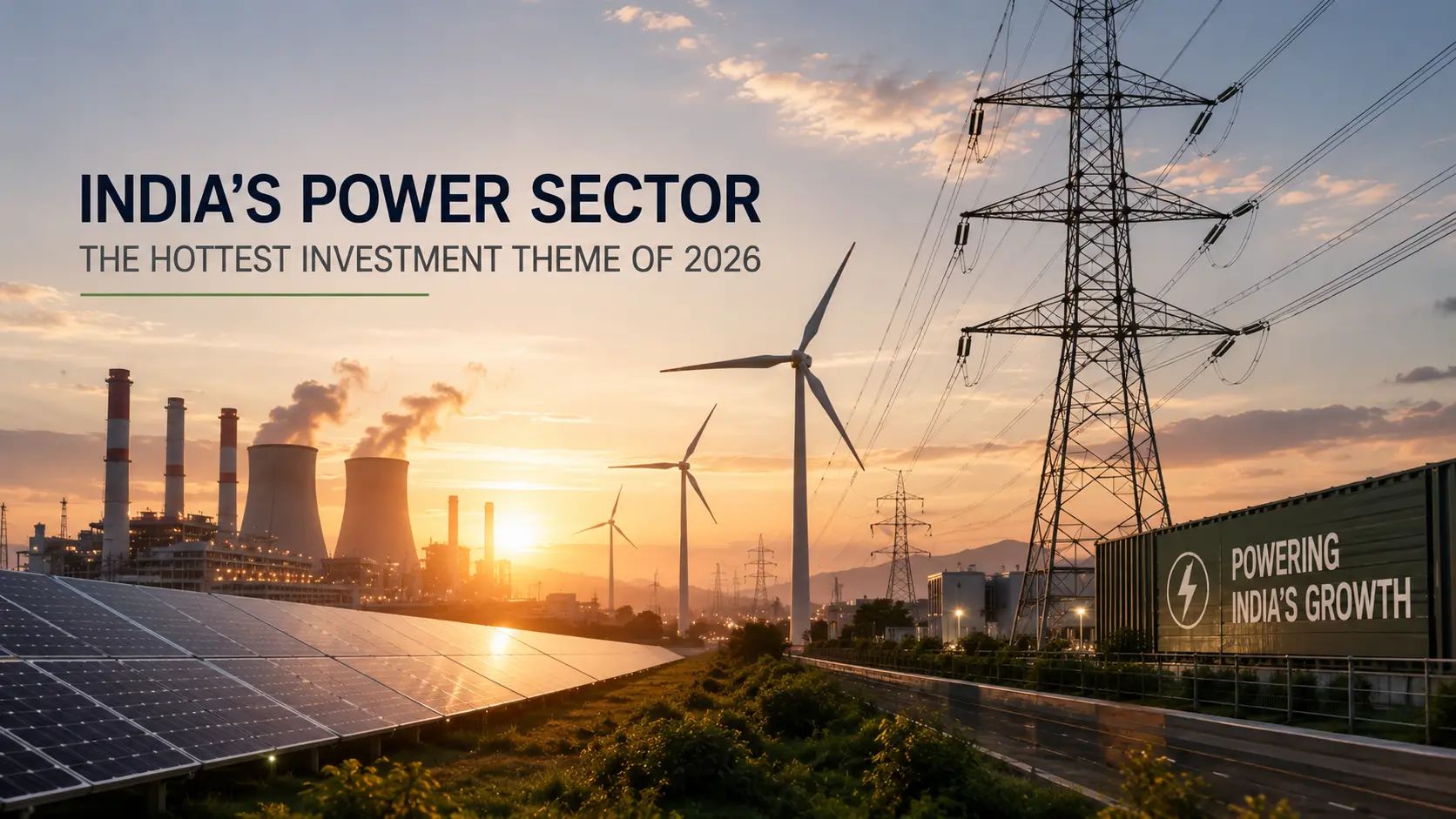
In today's global market arena where traditional asset classes are grappling with structural realignments and digital ecosystems are heavily dependent on computing infrastructure, a silent yet monumental shift is occurring in the real-world infrastructure markets. For the longest time, utility sectors were viewed by the investment community as defensive, low-growth avenues meant solely for yield preservation and risk aversion. However, as we cross into the midpoint of 2026, India's power sector has completely flipped the script. It has transformed from a sluggish, debt-ridden legacy framework into what global asset managers are now hailing as the single hottest capital appreciation engine of the decade. The numbers telling this story are not just incremental; they are explosive. We are living through an unprecedented epoch where the intersection of scorching climatic realities, hyper-scale data center rollouts, localized manufacturing booms under the Production Linked Incentive (PLI) schemes, and an irreversible electric vehicle (EV) pivot have converged to create an absolute super-cycle in energy demand.
This article provides a comprehensive deep dive into how India's power network is scaling up, analyzing both the structural efficiencies of this generation surge and the underlying financial realities that every modern market participant must understand to navigate this investment wave.
Autonomous Power Growth and the Efficiency It Provides
The structural expansion of India's generation capacity has completely shattered historical benchmarks. According to the latest data from the Ministry of Power and the Press Information Bureau (PIB), India's total installed power generation capacity reached an astonishing 524 GW as of late February 2026. To put this monumental feat into perspective, the Government of India has successfully injected 299.87 GW of fresh, state-of-the-art generation capacity since April 2014 alone. This incredible scale has single-handedly engineered a historic structural pivot — permanently shifting the nation from a chronic state of structural power deficit to an era of resilient power sufficiency. The pure velocity of this ramp-up is perfectly illustrated by the achievements of the recent fiscal year. During the financial year 2025–26 (up to January 31, 2026), the sector witnessed a historic record addition of 52,537 MW of generation capacity across conventional and green sources in a single year. This represents an absolute milestone in the history of global infrastructure planning, comfortably surpassing the previous record of 34,054 MW registered in FY 2024–25. This single-year surge expands the country's collective baseline infrastructure by over 11 percent in a breath-taking window of twelve months.
Key Milestone Table: India's Power Sector Status (Mid-2026)
| Sector Indicator | Metric Value (as of H1 2026) | Historical Context / Growth Trajectory |
|---|---|---|
| Total Installed Power Capacity | 524.00 GW | Up from ~243 GW in early 2014 |
| All-Time Record Peak Demand Met | 270.82 GW | Registered in May 2026; up 11.5% YoY in consumption |
| Total Non-Fossil/RE Capacity | 283.46 GW | Now represents more than 50% of total generation mix |
| National Synchronous Grid Length | Exceeds 500,000 ckm | The single largest integrated regional grid system globally |
| National Power Deficit Margin | 0.03% | Drastically reduced from 4.2% recorded in FY 2013-14 |
This massive explosion in capacity is being completely absorbed by an insatiable domestic market. In May 2026, relentless nationwide heatwaves combined with intense industrial activity pushed India's electricity consumption up by 11.5% year-on-year to 164.98 billion units (BU). Simultaneously, peak power demand hit a record high of 270.82 GW. Unlike speculative technological hype cycles, this is an infrastructure framework living out its growth story in real-time. For an economy targeting sustained 7%+ GDP growth, the power grid has evolved into the definitive foundational bedrock of macroeconomic productivity. To capture this secular expansion online and systematically evaluate the key corporate champions powering this multi-billion dollar trend, institutional portfolios are actively allocating funds across these leading power and energy ecosystem channels:
- NTPC Limited (NTPC): The undisputed conventional generation giant, aggressively pivoting to build a 60 GW green energy portfolio.
- Power Grid Corporation of India (POWERGRID): The monolithic central transmission monopoly expanding the green energy corridor.
- Tata Power Company (TATAPOWER): A vertically integrated private pioneer dominating EV charging, solar rooftops, and smart distribution networks.
- Adani Power & Adani Green Energy (ADANIPOWER / ADANIGREEN): Aggressive scale champions executing mega-scale hybrid parks in Khavda, Gujarat.
- Suzlon Energy (SUZLON): The revitalized wind turbine pioneer holding an active order book of 5.9 GW as of late 2026.
- Inox Wind (INOXWIND): A critical wind energy solution provider commanding a robust multi-gigawatt execution pipeline.
- BHEL (BHEL): The state-backed engineering giant experiencing a massive order revival for thermal and hydro engineering solutions.
- SJVN & NHPC (SJVN / NHPC): Public sector hydro power behemoths providing vital round-the-clock balancing power to the national grid.
"Spend consciously on capacity and expand intentionally on transmission."
Cons and Structural Risks of Riding the Power Wave Blindly
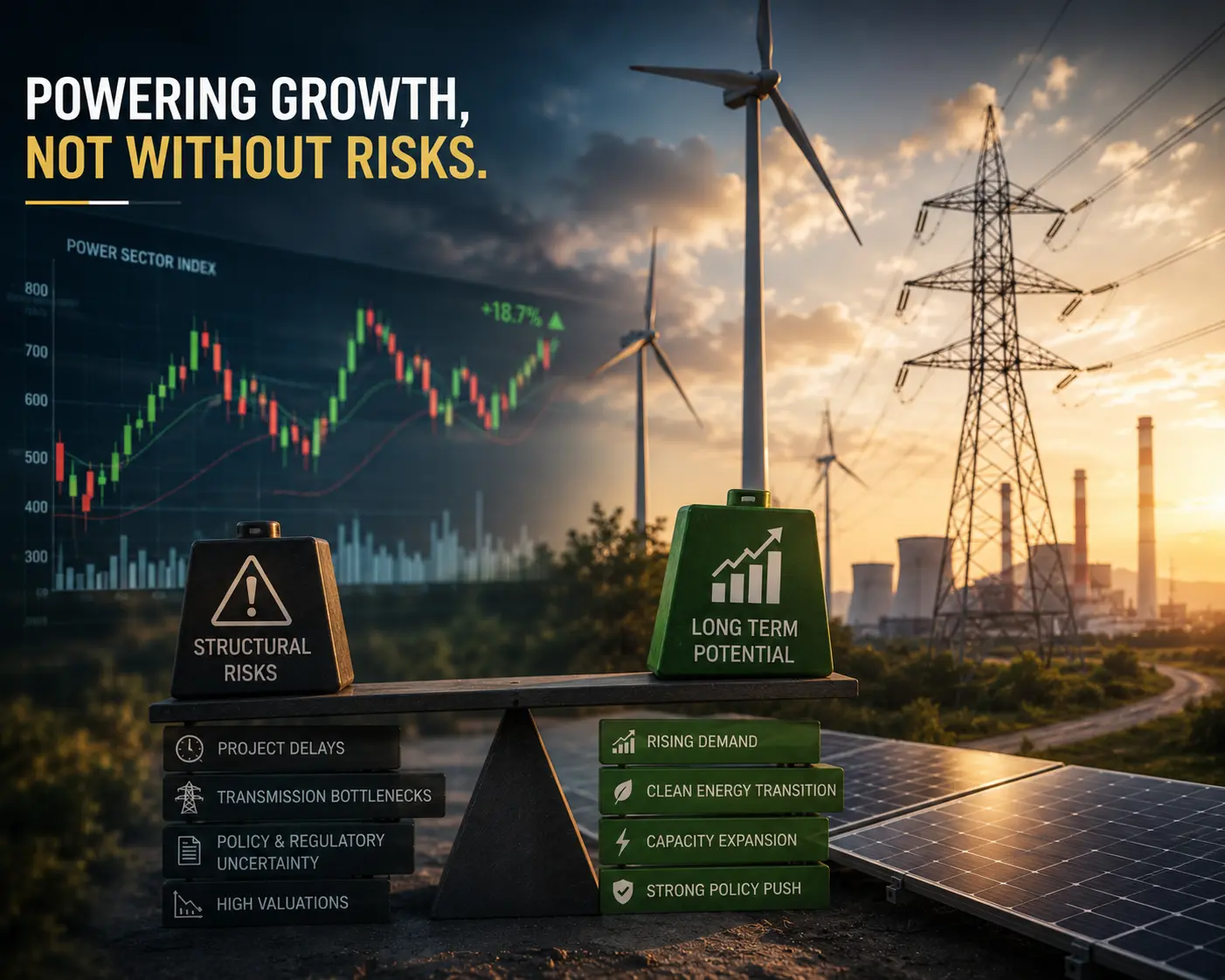
While the broader macro narrative surrounding India's power transformation is undeniable, allocating capital to this sector without considering structural bottlenecks can lead to severe portfolio damage. The primary risk facing retail and institutional investors alike is the immediate threat of runaway equity valuations outstripping operational ground realities. Over the past 24 months, momentum trading has driven several public and private utility stocks to unprecedented price-to-earnings (P/E) multiples. In many instances, expectations of immediate execution are priced in for the next five to seven years, leaving zero margin for regulatory, project, or procurement delays. A recent infrastructure study analyzing major corporate capital expenditure programs highlights a vital warning: while 75% of new capacity additions in FY 2025–26 came from renewable sources, project execution timelines are hitting a clear bottleneck. Statistics indicate that roughly 2 out of every 5 ambitious clean energy projects experience multi-quarter delays due to localized land acquisition gridlocks, state-level power purchase agreement (PPA) renegotiations, or supply chain disruptions in high-efficiency solar cell imports. For an unhedged investor, buying blindly into the power theme at peak momentum can result in severe capital drawdowns if quarterly order execution reports show even a slight miss.
Advertisement
Furthermore, the physical nature of power generation creates a complex operational loop. You cannot simply generate thousands of megawatts of clean energy in the resource-rich deserts of Rajasthan or the coastlines of Tamil Nadu without a robust network to carry it. The transmission and distribution (T&D) grid is under immense stress. Severe transmission congestion often leads to renewable energy curtailment, forcing developers to dump power or operate at suboptimal capacity utilization factors (CUF). This dynamic can heavily compress projected project Internal Rates of Return (IRRs), shifting an asset from a highly lucrative cash cow into a long-term capital trap.
The Foundational Investment Play: Restoring Financial Discipline and Infrastructure Depth
To truly unlock value from this theme, the investment community is shifting its focus toward the foundational layer of the energy ecosystem — resembling a traditional, structural approach focused on cash flows, discipline, and systemic resilience. The core philosophy driving the true success of India's power sector is not just adding capacity; it is the comprehensive modernization of the grid's financial and physical health. Historically, Indian power distribution companies (DISCOMs) were seen as the black hole of the sector, draining capital through high Aggregate Technical and Commercial (AT&C) losses and persistent payment defaults to power generators. This structural weakness has been dramatically transformed through aggressive policy frameworks. The implementation of the Revamped Distribution Sector Scheme (RDSS) and the strict enforcement of the Late Payment Surcharge (LPS) Rules have brought unparalleled financial discipline to the grid. Outstanding legacy dues from DISCOMs to power generating companies have plummeted from a catastrophic ₹1.4 lakh crore in June 2022 to a mere ₹4,109 crore by February 2026. Driven by this systemic cleanup, India's DISCOMs collectively posted a profit of ₹2,701 crore in FY25, completely reversing decades of structural losses. This newfound financial strength has paved the way for massive investments in grid modernization and distribution technology. The ongoing deployment of over 5.62 crore smart meters across Indian households is fundamentally reshaping consumption patterns, eliminating billing leakages, and paving the way for real-time, time-of-day pricing. On the transmission front, the International Energy Agency (IEA) reports that India's T&D investment is set to touch a record $26 billion in 2026 alone, driven by a blistering 15% compound annual growth rate over the last five years. The national synchronous grid, which currently spans over 500,000 circuit kilometers (ckm), is on track to expand to 648,000 ckm by 2032 under the National Electricity Plan, backed by a massive capital outlay of ₹9.15 lakh crore.
Simultaneously, the wind energy sector has entered an aggressive new growth phase. India's wind capacity has expanded 2.7-fold from 21 GW in 2014 to 56.09 GW by March 2026, supported by a record-breaking 6 GW addition in the last fiscal year alone. To sustain this momentum, the government has set an ambitious target of reaching 100 GW of wind capacity by 2030. Achieving this goal requires nearly 94 GW of new wind installations over the next nine years, providing an immense runway for specialized domestic component manufacturers and turbine suppliers. This shift toward localized, high-value manufacturing is further accelerated by the explosion of domestic solar module manufacturing capacity, which surged from a modest 2.3 GW in 2014 to a massive 172 GW by March 2026, transforming India into a self-reliant green energy powerhouse.
The Core Architecture of India's Clean Energy Transition
The operational roadmap for the energy transition is systematically categorized into four interconnected pillars, ensuring balanced grid stability and reliable power delivery across the nation:
Utility-Scale Generation: Large-scale solar and wind installations, led by mega-complexes like the Khavda Hybrid Renewable Energy Park, which form the baseline of new clean capacity.
Distributed Rooftop Solar: Driven by the ambitious PM Surya Ghar: Muft Bijli Yojana, which added 14.43 lakh rooftop systems in 2025 alone, empowering millions of households with localized generation.
Advanced Energy Storage: Supported by Pumped Hydro Storage (PHS) projects and Battery Energy Storage Systems (BESS), which achieved a historic 5.9 GWh capacity by March 2026 to manage grid fluctuations.
Green Energy Transmission Corridors: Specialized high-voltage direct current (HVDC) lines backed by a dedicated ₹600 crore budgetary allocation to ensure the seamless evacuation of renewable power across state lines.
At its core, the ultimate investment thesis for India's power sector relies on a deep appreciation of these structural mechanics. When you invest in advanced transmission grids, localized component manufacturing, and automated distribution systems, you are participating in a massive modernization wave. The core principle of success in infrastructure investing is clear: long-term wealth is built by identifying sectors where capacity expansion is backed by ironclad financial discipline and non-negotiable economic demand.
Read Further
- India's Power Sector: Progress, Reform, and the Road Ahead — Press Information Bureau, Government of India, March 2026
- India's Power Demand Hits Record 270.82 GW — Power Demand Tracker, Down To Earth, May 2026
Disclaimer: All data, statistics, and corporate references provided above are compiled from public internet resources, international energy reports, and official government press releases. This comprehensive macroeconomic briefing is intended strictly for informational and educational purposes and must not be construed as formal financial, legal, or investment advice.
Advertisement