

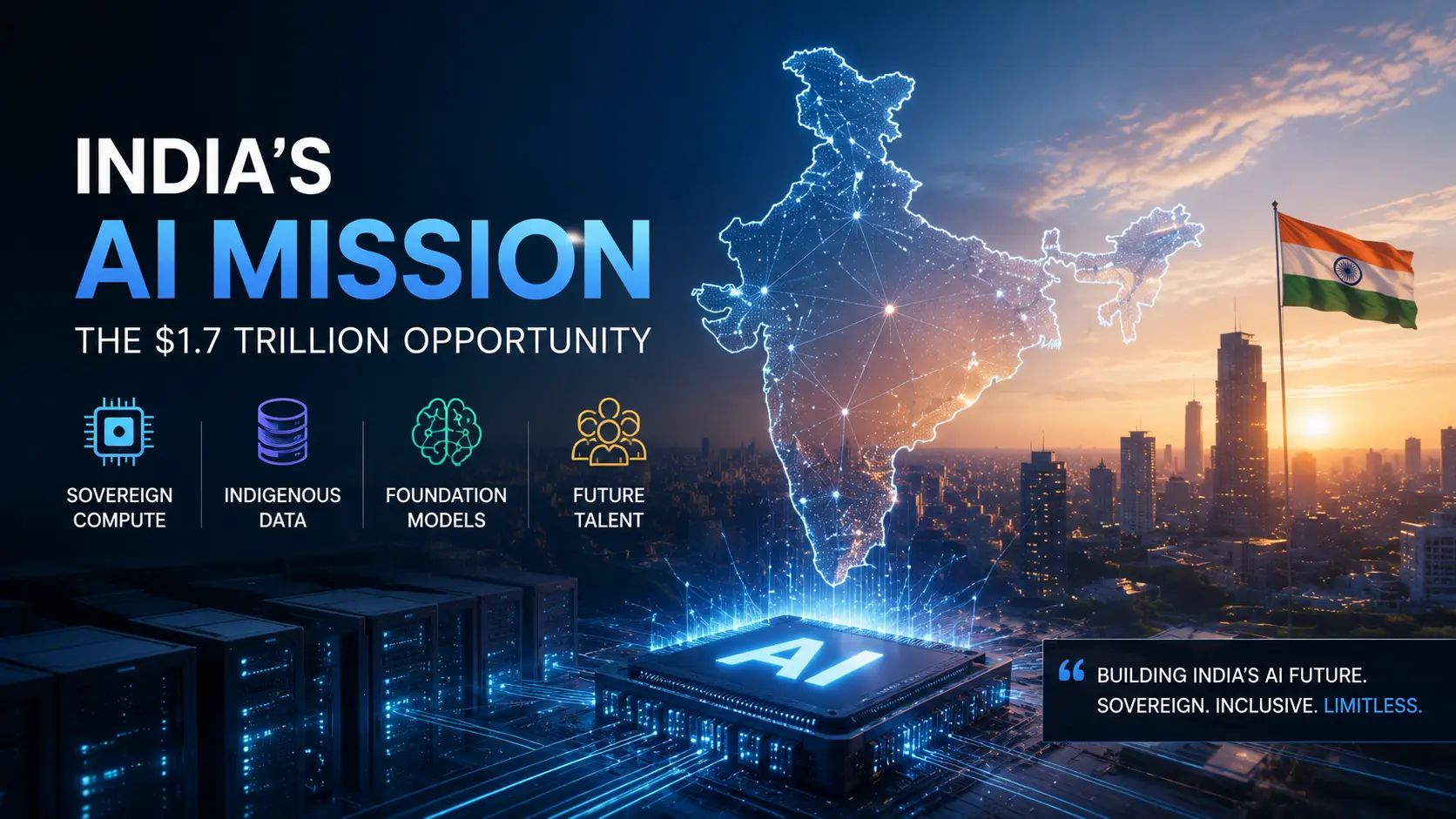
In today's global landscape, where artificial intelligence is transitioning rapidly from speculative lab experiments to foundational infrastructure, nations find themselves at a historic crossroads. Much like the personal dilemma between leaning on autonomous AI convenience or preserving mindful, deliberate methods of financial control — such as the classic Japanese Kakeibo technique — macro-economies face an identical systemic tension. Do they passively import black-box commercial algorithms from global hyper-scalers, or do they intentionally construct their own digital destiny? For a country of 1.4 billion citizens, the choice is clear. Passivity means economic dependency; intentionality builds a sovereign superpower. This is the strategic baseline behind the historic IndiaAI Mission, a multi-layered national initiative engineered to transform India's economic architecture and unlock a staggering $1.7 trillion opportunity by 2035. The core ethos of India's technological approach has always centered on democratization, scalability, and radical affordability. While Western frameworks often prioritize commercial optimization for deep-pocketed enterprises, the Indian approach treats cutting-edge technology as a critical public utility. By injecting strategic public capital, establishing robust physical layers, and standardizing access to computational assets, India is bypassing traditional pre-industrial constraints. Experts describe this phenomenon as a leapfrog directly into the "infinity era" — a paradigm where artificial intelligence stops being an elite privilege and starts functioning as a nationwide democratic multiplier across public services, healthcare, smart agriculture, and localized commerce.
Autonomous Compute Systems and Public Efficiency Infrastructure
To fully grasp how India intends to realize this trillion-dollar vision, one must look closely at the operational core of the IndiaAI Mission. The federal government originally established the mission with an overarching allocation exceeding ₹10,300 crore, deploying an aggressive ecosystem strategy based on specialized pillars. Rather than leaving the expensive physical infrastructure layer purely to private market forces, the state has actively intervened to level the playing field for homegrown developers, researchers, and early-stage startups. Central to this blueprint is the IndiaAI Compute Pillar. In the global tech space, computational power is the absolute bottleneck; graphics processing units (GPUs) have become the new digital gold. Recognizing this friction point, the mission has successfully onboarded over 38,000 GPUs into a unified infrastructure framework. To eliminate the prohibitive entry barriers that stifle young engineering teams, these high-end assets are heavily subsidized. Registered developers can access this sovereign compute infrastructure at a highly disruptive rate of just ₹65 per hour. This public intervention dramatically changes the innovation loop, transforming high-performance computing from a corporate luxury into an accessible public asset.
| IndiaAI Core Pillar Framework | Primary Strategic Focus & Infrastructure Asset | Measurable Operational Metric (Targeted Horizon) |
|---|---|---|
| IndiaAI Compute Infrastructure | Affordable high-end GPU clusters via public-private partnerships | 38,000+ GPUs onboarded; Subsidized rate of ₹65/hour |
| Application Development Initiative | Targeted solutions for critical India-specific structural challenges | 30+ core applications approved across healthcare, agri, & climate |
| AIKosh Dataset Platform | Unified non-personal repository for foundational training | 5,500+ datasets; 251 models; 385,000+ framework visits |
| Foundation Models & Sovereignty | Indigenous Large Multimodal Models (LMMs) via local languages | 500+ proposals; 12 elite startups/consortiums funded |
| IndiaAI FutureSkills Pipeline | Human capital scaling via localized labs and educational upgrades | 500 PhDs; 5,000 Postgraduates; 27 deeptech NIELIT labs |
Beyond raw computing power, an intelligence engine requires clean, representative data. The AIKosh Dataset Platform serves as the national data refinery. It gathers non-personal, multi-sector datasets from diverse government, academic, and non-government repositories. By late 2025, AIKosh had compiled more than 5,500 highly vetted datasets and hosted 251 distinct AI models spanning 20 specific socio-economic verticals. The platform has recorded over 385,000 platform visits and 26,000 direct developer downloads. This centralized infrastructure frees software builders from the exhausting, legally complex chore of scraping basic training data, allowing them to focus entirely on building high-value, localized application logic.
"True technological sovereignty cannot be achieved by simply consuming foreign models. India must own the physical layer, the foundational data layer, and the cognitive layer to ensure its economic growth remains resilient against global geopolitical shifts."
The Structural Cons and Risks of Unchecked Tech Importation
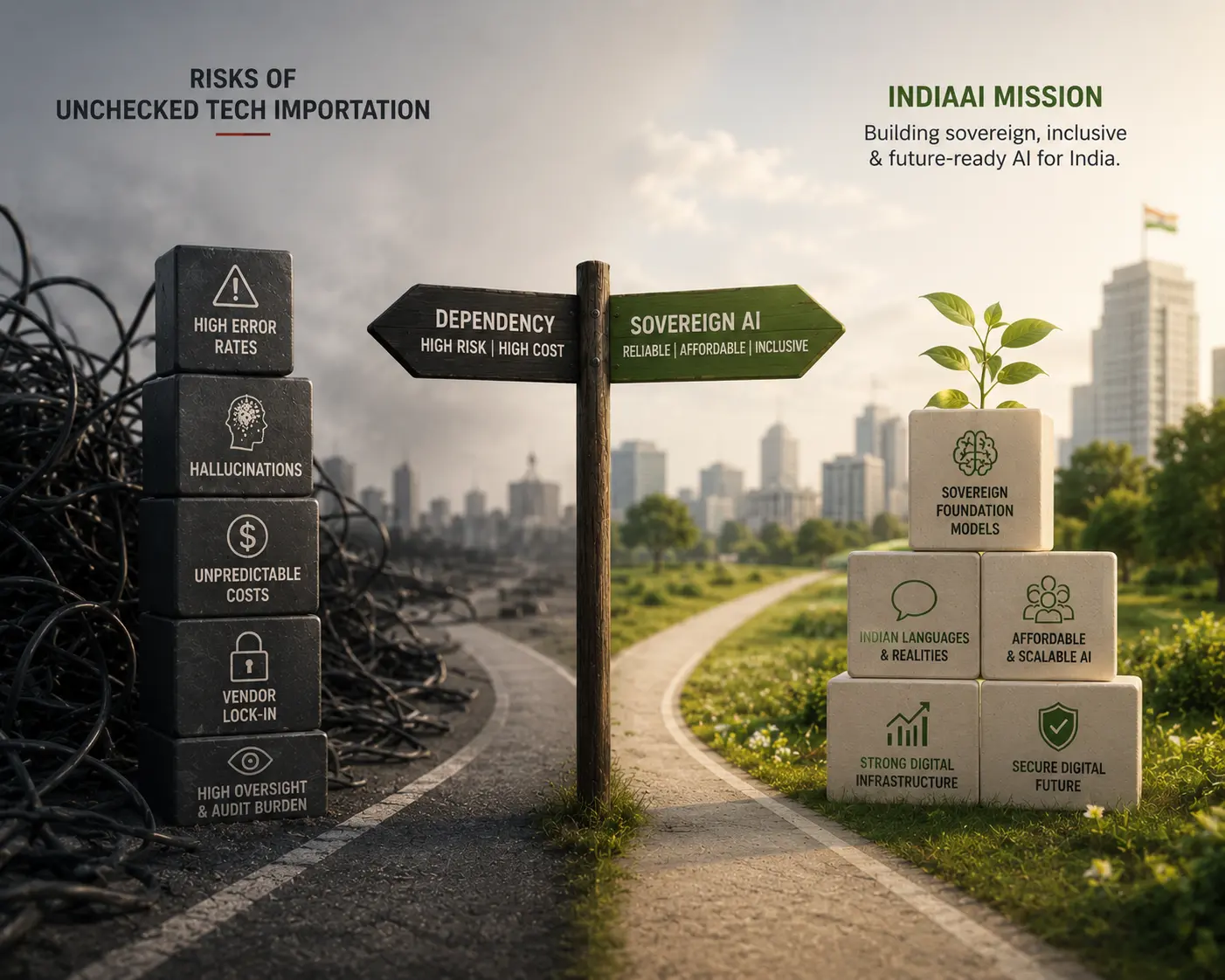
While the potential rewards are immense, the modern AI ecosystem presents significant systemic risks if left entirely unguided by sovereign frameworks. In commercial software markets, AI models are frequently prone to structural inaccuracies and high resource overheads. Recent engineering studies reveal that while major large language models offer sophisticated conversational experiences, they often struggle when applied to specialized, cross-functional business or public policy environments without heavy contextual tuning. In complex, multivariable workflows, standard out-of-the-box models show a structural error rate where deep prompts can yield a 65% accuracy variance — meaning roughly 2 out of every 5 complex outputs risk hallucination or miscalculation. In a domestic setting or a minor enterprise layout, a minor model error might cause nothing more than a passing inconvenience. However, when applied to national-scale financial infrastructure, critical diagnostic health programs, or macroeconomic agriculture forecasting, such structural margins of error can lead to massive losses, misallocated resources, and severe operational gridlock. Furthermore, an over-dependence on closed, foreign proprietary clouds traps local enterprises in an endless cycle of prompt tuning and unpredictable API licensing costs. This creates an administrative and financial burden, requiring constant human oversight just to audit and fix erratic model outputs. It is precisely to mitigate this vulnerability that the IndiaAI Mission stresses the development of indigenous Foundation Models, funding native pioneers like Sarvam AI, Soket AI, Gnani AI, and the BharatGen consortium led by IIT Bombay to construct sovereign, highly reliable Large Multimodal Models optimized specifically for Indian languages, realities, and price points.
Advertisement
The Seven Pillars: A Deep-Dive into Sovereign Architecture
To understand how this expansive network operates seamlessly, one must inspect the comprehensive seven-pillar strategy structured by the Ministry of Electronics and Information Technology (MeitY):
1. The Compute Groundwork: Deploying public-backed data centers capable of offering processing power as a utility to academic institutions, researchers, and emerging deep-tech firms.
2. The Application Development Initiative: Actively financing solutions tailored to clear national challenges. Key projects address early oncology detection, precision crop analytics for smallholders, automated vernacular legal translations, and adaptive climate modeling.
3. The AIKosh Open-Data Repository: Creating an expansive digital common where safely scrubbed, public-interest data remains accessible, reducing market concentration risks from tech monopolies.
4. Indigenous Foundation Models: Building core model weights from the ground up using local cultural contexts, regional idioms, and multiple official Indian languages to avoid cognitive monoculture.
5. IndiaAI FutureSkills: Grooming a massive wave of technical talent. This pillar explicitly funds 500 specialized PhD fellowships, 5,000 postgraduate tracks, and 8,000 undergraduate research initiatives, alongside establishing 27 deep-tech labs in Tier-2 and Tier-3 cities through NIELIT and local ITIs.
6. Safe & Trusted AI Frameworks: Structuring strict governance boundaries, standardizing model bias testing, and ensuring transparent guardrails to protect citizen data privacy.
7. The Startup Financing War-Chest: Running sector-specific hackathons, such as the CyberGuard AI challenge, and deploying capital to accelerate early-stage commercialization for deep-tech ventures.
By executing these seven vectors concurrently, the state ensures that the national technology strategy does not become fragmented. Each pillar reinforces the next: localized training from FutureSkills utilizes the subsidized hardware of the Compute Pillar to train on the open datasets of AIKosh, feeding new commercial startups supported by the Financing War-Chest.
Hardware Sovereignty: Budgetary Highlights and the 2047 Roadmap
A brilliant algorithm is entirely powerless without physical silicon and reliable electricity. The financial architecture formalized in recent Union Budgets highlights India's strategic push to secure the physical layer of the digital economy. The state has moved far beyond simple software promotion, aggressively expanding its domestic manufacturing capacity through the evolution of the India Semiconductor Mission (ISM) 2.0. Backed by a massive increase in the Electronic Component Scheme outlay to ₹40,000 crore, ISM 2.0 targets the high-value segments of the global value chain — focusing on raw equipment design, domestic material production, and the creation of full-stack Indian Intellectual Property. Furthermore, to convert the country into an attractive global data hub, the government introduced a landmark long-term tax holiday extending all the way to 2047 for global enterprises building advanced cloud data centers within Indian borders. By providing a 21-year period of fiscal certainty and establishing clear safe-harbor provisions, this ambitious policy encourages massive private capital inflows. It ensures that critical data infrastructure is physically built within the sovereign borders of India, protecting the nation's digital ecosystem from global supply chain shocks.
"Spend consciously on physical infrastructure, save intentionally on technological dependencies, and execute flawlessly on domestic manufacturing."
The Human-Centric Balance: Tech Utility vs. Social Mindfulness
At its core, India's grand AI strategy mirrors the fundamental philosophy of the traditional Kakeibo planner: tech utility must always be balanced with human intentionality. Just as a physical ledger forces an individual to pause, reflect, and spend mindfully, a nation's technology framework must prioritize human empowerment over blind, automated displacement. The ultimate goal of the India AI Mission is not to remove the human element from the economy, but to equip the country's workforce with a powerful cognitive force multiplier. By embedding artificial intelligence directly into school-level curricula, establishing specialized training frameworks for educators, and rolling out regional data labs, the state ensures that tech diffusion remains deeply inclusive. Whether it is a rural healthcare worker using an automated diagnostic tool to save lives or a small business owner leveraging agentic digital commerce networks to access global markets, the objective remains exactly the same. India is proving to the world that long-term macroeconomic success does not come from a passive reliance on foreign automated tech, but from building a proud, self-reliant ecosystem rooted in sovereign discipline and human-centric design.
Read Further
- Budget 2026-27 Announces the Launch of India Semiconductor Mission (ISM) 2.0 — Press Information Bureau, Government of India, February 2026
- Transforming India with AI: ₹10,300 Crore Mission, 38,000 GPUs — A Vision for Inclusive Growth — DD News
Disclaimer: References & Data Repositories: MeitY IndiaAI Knowledge Base, Union Budget 2026-27 Financial Blueprints, PIB Economic Releases (2025-2026). This content is intended strictly for informational and educational purposes and must not be construed as formal financial, investment, or policy advice.
Advertisement