

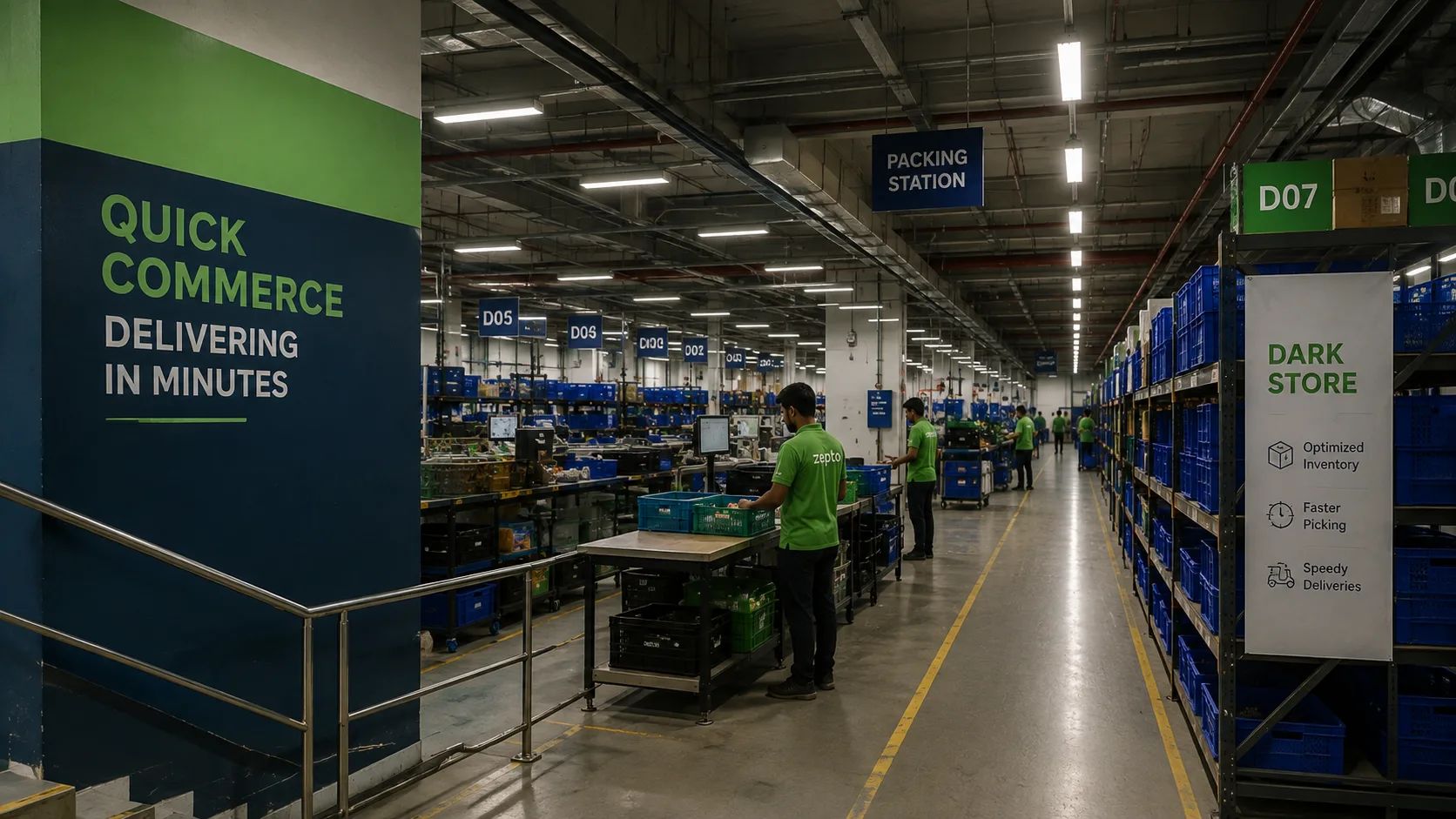
Everyone who is quantifying the Indian startup ecosystem in 2026 has definitely made the same underlying error. When market pundits, equity researchers, and tech journalists rave about the meteoric rise of quick commerce — the 10-minute delivery promise that has transformed Indian consumption — they care almost exclusively about the platform equity risk. They savagely dissect customer acquisition costs (CAC), discounting wars between Zepto, Blinkit, and Swiggy Instamart, average order values (AOV), and rider economics. They see the whole thing as just a digital, consumer-facing technology play. But when you scratch beneath the neon-hued app interfaces, you find a very different reality: the quick-commerce frenzy is fundamentally one of the most intense real estate arbitrage and capital structuring contests in recent Indian history.
By early 2026, even the most conservative projections estimate that the number of dark stores operating in India will have crossed 6,000, occupying millions of square feet of prime, hyper-dense urban real estate. These are not virtual nodes rolling around in the cloud — they're physical, tangible boxes necessitating significant capital investment in cold-chain infrastructure, stable power supply, and specialised loading bays. The grand illusion is that the tech platforms themselves are financing this physical footprint out of their venture capital war chests.
In reality, the heavy lifting of real estate acquisition, brownfield conversion, and ongoing capital structuring is being shouldered by a largely invisible layer of listed logistics developers, alternative investment funds (AIFs), and vehicles similar to REITs. While retail traders and venture capitalists lay bets on the unpredictable, money-losing end of platform equity, institutional money is quietly backing the physical at the other end, securing predictable yields.
This huge, silent transfer of wallet share is a key evolution in Indian commercial real estate. We are witnessing a clear bifurcation of "platform equity risk" (will Zepto beat Blinkit?) and "property yield risk" (will this 3,000-square-foot node in Koramangala generate a 7.5% cap rate no matter whose logo is on the door?). It doesn't play out in the tired tech narrative, but instead in the landlord's account book.
The Yield Disconnect: Cap Rates and Capital Structuring
To understand the dark-store financing mechanics, one needs to begin with an understanding of the significant shift in Indian commercial real estate yields. Historically, there was a strict pattern: premium Grade-A office space had the lowest, safest yields; high-street retail held a little bit higher yield with the added benefit of potential capital appreciation; and dusty, rural warehousing had the highest yields to compensate for associated risks and illiquidity.
Yet the micro-fulfilment craze has turned that long-held wisdom upside down. According to early 2026 data, traditional large-box logistics properties (similar to those in Bhiwandi or Jhajjar) are seeing their capitalisation rates tightening around 6.5%. Meanwhile, dark-store nodes — offering a locational premium closer to retail rather than the functional nature of industrial logistics — are achieving very attractive cap rates between 7.2% and 8.5%, depending on the specific lease structuring.
This is a deep cultural and spatial reorganisation. The original notion of warehousing in Indian tradition was akin to the Bazaar (बाज़ार) and its compatible Godam (गोदाम) — the English term "godown" is borrowed from the latter. These places were fixed, where goods steadily idled in place until they were required. The very derivation of the term logistics can be traced back to the ancient Greek word logistikos, meaning "skilled in calculating." Today's dark stores are the capital side of that calculus writ large. They're not passive godowns; they're urban, high-throughput kinetic points. Because they need specialised power backups for freezers, reinforced flooring for heavy racks, and rider staging space, the physical asset gets highly "sticky." Landlords understand that a quick-commerce platform can't just break a lease and move across the street without suffering catastrophic lost time and relocation costs. This stickiness gives institutional landlords immense leverage in negotiating yield.
As a result, there is a very interesting split in how financing is shaping up. The most common model is the sale-leaseback, in which a developer purchases a distressed retail or parking structure, retrofits the mechanical, electrical, and plumbing (MEP) infrastructure for dark-store use, and then leases it back to an operator such as Amazon or BB Now on a tightly locked 5-to-9-year term. What is entirely missed by the wider market is that more and more of these leases are including revenue-linked components. Instead of a flat fixed rent, performance-oriented AIFs will agree to take a base rent plus a micro-fraction of the gross merchandise value (GMV) flowing through that particular node. This means the real estate capital gets to play the upside of a neighbourhood's consumption density, not the customer acquisition costs of the platform.
"We don't see these now as real estate assets. We think of them as high-yield infrastructure bonds underwritten by the irresistible gravity of urban consumption. The platform is the tenant; the neighbourhood's craving for convenience produces the yield."
Deal Structure: A Four-Part Finance Framework
To finance a system of six thousand hyper-local logistics points, you need a level of institutional rigour well beyond that of a normal bank loan. The usual way for commercial real estate was painfully slow: a developer would buy a piece of land, get a regular construction loan, build a vanilla concrete box over three years, and then spend a year trying to find a tenant.
In the frenetic landscape of 2026 quick commerce, that legacy model is obsolete. Platforms require activating hundreds of nodes at once. To enable that, today's real estate capital structuring process is based on a highly compressed four-part process: Origination, Brownfield Conversion, Dynamic Lease Structuring, and Securitisation.
Phase One — Origination is no longer about finding a piece of open land, but rather an exercise in urban decay mapping through algorithms. Expert proptech teams comb through densely packed pin codes for "stranded assets" — shuttered single-screen cinemas, defunct car showrooms, underground parking garages, and disused banquet halls.
Phase Two — Brownfield Conversion is where the capital heavy-lifting occurs. Traditional retail needs aesthetic capex (glass façades, lights); dark stores need industrial capex. Institutional landlords are investing capital to improve grid connectivity, install industrial-grade HVAC and cold-chain backups, and strengthen buildings to hold deeper racking. The conversion cost per square foot has increased gradually, but it is precisely this high bar to entry which protects the landlord's yield from novice competition.
Phase Three — Dynamic Lease Structuring is where the actual financial development takes place. Performance-oriented AIFs today are embedding IoT (Internet of Things) throughput sensors directly into the lease contract. If a particular Swiggy Instamart node crosses a certain daily orders threshold, the rent automatically ratchets up via a digital smart contract. Conversely, if order velocity drops below a certain threshold, the platform gets a minor rebate, sharing the seasonal volatility risk.
Phase Four — Securitisation is the exit or yield-harvesting mechanism. After a portfolio of 50 or 100 dark stores is established and producing cash-flow, the originating developer bundles these assets and sells them into a logistics REIT or a yield-focused AIF, recycling the capital to finance the next wave of conversions.
Advertisement
"You cannot underwrite a 10-minute delivery node with a 10-year static mindset. The lease must breathe with the throughput of the warehouse; while the platform is processing a thousand orders an hour, the landlord's ledger must capture that velocity in real-time."
Institutional Pioneers: Who Holds the Paper?
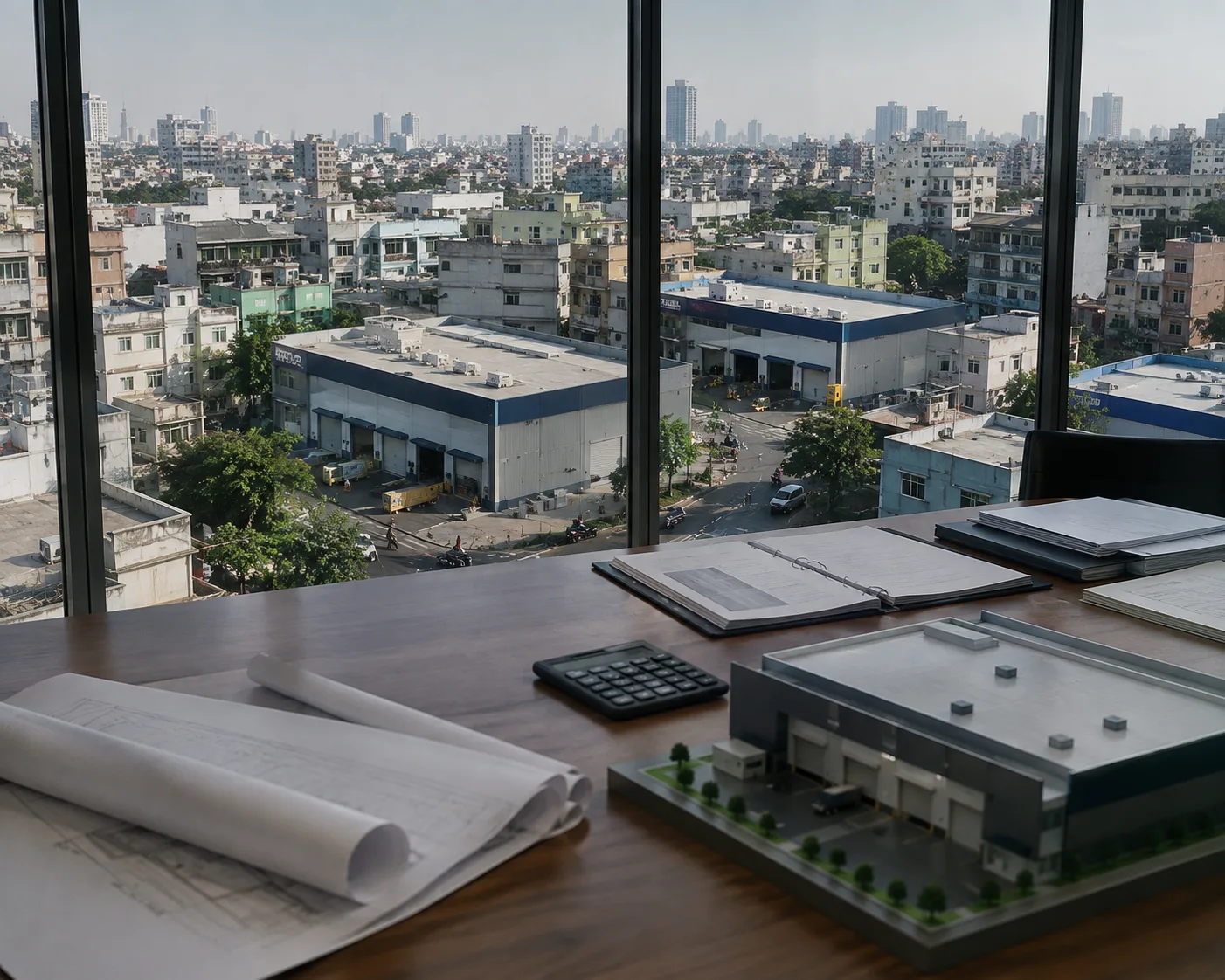
If the quick-commerce platforms are the colourful frontend of this boom, then who holds the money in the backend? The 2026 financier landscape is very niche. Two or three years ago, large-format industrial developers such as IndoSpace, Welspun One, and ESR India largely concentrated on giant multi-million square foot Grade-A logistics parks at the city's edge — venues for 18-wheeler trucks, not electric scooters.
However, as the logistical centre of gravity moved from the margin into the hyper-local core, these institutional giants needed to reposition. They started creating specific "urban logistics" and "micro-fulfilment" vehicles within their overall fund structures, understanding that a 5,000 square foot node in the centre of South Delhi could earn a premium that would justify the severe headaches of operations.
We are also seeing the silent but aggressive entry of specialised warehousing funds and REIT-like vehicles. While big office REITs like Embassy or Mindspace have historically dominated the headlines, a new generation of private logistics trusts is scooping up these stabilised dark-store assets — the ultimate consolidators who don't want the risk of build or brownfield conversion; they want the stabilised, frozen cash flows. When a developer completes the conversion of a closed retail plaza into a high-density Blinkit hub, it is these specialised funds that come in to do the sale-leaseback, unlocking the developer's balance sheet.
We need to dissociate this dynamic from just a generic "logistics is growing" storyline. The underwriting schemes for these micro-nodes are a far cry from traditional warehousing. The primary risk in a large exurban warehouse is tenant default leading to long vacancy periods, because there are just a few players (such as Amazon or Flipkart) who need 500,000 square feet. But in the micro-fulfilment world, the ultimate commodity is the space itself. If Zepto leaves a fully-equipped 3,000 square foot node with heavy power and cold-chain intact, there will be a line of cloud kitchens, decentralised pharmacy distributors, and rival quick-commerce platforms waiting to pick up the lease in a matter of days. The institutional capital that owns the paper knows that the inherent value is in the zoning, the power grid connection, and the site — not the particular tenant that stands on it.
"We are not betting on which app will win the grocery war. We are betting that urban populations will never again tolerate waiting more than twenty minutes for toothpaste. The victor is irrelevant to the landlord; the rent is due on the 1st regardless."
The Dangers of Zoning: Risks and Limitations
It would be a serious misanalysis to describe this property financing environment as nothing but upside. The most immediate and existential threat to the dark-store model is not consumer demand, but the "Zoning Sword of Damocles." In 2026, tightly packed urban centres like Mumbai, Bengaluru, and Delhi are approaching a severe municipal reckoning. Dark stores exist in a legal grey zone: they are technically warehouses but are squeezed into spaces zoned for light retail or residential use. A growing volume of rider traffic, noise pollution from round-the-clock loading and unloading, and the strain that commercial refrigeration units put on local power grids have caused Resident Welfare Association (RWA) opposition to boil over. Municipal bodies such as the BMC in Mumbai and the DDA in Delhi are perpetually hovering over these nodes, threatening to re-zone them — which could mean costly relocations or disabling compliance upgrades, wiping out a landlord's yield spread in just months.
Platform consolidation resulting in stranded assets is another huge constraint. The space is currently held up by harsh venture capital, with widespread investor support subsidising multiple players in the exact same micro-markets. It is not uncommon to find a Blinkit, a Zepto, and a BB Now hub within a 500-metre radius of one another. But this could change overnight if macroeconomic conditions tighten and a wave of M&A sweeps the industry — in which case the newly merged company would be the first to "rationalise" its network, suddenly resulting in hundreds of highly specialised, high-capex properties re-entering the market all at once.
High maintenance capex is the third structural constraint. Unlike a conventional warehouse which is basically a passive concrete shell, a dark store is a living machine. Continuous movement of goods, very high staff turnover, and operational stress on cold-chain infrastructure result in acceleration of asset degradation. Landlords who execute plain vanilla sale-leasebacks without factoring in accelerated deterioration end up haemorrhaging cash on structural repairs and MEP refurbishments. The institutional capital that wins in this space is the capital that views real estate management as a real-time, technology-enabled operations discipline, not a passive rent-collection game.
"A perfectly modelled discounted cash flow is worth nothing if the local municipal corporation padlocks your node for violating a residential zoning ordinance. The biggest risk to yield is not market competition; it's local bureaucracy."
The Final Tally
As the dust settles on the great delivery wars, a clear hierarchy of capital is forming. The VCs and retail equity traders will keep riding the stomach-churning volatility of the tech platform, constantly pivoting between narratives of market dominance and cash-burn anxiety. But beneath the din, the structural underpinning of Indian commerce has been irreversibly rewired.
More than 6,000 dark stores sprawled across the country are no longer just a logistics experiment — they are a new, hugely lucrative asset class in commercial real estate. The institutional funds, specialised developers, and REITs that cracked the code on brownfield conversion, navigated the municipal zoning labyrinths, and pioneered dynamic, revenue-linked lease structures are the true, silent victors.
By fully decoupling the delicate equity risk of the platform from the resilient yield risk of the property, they have engineered a business model that turns the chaos of quick commerce into solid, predictable, high-yield infrastructure dividends. The apps may change, the logos may be rebranded, and the platforms may merge. But the neighbourhood still demands the physical closeness with which it has long been satisfied.
Read Further
[1] CBRE India. India Logistics Market Outlook 2026 — Quick-Commerce and New-Age Warehousing Trends — Click here
[2] SEBI. Real Estate Investment Trusts (REITs) Regulations — Legal Framework for Securitisation of Logistics Assets in India — Click here
Disclaimer: All of the above data was obtained from publicly accessible online sources and research. This should not be considered as professional financial, medical, or legal advice.
Advertisement