

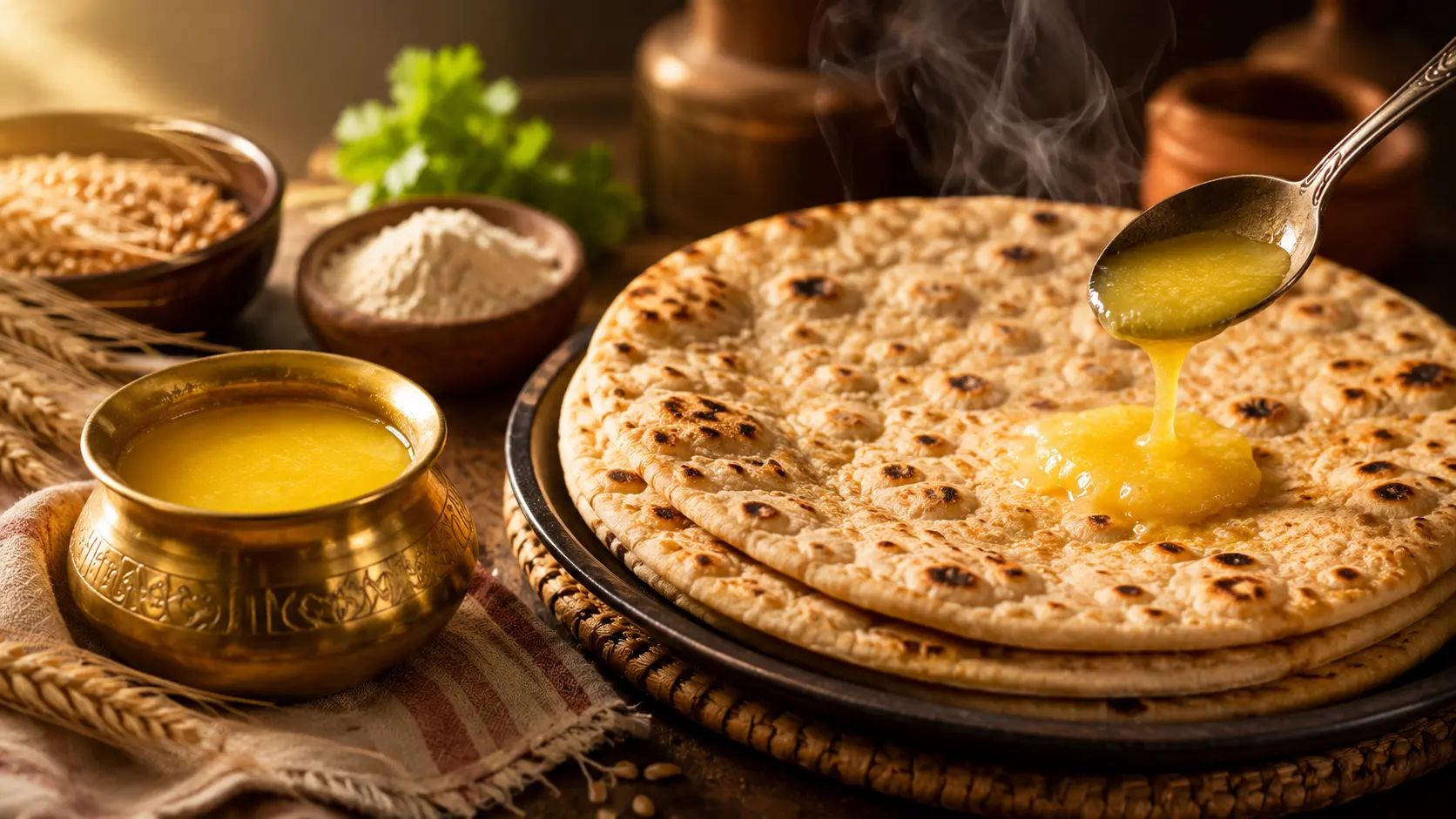
Across modern fitness culture, the dry whole-wheat roti has become an unquestioned symbol of dietary discipline. In the race to minimize daily caloric counts, ghee is routinely the first casualty to be scraped off the dinner plate. The assumption seems intuitively sound: eliminate dense lipids, save 45 calories per roti, and accelerate fat loss.
Biochemical and clinical metabolic research, however, reveals a starkly different reality.
Consuming whole-wheat flatbread dry is often a metabolic misstep for blood sugar stability and micronutrient absorption. When evaluated through the mechanics of gastric emptying, digestive enzyme kinetics, and intestinal transport, applying a measured teaspoon of pure desi ghee to a fresh roti is not an indulgence — it is a sophisticated biochemical strategy that optimizes glucose tolerance, enhances fat-soluble vitamin uptake, and nourishes the gastrointestinal lining.
Glycemic Index Moderation and Insulin Dynamics
The primary mechanism through which ghee optimizes the nutritional profile of a whole-wheat flat bread lies within the physics of gastric emptying and macronutrient interaction. A dry flat bread is composed primarily of complex carbohydrates in the form of starches. When ingested entirely on its own, the enzyme salivary amylase rapidly initiates the breakdown of these starches into glucose chains, a process that accelerates significantly once the bolus hits the small intestine.
According to clinical metabolic studies, wheat-based flat breads possess a moderate-to-high Glycemic Index (GI). When consumed dry, they cause a relatively sharp spike in postprandial blood glucose levels. This rapid influx of glucose forces the beta cells of the pancreas to secrete a corresponding surge of insulin to facilitate cellular uptake. The subsequent physiological equation is predictable: ΔGlucose → ↑Insulin → ↓Energy, leading to the notorious mid-afternoon energy crash and a premature return of hunger cues.
"Smear consciously to regulate metabolically; true satiety is built on structural synergy, not caloric deprivation."
When you introduce a precise layer of ghee to the flat bread, you fundamentally alter this timeline. Ghee is an incredibly rich source of pure lipids, particularly short-chain and medium-chain fatty acids. Lipids act as a natural brake on the digestive tract. The presence of fat in the duodenum triggers the release of cholecystokinin (CCK) and enterogastrone, hormones that slow down gastric motility and delay stomach emptying. Consequently, the breakdown of wheat starches is metered over a significantly longer period. Instead of a steep glycemic spike, the bloodstream experiences a controlled, linear release of glucose, sparing the pancreas from excessive insulin demands and stabilizing systemic energy curves.
Enhanced Bioavailability of Fat-Soluble Micronutrients
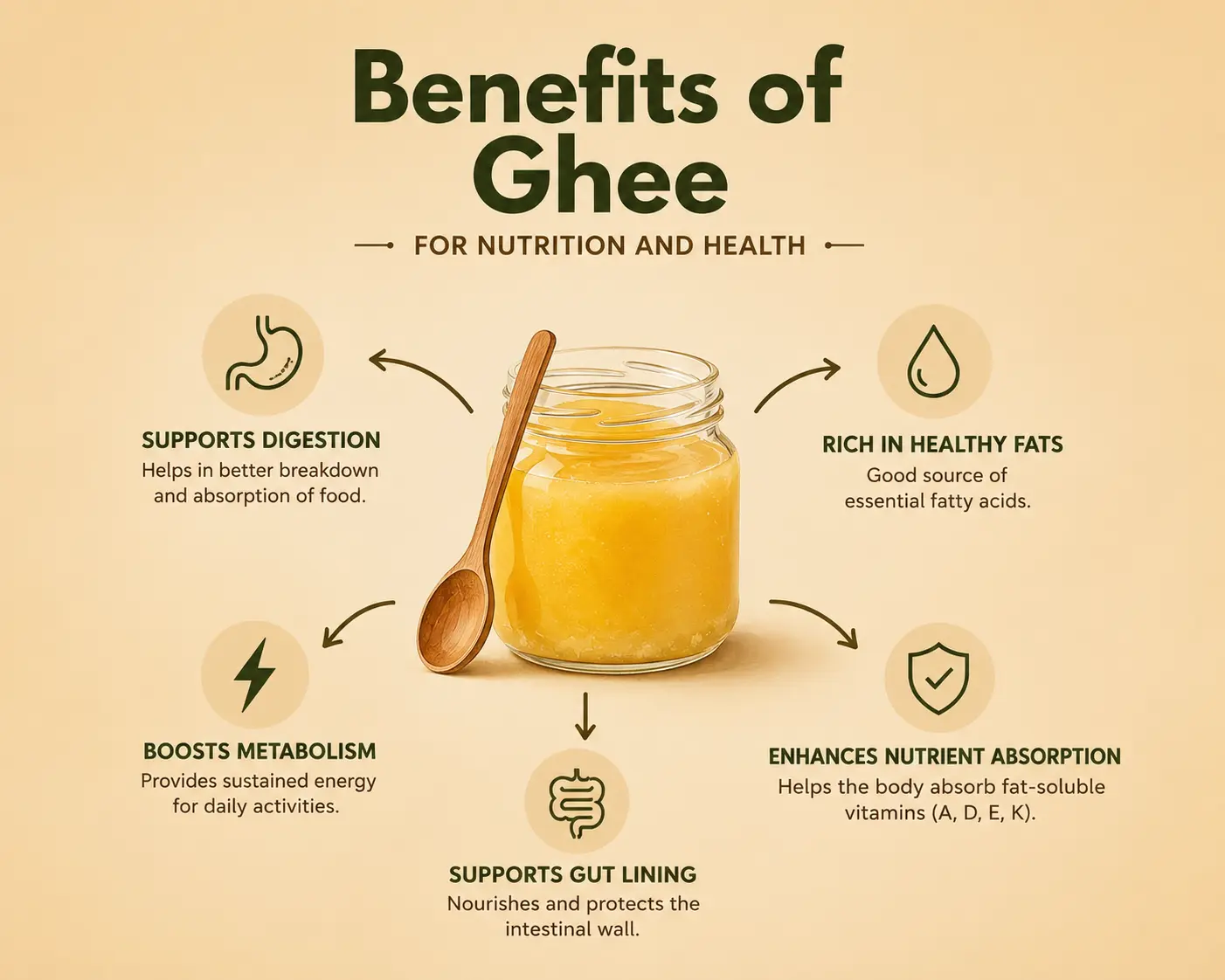
A common pitfall of modern dry dieting is the structural failure to absorb what we actually consume. Whole grain flour utilized in traditional rotis is naturally rich in vital micronutrients, trace minerals, and essential fat-soluble vitamins. However, the human body operates on a strict chemical hierarchy regarding nutrient assimilation: without a lipophilic transport vehicle, fat-soluble vitamins cannot pass through the aqueous unstirred mucus layer of the intestinal microvilli.
Ghee provides the exact lipid matrix required to unlock this latent nutritional potential. It contains high-density concentrations of naturally occurring fat-soluble vitamins, notably Vitamin A, Vitamin E, and Vitamin K2, while simultaneously acting as a solvent for the micronutrients present within the grain itself. When these elements are bound within a lipid emulsion, they form mixed micelles during digestion. These micelles effortlessly diffuse across the epithelial membranes of the small intestine, maximizing systemic bioavailability.
The Lipophilic Absorption Matrix Without adequate fat co-ingestion, up to 65% of fat-soluble micronutrients pass through the gastrointestinal tract entirely unabsorbed. This calculates to nearly 2 out of every 5 meals failing to deliver their micro-nutritional payload, resulting in sub-clinical deficiencies despite eating theoretically "clean" whole foods. Adding a structured lipid medium satisfies the exact chemical prerequisites for epithelial cellular transit.
Advertisement
Furthermore, traditional ghee contains high levels of Butyric Acid — a short-chain fatty acid (C₄H₈O₂) that serves as the primary fuel source for the colonocytes lining the large intestine. By introducing exogenous butyrate alongside the prebiotic fibers in whole wheat, you actively nourish the gut lining, reinforce tight junctions, and mitigate localized inflammation. This unique interaction turns a simple carbohydrate vehicle into an active therapeutic agent for gastrointestinal integrity.
Neutralizing Anti-Nutrients via Lipid Coupling
An overlooked dimension of whole grains is the presence of phytic acid (myo-inositol 1,2,3,4,5,6-hexakisphosphate), a naturally occurring storage form of phosphorus found in seeds and grains. Phytic acid acts as a potent anti-nutrient; its chemical structure allows it to bind tightly to essential minerals like iron, zinc, calcium, and magnesium within the digestive tract, forming insoluble precipitates that the human body cannot break down or absorb.
While traditional preparation methods like fermentation, kneading, and resting the dough partially activate the enzyme phytase to break down this anti-nutrient, significant quantities often remain in the final cooked flat bread. When a flat bread is eaten completely dry, phytic acid has an open pathway to chelate with other dietary minerals present in your stomach. However, the introduction of clarified butter introduces short-chain fatty acids that actively modulate the internal pH of the gastric chyme. This structural shift, combined with the protective lipid coating over the mucosal barrier, helps optimize mineral ionization, allowing the body to intercept and absorb trace minerals far more effectively than it could under dry, high-phytate conditions.
This anti-nutrient dynamic is also central to why grain-heavy diets without adequate fat co-ingestion can silently drive mineral deficiencies — an issue explored in depth in 84% of Indian Vegetarians Are Protein Deficient. Here's What Your Thali Is Missing.
The 1-Teaspoon Rule: Practical Portions & Smoke Point Stability
While the metabolic advantages of pairing ghee with complex carbohydrates are substantial, the law of caloric density remains non-negotiable. Pure ghee contains approximately 45 calories and 5 grams of lipids per level teaspoon (5ml).
Optimal Dosage Guidelines:
- 1 Teaspoon Per Major Meal: Applying half a teaspoon to one teaspoon across one to two rotis provides sufficient short- and medium-chain fatty acids to trigger CCK release and blunt postprandial glycemic spikes without overwhelming the meal's caloric budget.
- Thermal Stability: With a high smoke point of 250°C (482°F), traditional bilona ghee does not degrade or produce toxic lipid peroxides during contact with steaming flatbreads, unlike unstable polyunsaturated vegetable oils.
- Satiety Signaling: By prolonging gastric transit, a ghee-brushed roti delays the return of ghrelin (the hunger hormone), significantly reducing the urge for mid-afternoon snacking or refined sugar cravings.
Read Further
Disclaimer: All technical data, structural breakdowns, and physiological studies referenced in this article were synthesized from verified nutritional science literature and clinical metabolic research, including peer-reviewed sources indexed in PubMed and Frontiers in Nutrition. This content is provided for educational and analytical purposes and should not be construed as direct medical or clinical dietary advice. Consult a qualified physician or registered dietitian before making significant dietary modifications.
Advertisement