

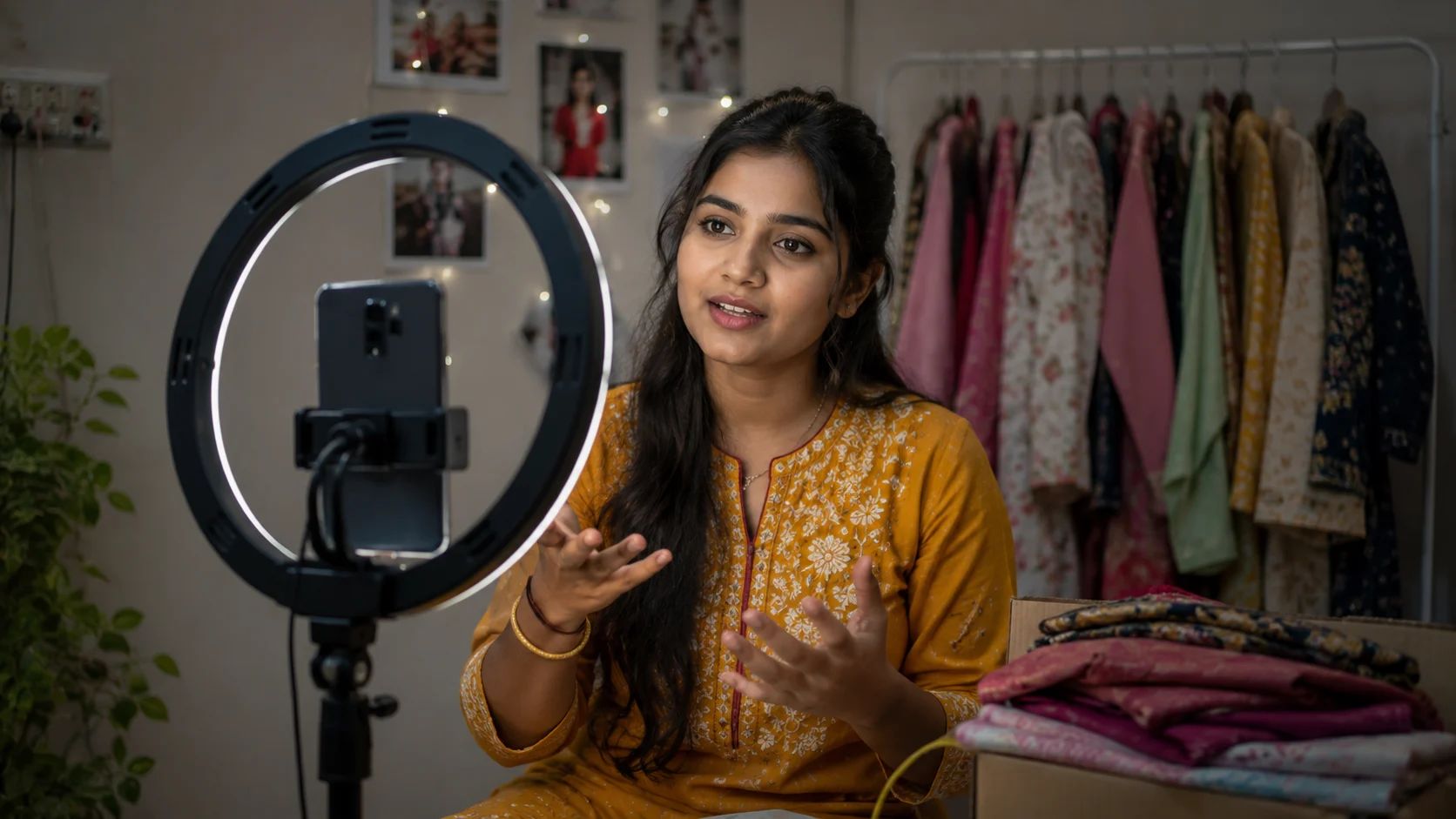
In today's landscape where algorithms dictate the flow of modern commerce and human attention, India's creator economy is witnessing an intense, unprecedented structural migration. For over a decade, digital influence was viewed as an elite, ultra-exclusive metropolitan club — an ecosystem strictly dominated by urban creators with high-end mirrorless setups, glossy aesthetic backgrounds, and direct geographic access to premium agency partnerships in Mumbai, Delhi, and Bengaluru. However, as deep mobile internet penetration hit saturation across Bharat and low-cost 5G handsets became universally accessible, an alternative digital paradigm exploded. Tier 2 and Tier 3 cities became the structural engines of a new volume-driven movement, generating an expansive demographic of aspiring professionals chasing the ultimate digital dream through a simple, handheld screen. This decentralized explosion has successfully minted upwards of 50,000 active 'creators' across regional hubs like Patna, Indore, Surat, Lucknow, and Jaipur. These small-town storytellers are rapidly re-architecting the very meaning of cultural resonance, bypassing traditional regional gatekeepers to amass staggering, dedicated follower bases. Driven by local dialects, authentic household struggles, and hyper-relatable comedy, their content routinely outpaces metropolitan lifestyle blogs in baseline engagement metrics. Yet, behind this magnificent illusion of democratic viral stardom lies an incredibly harsh, deeply unyielding structural bottleneck. The rapid industrialization of short-form media has created a steep, highly polarized pyramidal landscape where online fame and cultural visibility completely fail to translate into sustainable, real-world financial viability.
"The influencer industry spent its first decade chasing scale. In today's landscape, that equation is complicated by an unyielding parameter: resonance. While a small-town creator can command unprecedented trust, the macroeconomic architecture behind monetization is broken for almost 90% of the long-tail ecosystem."
Deconstructing the Macroeconomic Machine: Engagement vs. Monetization
The structural paradox of regional digital influence lies entirely within the fundamental dislocation between attention metrics and absolute monetary value. To understand why 50,000 creators in Tier 2 India are struggling, one must analyze the stark contrast in engagement dynamics. Recent industry studies reveal that while metropolitan creators sustain a flat average engagement rate of 3% to 4%, creators operating out of Tier 2 cities boast engagement rates ranging from 3.5% to 4.5%, climbing to a remarkable 4.5% to 5.5% in Tier 3 and Tier 4 territories. Audiences in regional India do not merely consume content passively; they demonstrate an intense, hyper-loyal community attachment that translates into high trust and exceptional organic conversion rates. Brands have noticed this operational shift, leading to a massive increase in regional and vernacular briefs. However, this intense cultural resonance encounters an immediate structural failure when encountering brand budget allocations. Despite regional creators accounting for nearly 35% to 40% of the overall audience engagement volume across modern multi-platform ad campaigns, they command a miserable 8% to 20% slice of the total influencer marketing spend. The financial benchmark prices tell a grim, highly asymmetric story. While a macro-influencer based in a tier-1 city can command premium retainers, a small-town nano-creator (holding between 1,000 to 10,000 followers) is forced to execute short-form brand integration briefs for as low as USD 6 to USD 60 per asset. Micro-creators holding up to 100,000 followers rarely cross the USD 30 to USD 970 threshold per dedicated integration, rendering it practically impossible to build a structurally viable business or establish a baseline livelihood solely from brand revenue.
The Macroeconomic Divergence: A Comparative Breakdown
- Total Active Creator Base across India: 4.0M – 4.4M Professionals
- Instagram Infrastructure Penetration: 3.3M – 3.7M Accounts
- Tier-2 Minted Hyper-Active Segment: ~50,000 Creators
- Average Engagement Rate (Metro Cities): 3.0% – 4.0%
- Average Engagement Rate (Tier 3 & 4 Cities): 4.5% – 5.5%
- Regional Influencer Marketing Budget Share: 8% – 20% (Max)
- Proportion of Creators Earning a Stable, Viable Income: Less than 12%
The Invisible Chore: Algorithmic Overdrive and Content Inflation
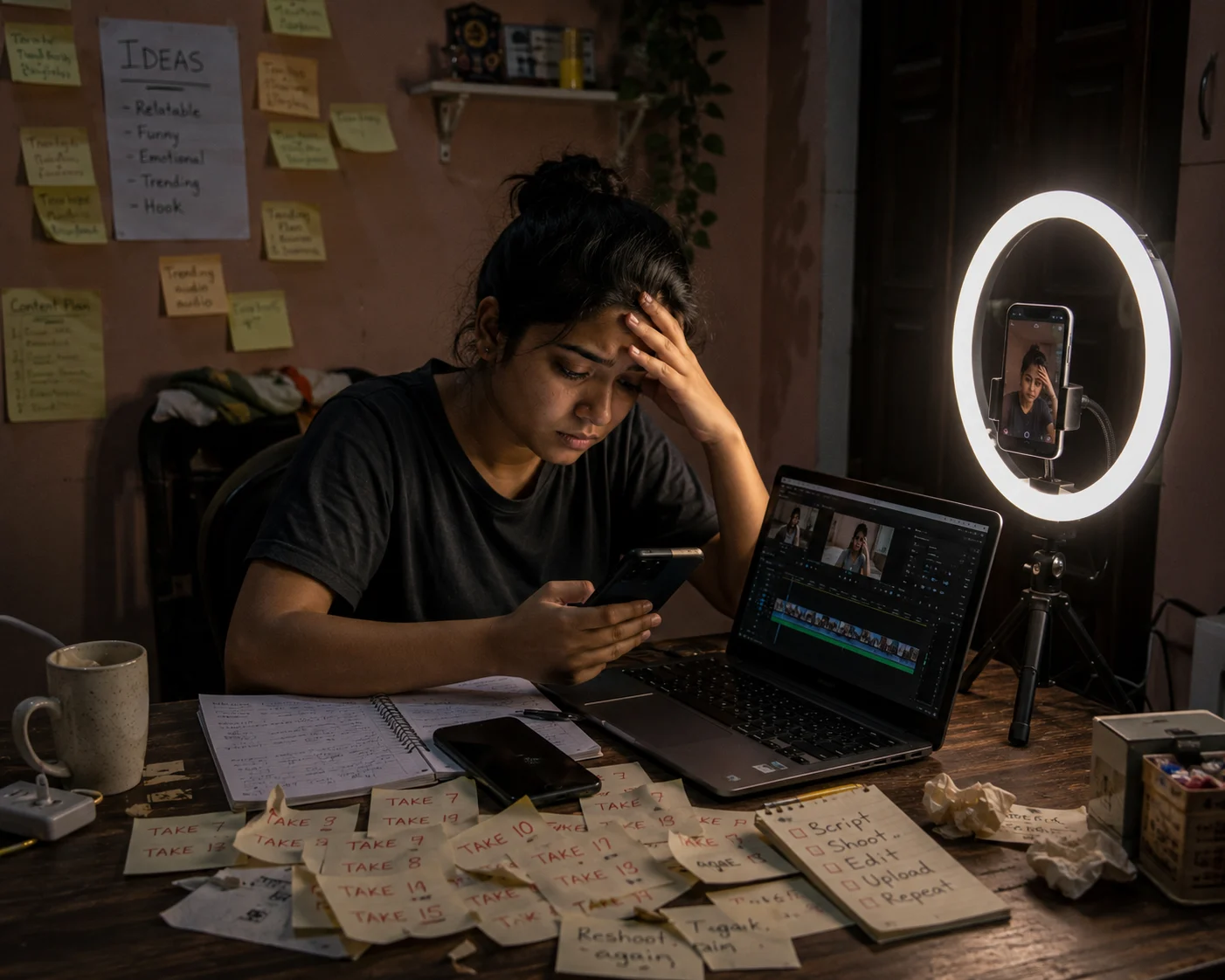
For the thousands of individual creators operating within small-town environments, the daily routine of short-form production transforms into an endless, exhausting chore. Unlike professional production houses, these independent individual creators, who hold an estimated 56.6% dominant share of the structural creator market, function as isolated, single-person entities. The process is characterized by intense, manual hyper-repetition: a creator operates within a confined domestic space, dealing with a single dying smartphone, a basic low-cost ring light, and zero external technical assistance. To satisfy the relentless velocity of short-form algorithms, they must write, shoot, edit, and reshoot the exact same content assets twelve to fifteen times to secure a brief window of algorithmic visibility. This setup triggers a brutal form of content inflation. Because platforms prioritize high-frequency consistency, regional creators are forced into an unyielding, high-volume production cycle. Giving continuous prompts to basic mobile editing applications, keeping track of hyper-fickle trending audio clips, and constantly adjusting content formats becomes a tiresome, high-stress chore that consumes massive intellectual and emotional capital. Yet, this intense labor yields highly volatile, deeply inconsistent rewards. The algorithmic architecture is built on variable payout patterns and unpredictable reach drops, turning the dream of a creative career into a highly stressful, exhausting loop. The mental toll manifests directly as severe professional burnout, persistent anxiety, and massive headaches, forcing many to realize that the digital gold rush functions more like an uncompensated, high-volume attention factory.
Advertisement
"Behind every viral, high-spirited regional Reel is an exhausting cycle of twelve reshoots, a heating low-end device, and a creator trapped in a relentless loop of content inflation — running faster and faster just to see their monetization metrics stand entirely still."
The Institutional Divide and the Illusion of the 'Middle-Class' Creator
The true systemic crisis plaguing the structural expansion of India's creator economy is the complete, absolute absence of a stable "middle-class" creator segment. In a healthy, mature corporate or creative ecosystem, there exists a sustainable middle tier that earns a reliable, predictable livelihood, separating the top-tier elite from the entry-level amateur base. However, the short-form economy bypasses this structural stability entirely. The financial landscape is heavily polarized: a minuscule 12% slice of the active creator base captures the overwhelming majority of commercial brand deals and platform monetization payouts, while the remaining 88% are left completely exposed to financial instability, surviving on irregular compensation, barter arrangements, or zero pay.
This divide is further widened by the rapid, uneven institutionalization of the broader market. The modern influencer space is entering its formal corporate age, with the macro influencer marketing sector projected to hit INR 5,000 Crore by 2027. A growing segment — roughly 15.2% of highly capitalized active creators — has formalised operations by registering as official business entities or individual GST taxpayers, allowing them to leverage corporate networks and secure direct agency retainers. Conversely, the 50,000 creators minted in Tier 2 India remain largely unorganized and structurally isolated. They operate entirely outside formal legal protections, lacking standard pricing frameworks, formal contracts, or transparent monetization pathways. This leaves them highly vulnerable to aggressive exploitation by mid-tier aggregator agencies who extract maximum audience engagement while offering negligible financial returns.
Algorithmic Automation and the Path Toward Structural Correction
As the traditional mechanisms of human brand curation fail to distribute financial rewards equitably, technology is beginning to intervene in highly complex, dual-faceted ways. Modern creators are increasingly turning to advanced automation, with over 59% of active professionals regularly implementing basic artificial intelligence and automated systems into their daily production pipelines. The structural adoption metrics indicate that AI-driven content ideation leads the wave at 64.4%, followed closely by automated creative design at 31.9% and real-time algorithmic trend analysis at 28.1%. These digital tools are designed to streamline production, allowing small-town creators to minimize manual editing overhead and optimize their output efficiency to stay competitive within the aggressive digital landscape. However, automation alone cannot fix a fundamentally broken commercial distribution model. For India's regional creator economy to achieve long-term viability, the entire corporate ecosystem must undergo a systematic transformation. Brands must evolve beyond crude follower volume matrices and construct sophisticated, hyper-local attribution models that accurately calculate the real conversion value of regional resonance. Regional creators must also aggressively organize into localized digital collectives or formal micro-enterprises to build collective bargaining power against predatory intermediaries. Until these structural and financial corrections are deeply institutionalized across the sector, the Reels economy will continue to function as an asymmetric lottery — minting thousands of visible regional stars while quietly exploiting the digital aspirations of small-town India.
Read Further
- India's Creator Economy: Hope, Hype and Hard Truths — Deccan Herald (citing BCG's "From Content to Commerce" report)
- India's 3.5–4.5 Million Creator Economy Powers ₹3,500 Crore Influencer Marketing Industry Growth — Kofluence "Decoding Influence" Report 2025, via Business Standard
Disclaimer: All the structural data, financial estimates, and macroeconomic metrics provided within this comprehensive article were synthesized from contemporary internet resources, industry research reports, and localized creator studies. This analytical document should not be taken as a direct financial quote from our website or structured professional business advice.
Advertisement