

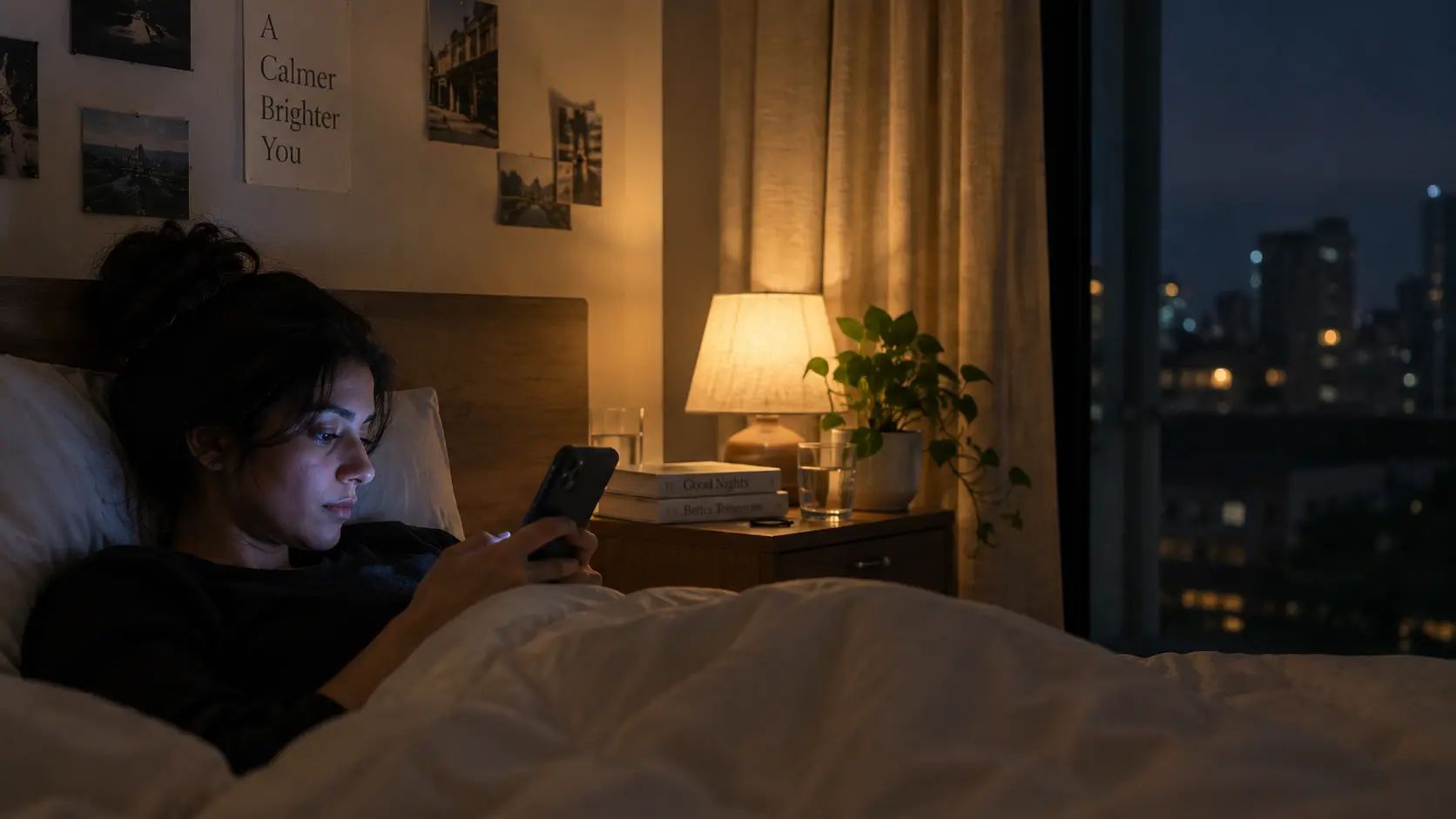
It is 11:34 PM. The apartment is quiet save for the hum of the refrigerator and the distant muffled swish of highway traffic outside your window. You told yourself you would be asleep by 11:00 PM tonight. You have a presentation at work tomorrow morning, an 8:30 AM team sync, and a lingering sense of fatigue that has settled into your shoulders over the past three weeks. Here you are, lying flat on your back in a dimly lit bedroom, your face illuminated by the cool bluish glare of a 6.1-inch OLED screen.
Your thumb is performing a motion so practised, so automatic, that it operates independently of thought: a vertical flick upward, followed by a momentary pause, followed by another flick. A TikTok video of a stranger organising their pantry gives way to a breaking news thread on Twitter, which cascades into an Instagram carousel of an acquaintance's vacation in Portugal, which loops back into a Reddit discussion board analysing a movie you haven't seen in five years. You aren't even enjoying yourself. There is no joy in this consumption; there is a strange, dull compulsion — an invisible tether holding your attention captive.
You look at the clock again. It is now 12:15 AM. A familiar surge of guilt and low-grade panic prickles behind your ribs. "I have to stop," you tell yourself. "If I fall asleep now I will only get five hours and fifteen minutes of rest." Instead of locking the phone and placing it on the nightstand, your thumb flicks upward once more. Another video begins to play.
If this scenario feels uncomfortably familiar, you are far from alone. Across industrialised societies, the final hour before sleep has been systematically colonised by technology companies whose business models depend entirely on capturing and retaining human attention. According to data compiled by Nielsen and industry research group Data.ai, the average adult spends upwards of 3 hours and 15 minutes interacting with devices every single day, with a significant concentration of heavy usage occurring between 9:00 PM and midnight. We are attempting to wind down our systems in an environment engineered to keep them in a state of high-alert engagement.
The conventional advice offered to people struggling with late-night screen time is as well-meaning as it is utterly useless: "Just put your phone in another room," "Have willpower," or "Read a physical book instead." These suggestions treat a neurobiological design problem as a simple matter of moral failing. When you inevitably fail to maintain a digital blackout after a gruelling twelve-hour workday, you internalise that failure as a personal defect, convincing yourself that you lack discipline.
This article explores a different approach. We are not going to pretend you can throw your phone into a drawer at 8:00 PM and live like a 19th-century monk. Modern life is complex, interconnected, and demanding; our phones are tools, communication nexuses, and logistical hubs. Instead, we are going to build a sustainable digital wind-down routine based on the principles of environmental friction, habit replacement, and strategic compromise. By acknowledging how variable-reward loops operate in our brains and restructuring our evening environment, we can reclaim our nights without throwing our devices out the window.
Why "Just Use Less" Fails: Cues, Convenience and Variable-Reward Scrolling
To understand why telling yourself to "just use less" is a losing battle, we must first examine the architecture of digital products. Applications like TikTok, Instagram, YouTube Shorts, and X (Twitter) are not passive utilities like a calculator or a weather app. They are behavioural modification systems designed by teams of behavioural psychologists, data scientists, and user-experience engineers whose explicit objective is to maximise "time on device."
At the core of this engineering is the concept of the variable-ratio schedule of reinforcement — the psychological mechanism that makes slot machines so addictive. In B.F. Skinner's behavioural experiments, laboratory pigeons pressing levers received food pellets on unpredictable schedules. Sometimes pressing the lever produced a reward; sometimes it produced nothing; sometimes it took ten presses. Skinner discovered that variable reinforcement schedules produced the highest rates of response and the greatest resistance to extinction. The animal keeps pressing because the next press might be the payoff.
Your smartphone operates on this principle. When you open your social media feed at 11:00 PM you do not know what you are going to get. The first swipe reveals a post from an acquaintance; the second swipe reveals a corporate ad; the third swipe delivers a hilarious video that triggers a sudden burst of dopamine. That unpredictable reward acts as a neurochemical trigger, reinforcing the neural pathway that connects "feeling tired or bored" with "reaching for the phone." Over months and years of repetition, this loop becomes an automated habit etched deeply into the ganglia.
The Role of Environmental Cues and Frictionless Access
Behavioural psychologist Dr. Wendy Wood, author of Good Habits, Bad Habits, has demonstrated through decades of research that human beings do not rely primarily on willpower to navigate life. Instead we rely heavily on cues and convenience. Willpower is a cognitive resource that depletes rapidly under conditions of stress, decision fatigue, and physical exhaustion — all of which peak precisely at the end of a long workday.
Consider the positioning of your phone during the evening hours. For most people, the phone rests on the sofa cushion beside them while watching television, sits on the dining table during dinner, and rests within arm's reach on the mattress — or even under the pillow — while trying to sleep. The friction required to access the device is zero. It demands zero movement, zero cognitive effort, and zero planning. In contrast, picking up a book requires sitting up, turning on a lamp, locating the bookmark, and engaging in cognitive processing. When the brain is tired it naturally follows the path of least resistance. Zero friction always wins against fatigue.
The Neurological Cost of Late-Night Blue Light and Cognitive Arousal
Beyond conditioning, late-night scrolling exacts a heavy toll on our physiological machinery. The human circadian rhythm is governed by intrinsically photosensitive retinal ganglion cells (ipRGCs) that contain the photopigment melanopsin. These cells are exquisitely sensitive to wavelength — specifically the high-energy visible blue light emitted by LED and OLED smartphone screens in the 460–480 nanometre range.
When light in this spectrum hits the retina at night, it signals the suprachiasmatic nucleus in the hypothalamus to suppress the pineal gland's production of melatonin — the neurohormone responsible for signalling biological night to the body. Simultaneously, the content we consume — news headlines, work emails, heated debates, dynamic video transitions — triggers micro-spikes in cortisol and adrenaline. We are attempting to coax our systems into a state of deep restorative sleep while bathing our brains in chemical signals that mimic being hunted by a predator. The result is increased sleep latency (the time it takes to fall asleep) and severely degraded slow-wave and REM sleep architecture.
Audit the Hour Before Sleep: Apps, Emotional Triggers, Messages and Unfinished Tasks
Before you can redesign your evening routine you must conduct an honest forensic audit of your current behaviour. Most people have a vague emotional awareness of their screen time. Vagueness is the enemy of change. Without data you cannot diagnose the specific friction points that trigger your late-night scrolling sessions.
Step 1: Uncovering Your True App Usage Patterns
For three days, do not try to change your habits. Instead, act as a scientist observing a subject. Each morning open your phone's built-in wellbeing tracker (Screen Time on iOS, Digital Wellbeing on Android) and record three specific metrics:
- Total pickup count between 8:00 PM and midnight
- Specific applications opened during that window, ranked by duration
- The exact timestamp of your last phone unlock of the night
You will likely discover surprises. Many people who believe they spend their nights reading articles or catching up on work discover that 60% of their evening screen time is consumed by infinite-scroll feeds like Instagram Reels, TikTok, or Reddit. Quantifying the problem strips away the fog of denial.
Step 2: Identifying Emotional Triggers
Scrolling is rarely about entertainment; it is almost always an emotional regulatory mechanism. When we pick up our phones at night we are typically trying to escape or soothe one of several distinct emotional states:
1. Undigested Stress and Work Anxiety — You closed your laptop at 7:00 PM. Your nervous system is still processing the implicit threat of an unanswered email from your manager or a looming project deadline. Scrolling offers a low-stakes distraction that numbs the discomfort of lingering anxiety.
2. Loneliness and the Need for Connection — At the end of the day when external demands recede, an underlying sense of isolation often emerges. Social media offers the illusion of connection — watching people's lives without the vulnerability of actual interaction.
3. Decision Fatigue and Exhaustion — After making hundreds of micro-decisions all day your prefrontal cortex is completely offline. You lack the executive function required to initiate a complex or rewarding activity like cooking, stretching, or reading dense nonfiction, so you default to passive scrolling, which demands zero cognitive input.
4. Revenge Bedtime Procrastination — Coined in Chinese social media culture (bàofùxìng áo shuì), this phenomenon describes a psychological state where individuals who feel they have no control over their daytime hours refuse to go to sleep early, seizing late-night hours as the only window of personal autonomy.
Step 3: Accounting for Messages and Unfinished Tasks
Another big reason people use their phones at night is the open loop — the mental stress of things that are not finished. You see a message from a friend or a work email at 9:45 PM. Even if you don't open it your brain notices it as a task that is not done. A full audit of your habits requires you to list all these problems so you can create clear limits around them.
Create a Three-Stage Wind-Down: Essential Messages, Low-Stimulation Activity and Phone Parking
Trying to go from a fast-paced workday or from scrolling through social media straight into sleep is like slamming the brakes on a car going 80 miles per hour on ice. It causes skidding, resistance, and stress on your system. A good wind-down has to be slow, planned, and structured in steps that gradually reduce your body and mind's energy.
We suggest a three-stage wind-down that starts 90 minutes before you want to go to bed. This timing matches how your body naturally works, giving your temperature and hormones time to shift so you can sleep.
Stage 1 (90 Minutes Before Bed): Essential Messages and Triage
The big mistake in attempts to stop phone use is fear of missing something important. "What if my boss needs me?" "What if there is a problem with family?" This worry keeps people checking their phones. In Stage 1 you deal with this worry directly by having a dedicated message check. During this 15-minute window you look at your messages with a timed goal: clear the way. Answer messages, check for family emergencies, and finish any final tasks. Once this time is done you let close people know what to expect if needed, and turn off unimportant notifications. This is not a ban on the phone — it is a planned check that closes open loops so your brain stops worrying about what is happening on the phone.
Stage 2 (60 Minutes Before Bed): Low-Stimulation Activity
After the check is done you move into a low-stimulation window. During this stage the phone stays nearby, but the way you use it changes significantly. High-stimulation apps — social media, news, email, games — are not allowed. Instead you engage in low-stimulation activities, either on the phone or in life: reading a book on a Kindle with the light turned low, listening to an audiobook or a familiar podcast with a sleep timer, or doing a gentle stretch on YouTube while casting it to the TV so the phone is not in your hands. The goal is to keep things calm and unstimulating.
Advertisement
Stage 3 (30 Minutes Before Bed): Phone Parking and Zero-Screen Transition
The last stage is a firm rule. Thirty minutes before you go to sleep the phone goes to a spot outside the bedroom — or on a charger across the room where you cannot reach it without getting out of bed. In this half-hour, the lights in your room and living area should be very low. Bright overhead lights are turned off and replaced with warm desk or floor lamps. This tells the part of your brain that controls sleep that it is time to rest, helping your body produce melatonin. You spend this time doing real-life activities: skincare, writing in a journal, light stretching, reading a physical book, or talking quietly with a partner.
Use Practical Friction: Charging Location, Grayscale, Notification Groups and Automated Limits
Relying on motivation to follow a wind-down plan is like trying to hold water in a sieve. When you are tired, motivation disappears. Lasting change depends on how your environment is set up — specifically by adding smart difficulty to things you don't want to do and making the things you want to do easier.
1. The Charging Station Exile
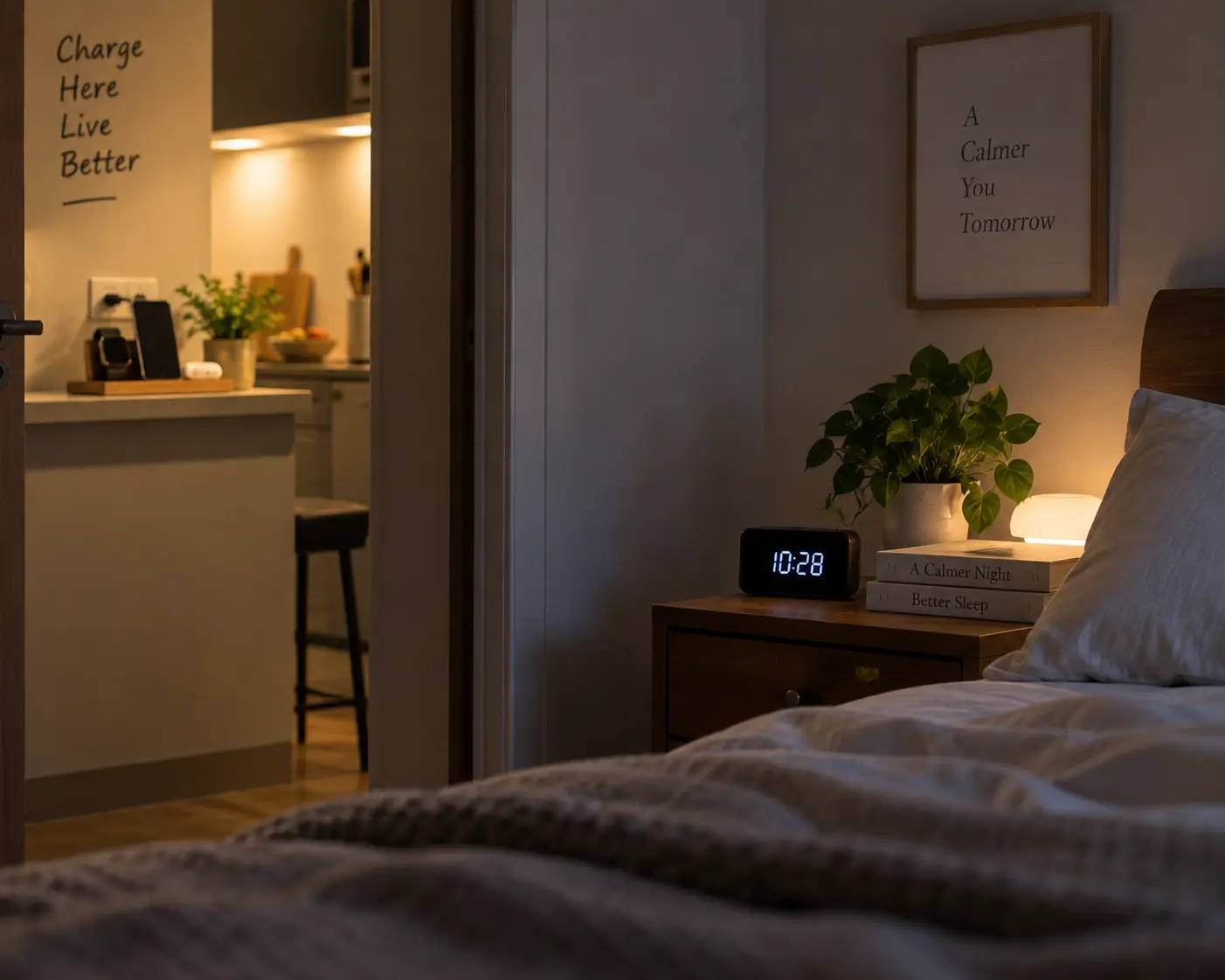
The single most effective thing you can do tonight costs nothing and takes just ten seconds: move your phone charger out of the bedroom. Buy a multi-device charging dock and keep it in the kitchen, hallway, or home office. When you walk into your bedroom at night your phone stays plugged in at that charging station. If you need an alarm clock in the morning, get a simple digital alarm clock. Taking your phone away from your bedside eliminates the "middle-of-the-night wake and scroll" habit — the semi-conscious act of checking notifications at 3:00 AM just because the glowing rectangle is right next to your pillow.
2. The Grayscale Nuclear Option
Smartphone makers spend billions of dollars hiring designers to make app icons and interfaces as bright, colourful, and eye-catching as possible — flashing red notification badges, glowing gradients, high-contrast screens. You can instantly reduce the power these visuals have over your brain by switching your phone's display to grayscale.
On iOS: go to Settings → Accessibility → Display & Text Size → Colour Filters, then turn on Grayscale. On Android: look under Settings → Digital Wellbeing → Bedtime Mode, or Accessibility → Colour Correction. When your screen turns into shades of grey, scrolling through Instagram or reading news feeds feels dull and flat. Your brain stops seeing the screen as a carnival of rewards and starts treating it like a boring spreadsheet. That makes it much easier to walk away.
3. Radical Notification Triage
Your phone constantly screams for attention because every app is set up to interrupt you whenever it wants. Take back control by going through your notification settings rigorously. Disable all notifications except those from direct human communication — phone calls and text messages from family members. Turn off badge counts — the red numbers on app icons that make you feel urgent and anxious. Social media apps, news outlets, shopping tools, and productivity programmes do not deserve the right to break your focus without your permission. When you cut down on interruptions you lower the baseline anxiety that leads to late-night phone checking.
4. Automated App Limits and Downtime
Do not trust your evening brain to remember your rules. Let software enforce your boundaries instead. Set up Apple Screen Time or Android Digital Wellbeing to lock social media and browser apps at 9:30 PM every single night. Even though it is possible to tap "Ignore Limit," the steps — entering a passcode or clicking through several warning screens — create a crucial pause. In that moment your executive brain gets a chance to step in and say, "Wait, what am I doing?"
Replace Scrolling with a Menu of Five-Minute, 15-Minute and 30-Minute Activities
When you successfully remove your phone from your hands during wind-down time you will face a vacuum. Habit loops work like this: a cue (boredom or fatigue) triggers a routine (scrolling) which delivers a reward (stimulation or numbness). If you try to eliminate the routine without offering something in its place, you will fall right back into old patterns. You need to build a Wind-Down Menu — a list or digital file of alternative activities grouped by how long they take.
The Five-Minute Micro-Interventions
When you are so drained that even opening a book feels like climbing Mount Everest, use these low-effort actions:
- The Brain Dump Journal: Grab a notebook and write down everything running through your mind — unfinished tasks, worries, random thoughts. Research from Baylor University published in the Journal of Experimental Psychology shows that writing a specific to-do list before bed helps the brain offload clutter onto paper, reducing sleep latency by an average of nine minutes.
- Box Breathing or 4-7-8 Relaxation: Lie on your back or sit comfortably and breathe slowly: inhale for four seconds, hold for seven, exhale for eight. Do this for four rounds. It activates the parasympathetic nervous system, lowers heart rate, and reduces cortisol.
- A Single Physical Stretch: Stand up and reach for your toes, roll your shoulders backward ten times, or stretch your neck side to side. Reconnecting with your body pulls your awareness away from distractions.
The 15-Minute Medium Interventions
When you have energy and want to enjoy a restorative activity:
- Reading Physical Fiction: Unlike nonfiction, which engages logic and problem-solving, immersive fiction acts like a cognitive escape. Studies from the University of Sussex found that reading fiction for six minutes drops heart rate and muscle tension by up to 68%.
- Preparing Tomorrow's Environment: Lay out your workout clothes, fill a glass of water, tidy the kitchen counter. Waking up to an organised space helps reduce morning stress.
- Listening to an Ambient Soundscape or Long-Form Audio: Put on a playlist of rain sounds, brown noise, or a slow podcast with a sleep timer set. Let the rhythm guide you toward calm.
The 30-Minute Deep Wind-Downs
For nights when you start early and want a proper ritual:
- A Warm Shower or Bath: Take a warm shower or bath about 90 minutes before bedtime. It raises your core temperature briefly; after you step out, your body cools quickly. That temperature drop signals the hypothalamus that it is time to sleep — mimicking natural circadian shifts.
- Journaling or Creative Writing: Write freely without judgement. Let emotions flow onto the page. This helps process feelings accumulated during the day.
- Gentle Restorative Yoga: Do a slow sequence of floor-based stretches focusing on hips and spine. Move gently, focusing on breath and sensation.
What to Do After a Setback: Avoid Shame-Based Tracking
Let us be honest: you will have setbacks. There will be a Tuesday night three weeks from now where you are exhausted, stressed, and emotionally fragile. You will ignore your app limits, bypass your charging station rule, bring your phone into bed, and scroll TikTok until 1:30 AM. When that happens — and it will — how you respond decides whether that one slip becomes a relapse or a minor bump in the road.
The Trap of Shame-Based Tracking
Many people trying to improve their habits fall into the trap of judgemental tracking. They use apps that give them grades or streaks. When they fail and the counter resets to zero, shame floods in: "I failed again. I have no discipline. This whole thing is useless." Psychological research shows that shame is not a lasting motivator — it spikes cortisol and causes emotional distress. What does the brain do to soothe itself? It reaches for comfort behaviours — like scrolling. You end up stuck in a self-reinforcing cycle.
The "Never Two Days in a Row" Rule
Instead of demanding perfection, adopt the "Never Two Days in a Row" rule, made famous by productivity author James Clear. Missing your wind-down routine on a Wednesday night is one data point — an outlier caused by unusual stress or exhaustion. Missing it on both Wednesday and Thursday creates a new bad habit.
When you wake up after a late-night scrolling session:
1. Forgive Yourself Instantly — Recognise that you are human, your brain was tired, and the tech world is built to exploit your vulnerabilities.
2. Perform a Gentle Autopsy — Ask one non-judgemental question: "What specific trigger or emotional state broke my defences last night?" Was I too tired? Did I skip dinner? Was I avoiding a conversation?
3. Reset Immediately Without Drama — Don't wait until Monday. Just plug your phone into the charging station at 9:30 PM that night and restart the routine.
When Sleep Difficulty Deserves Professional Evaluation
Changing your habits and creating a better wind-down routine will greatly improve sleep quality for most people. But behavioural changes have their limits. Sometimes poor sleep is not just due to screen time — it is a sign of an underlying condition that needs clinical help.
You should talk to a doctor, sleep specialist, or licensed health professional if you experience any of these symptoms consistently — even after maintaining strong sleep hygiene and digital boundaries for four to six weeks:
- Chronic Sleep Latency — Consistently taking more than 45 to 60 minutes to fall asleep every night even when exhausted
- Frequent Night-Time Awakenings — Waking multiple times each night and staying awake for hours unable to fall back asleep
- Excessive Daytime Sleepiness — Feeling extremely tired, falling asleep unintentionally during normal daily activities like driving or working, or waking up unrefreshed after 7–8 hours in bed
- Physical Symptoms During Sleep — Loud snoring, gasping, choking sensations, or observed breathing pauses (signs of sleep apnea), or uncomfortable crawling sensations in the legs in the evening (Restless Legs Syndrome)
- Persistent Psychological Distress — Insomnia accompanied by constant dread, racing thoughts, hopelessness, severe anxiety, or clinical depression
Cognitive Behavioural Therapy for Insomnia (CBT-I) is recognised by the American College of Physicians as the gold-standard treatment for insomnia. It works better than sleeping pills and does not cause dependence or grogginess. There is strength in knowing when to seek expert support.
Reclaiming Your Nights
Take back your evenings. Turn your phone into a tool, not a master. Build systems that protect your rest. Every night, choose presence over distraction, peace over panic. Your brain deserves better. Your sleep matters. Start tonight.
Building a wind-down routine that actually sticks is not about being perfect or giving up technology completely. The real goal is to make sure you are in control — not the other way around. Instead of relying on willpower, build in small, smart changes to your environment. Move your charger to the other side of the room. Turn your phone to grayscale. Break the hour before bed into stages: one for winding down, one for reading or journaling, one for quiet reflection. Have a few enjoyable offline ideas ready — a puzzle, a book, a simple breathing exercise. The point is not to be flawless. It is to make rest the default choice. When 10:30 PM comes around, let your phone stay in its designated spot — outside the bedroom. Let your mind rest. That is what it has been asking for all day.
Read Further
[1] Baylor University Sleep Neuroscience and Cognition Laboratory. Can Writing Your To-Do's Help You to Doze? — Journal of Experimental Psychology Study — Click here
[2] University of Sussex. Reading Can Help Reduce Stress — Six Minutes of Reading Reduces Muscle Tension and Heart Rate by 68% — Click here
If you are experiencing persistent sleep difficulty, anxiety, or signs of depression, please speak with a qualified healthcare professional or mental health practitioner. This article is for general informational purposes only and does not constitute medical advice.
Advertisement