

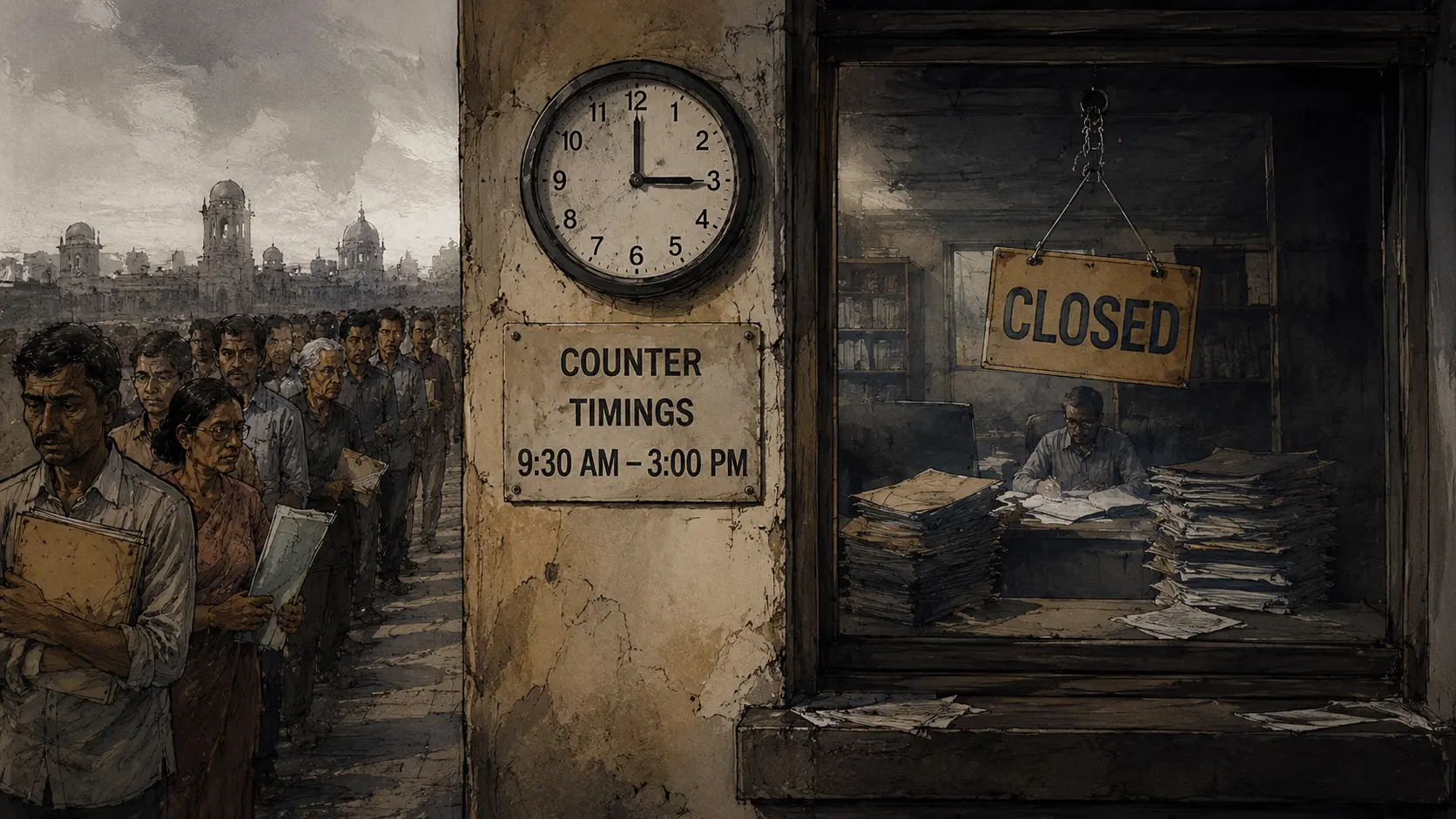
In today's era where everything is being optimized and accelerated by cutting-edge technology, we find ourselves living in a deeply conflicted reality. On one hand, we are promised seamless service, automated processing, and digital equity that should theoretically grant every single citizen instantaneous access to their civil, economic, and financial rights. On the other hand, the physical and bureaucratic machinery responsible for executing these rights operates under archaic frameworks, restricted operational hours, and systemic fatigue. It is a world where your legal guarantees are absolute on paper, yet practically unobtainable after a certain hour of the afternoon. We don't know where we actually lost the balance between theoretical institutional promises and the agonizing reality of everyday administrative barriers, we don't know.
So this article basically is going to get you all aware about what is actually happening within the modern administrative pipelines and what we should do with our expectations of institutional delivery versus cultivating authentic, self-reliant frameworks for economic survival. When a public or financial institution closes its physical or digital gates precisely at 3:00 PM, it doesn't merely end a workday; it halts the execution of critical systemic equities. This artificial ceiling leaves thousands of processing requests, applications, and urgent financial liquidations stranded in limbo, introducing an error margin into the livelihood of working-class people which can cause heavy losses in business and personal security alike.
Institutional Bottlenecks and the Structural Efficiency They Promise
Modern public and financial administrations love to advertise their evolution. We hear endless talk about modernized infrastructure, centralized databases, and digital public portals designed to make the clearance of rights, deeds, permits, and credits faster and with better efficiency. Bureaucratic entities roll out online processing systems with the promise that citizens can bypass the legendary long lines and counter delays that have defined government and banking halls for over a century. They position these advancements as structural assets that protect people, remove manual errors, and guarantee equal access to systemic privileges.
However, when we look beneath the glossy surface of digital front-ends, we discover that the back-end infrastructure is completely dependent on human intervention, rigid civil service schedules, and legacy operational laws. The modern administrative apparatus is built around a paradox: the portal is open 24/7, but the processing desk shuts down early. An application submitted online at 3:05 PM sits dormant for sixteen hours before a human clerk opens it. The illusion of instant digital access creates a false sense of security, masking the stark reality that our fundamental transactions — be it real estate transfers, micro-loan approvals, small business registration clearances, or emergency subsidy payouts — remain completely tethered to an outdated clock.
The Infrastructure Disconnect (Statistical Realities)
Recent global operational analyses reveal that while over 78% of public and financial institutions provide online application interfaces, the processing efficiency drops by a staggering 82% after the official physical office closure hours. This creates an accumulation bottleneck where over 60% of all daily administrative submissions are forced into a backlog, delaying critical cash-flows and legal authorizations for millions of applicants worldwide.
These systems are designed to process routine data efficiently under ideal, tightly controlled conditions, but they break down completely when faced with high-volume, erratic human demands. When citizens rely purely on these institutions for their immediate financial or legal survival, they are at the mercy of internal structural timelines. A small business owner awaiting a permit approval to secure a time-sensitive supplier contract can lose everything simply because the verification staff logged off for the evening. The system functions smoothly for the institution itself, but for the individual waiting on the outside, it becomes an arbitrary barrier to their progress.
"Systemic access shouldn't depend on an archaic clock, yet our most critical rights wait for the next business morning."
Cons of Depending on Centralized Bureaucratic Channels
Relying heavily on centralized administrative systems for our financial and civic security introduces massive operational risks that the average citizen rarely considers until it is too late. In recent studies analyzing public administrative workflows, a massive discrepancy has been uncovered regarding the accuracy and reliability of automated-yet-restricted processing pipelines. When systems force a heavy volume of backlogged transactions through compressed operational windows, errors spike dramatically. Studies indicate a vast difference of 65% in processing accuracy during peak wrap-up hours right before closure, which calculates to mean that every 2nd out of 5th complex application processed under time constraints gets handled wrong or flagged with an error.
This leaves an error in processing which, if not in minor household paperwork, but in business filings, property documentation, and large financial transfers can get you into a heavy loss. When a document is rejected due to a minor clerical mistake or a systems glitch at 2:55 PM, the applicant cannot simply correct it on the spot. They are pushed entirely out of the system, forced to wait for the next cycle, and compelled to resubmit their paperwork from scratch. This starts an endless loop of correcting records, waiting for subsequent reviews, and facing repeated delays, which will become a tiresome chore of the week taking more time, physical head-work, and giving major headaches and migraines to anyone trying to navigate the system.
Advertisement
Furthermore, centralized bureaucracies lack a human-based mindset which can think alike like humans and make decisions after calculating endless possibilities in every scenario. An automated portal or a rushed clerk operating on a strict timeline sees only a binary checkbox. They cannot evaluate the urgency of an emergency medical withdrawal, a critical real estate deadline, or an immediate commercial liability. The total absence of flexibility means that if your paperwork does not neatly fit into the standardized institutional box by the time the afternoon bell rings, you are functionally stripped of your ability to act until the following day. This extreme dependency undermines personal autonomy and leaves individuals highly vulnerable to systemic failures completely beyond their control.
The Traditional Self-Reliance Framework: Architectural Autonomy

To insulate ourselves from the unpredictable closures and operational inefficiencies of centralized offices, we must examine historical frameworks of decentralized resilience and community-based self-reliance. Long before modern states and giant financial institutions centralized the distribution of financial security, communities relied on localized, highly structured systems of mutual aid, personal accountability, and autonomous accounting. A profound historical example is found in traditional Japanese community dynamics, where personal financial tracking and collective resource pool management were utilized to build absolute economic resilience against external societal disruptions.
This philosophy of strict structural dependence on oneself rather than a distant office is perfectly mirrored in the core principles of Kakeibo, which was created in 1904 by Hani Motoko, Japan's first female journalist. While Kakeibo is celebrated as a handwritten notebook system for household financial accounts to encourage mindful spending, its deeper societal significance lay in teaching families — particularly women who managed the household structures during Japan's rapid modernization period — how to gain absolute financial discipline independent of external banking support. The system taught people to separate their resources into intentional, unshakeable structures: needs, wants, culture, and the unexpected. By practicing rigorous, manual self-auditing, citizens built an internal fortress of capital that protected them from the rigid limitations of formal institutions.
The Power of Intentional Frameworks
Historical data indicates that societies utilizing manual, decentralized budgeting and localized asset retention achieved average household savings rates of 23%, contrasting sharply with modern Western frameworks where heavy reliance on continuous credit, automated banking applications, and state institutional buffers has caused average savings rates to plummet to a fragile 3.6%, leaving up to 68% of individuals abandoning their personal financial structures within 90 days.
Now, creating an independent framework may sound like an outdated, tedious version of modern digital conveniences, but it contains a profound psychological and operational truth. When you write, track, and manage your resources, legal backups, and operational pathways yourself, your mind becomes fully aware of what you are doing. You cease to be a passive participant waiting for a bureaucrat to approve your status or open a counter. You become a proactive architect of your own security. Developing localized asset pools, maintaining physical records of your rights, and engineering personal financial safety nets ensures that your daily survival never hinges on whether a physical office door is locked at 3:00 PM.
"Build your own financial sanctuary and protect your assets consciously, so your security never closes at three."
Ultimately, we must realize that while modern systems and digital portals provide undeniable convenience when they work, they should never become our sole point of failure. Relying completely on an external entity to grant, verify, or process your economic rights is a structural vulnerability. By adopting a mindset of absolute personal responsibility, tracking our assets with intentionality, and recognizing that public systems are inherently flawed, we reclaim our autonomy. We must build personal infrastructures that run seamlessly twenty-four hours a day, entirely insulated from the arbitrary schedules of bureaucratic gatekeepers.
Read Further
- Kakeibo: The Japanese Art of Saving Money — Hani Motoko's 1904 System, Wikipedia
- Digital Government Frontiers Report 2024: E-Services and Processing Efficiency Gaps — OECD
- Household Saving Behaviour and Financial Resilience — OECD Working Papers on Finance, Insurance and Private Pensions
Disclaimer: This article is intended for general informational and educational purposes only and does not constitute professional financial, legal, or institutional advice. All statistical references are compiled from publicly available operational research and digital governance studies.
Advertisement